You are here
News Feeds
CEED Stands in Solidarity with ICE OUT Minnesota on Jan. 23
Minneapolis, MN (January 21, 2026) | The Center for Earth, Energy & Democracy (CEED) stands in solidarity with Minnesota’s immigrant communities and those mobilizing to protect them, and supports this Friday’s ICE OUT Minnesota: Day of Truth & Freedom general strike, march and rally. Across Minnesota, we will use our collective action to pause the economy and take action to be heard on January 23.
Our communities in Minnesota are living through an ongoing escalation of violence and fear due to a surge of ICE raids and brutality that have terrorized Black, Brown, Indigenous and immigrant families across the state.
On January 23, hundreds of local organizations, faith groups, unions and businesses are joining forces to call for ICE and other federal forces to leave Minnesota immediately. Together, we are calling for accountability for ICE’s unlawful attacks on our communities and demanding an end to funding for ICE and its racist agenda of raids and brutality. We are also calling on Minnesotan and national companies to stop doing business with ICE and assert 4th Amendment rights by refusing ICE entry into their businesses. Join us at the march and rally in downtown Minneapolis at 2:00 PM on January 23.
Why CEED Stands in Solidarity with ICE OUT MinnesotaEnvironmental justice and immigrant justice are inseparable. The same systems that extract wealth from communities and devastate the land also criminalize migration and exploit immigrant workers. Immigrant communities are on the frontlines of the climate crisis and pollution, while also facing disproportionate enforcement, surveillance, and displacement. As we organize for community-controlled renewable energy and local economic alternatives, we must oppose all forms of state violence against the communities building these alternatives.
There can be no democracy without justice. CEED’s vision of energy democracy depends on robust democratic institutions, constitutional protections, and the ability of communities to organize without fear. The human rights violations documented by ICE in Minnesota—including illegal detentions, warrantless stops, and the killing of Renee Nicole Good—undermine the very democratic foundations our work depends upon. When federal agents operate outside the law with impunity, it weakens all our rights to organize, speak out, and challenge systems of extraction and oppression.
A just transition requires justice for all. CEED’s work centers the leadership of frontline communities in building a regenerative economy rooted in energy democracy and community control. The ICE surge terrorizing Minnesota communities which cost Renee Nicole Good her life is a direct attack on the communities we work alongside. There can be no just transition when we live under threat of detention, family separation, and state violence.
Despite the attacks on our communities, we are seeing a powerful outpouring of solidarity through mutual aid efforts here in Minnesota. Volunteers are going door to door and distributing groceries to vulnerable neighbors, while mothers are patrolling the streets to document and deter immigration raids. Lawyers are out in the streets defending the right to protest, while neighbors are raising funds to pay for legal fees and bonds.
CEED recognizes that our staff, partners, and communities across Minnesota are directly impacted by ICE activities. We see you, we stand with you, and we commit to using our voice and resources to support this urgent call for justice, accountability, and human rights.
CEED encourages staff and partners in Minnesota to support these efforts and participate in ICE OUT Minnesota: Day of Truth & Freedom on January 23, in ways that feel right, and if they choose to do so. You can learn more and sign the pledge at iceoutnowmn.com
From our home in Minneapolis, the Center for Earth Energy and Democracy (CEED) works toward just transition, energy democracy, and climate justice at state, regional and national levels. We believe that front line communities must lead the transition from an extractive economy to one rooted in regeneration, cooperation, and community control.
The post CEED Stands in Solidarity with ICE OUT Minnesota on Jan. 23 appeared first on CEED.
Billionaire Wealth Just Hit $18.3 Trillion. Why that’s bad news for the rest of us.
A new report from Oxfam Resisting the Rule of the Rich: Protecting Freedom from Billionaire Power shows billionaire wealth reached $18.3 trillion in 2025, the highest level in human history. That’s more than the GDP of China, the world’s second largest economy. In fact, since 2020, billionaire wealth has increased by 81%.
All of this happens while one in four people don’t regularly have enough to eat, and nearly half the world lives in poverty. Families face rising costs for basics like food, rent, and electricity. Public services are stretched thin. Climate disasters hit harder and more often.
But what is worrying is that this small group holding extreme wealth, isn’t just buying luxury. They are buying control. Political outcomes. And of course, more fossil fuels. Billionaire power is building a dystopian, unliveable world with many government allies helping lock it in. Here is how:
Billionaires are buying democracy, and blocking climate actionOxfam’s report is clear: extreme wealth doesn’t sit quietly in bank accounts. It gets turned into political control. Alongside getting richer, billionaires are tightening their grip on the institutions meant to serve the public.
The research finds that billionaires are now 4,000 times more likely to hold political office than ordinary people. That imbalance shapes real decisions, deciding what gets funded, what gets blocked, and whose voices are ignored.
And when billionaire political interests dominate, the consequences are brutal and predictable:
- climate action slows, fossil fuel expansion is protected, regulation is weakened, and public money gets funnelled into corporate profit instead of community needs.
- People demanding justice face crackdowns, shrinking civic space, and rising repression.
Oxfam points to the US Trump administration as a warning sign: a pro-billionaire government agenda that slashes taxes for the super-rich, undermines global cooperation to tax corporations, rolls back action on monopoly power, and boosts billionaire portfolios. But this isn’t confined to one country. Oligarchy is going global, and it’s undermining societies everywhere.
And it doesn’t stop at economic policy. Oxfam warns that civil liberties and political rights are being rolled back globally. 2024 marked the nineteenth successive year of decline, with a quarter of countries curtailing freedom of expression. When people protest, governments increasingly respond with violence.
Our bills are going up as their fortunes explodeIn 2025, billionaire wealth surged by $2.5 trillion which is what is held by the bottom half of humanity (4.1 billion people). Oxfam estimates this money would be enough to eradicate extreme poverty 26 times over.
At the same time, people are told there’s “no money” for clean energy, resilient infrastructure, or strong public services. Communities are pushed to accept austerity and “tough choices,” while extreme wealth concentrates at record speed.
Oxfam links these choices to real harm: governments slash aid budgets, directly hitting people living in poverty and potentially contributing to more than 14 million additional deaths by 2030.
The result is a world where life feels more unaffordable and more unstable, and where climate action gets treated like an optional extra, instead of a survival plan.
The climate crisis is a business model for the super richBillionaire lifestyles are high-emitting, and that matters. But the deeper problem runs through the economic model itself: billionaire wealth is built on extraction and climate plunder.
Many billionaires profit directly from industries tied to pollution and destruction: fossil fuels, mining, deforestation, and corporate land grabs. Their money shapes the political decisions that keep these industries protected, subsidized, and expanding.
And the fallout hits everyone else: higher bills, weaker public systems, polluted air and water, and escalating climate risks. Communities in the Global South and frontline regions pay first and worst while the people most responsible stay insulated from the damage.
They control what we read (and believe)Billionaire power doesn’t stop at politics. It reaches into the media and the information systems we rely on every day.
The Oxfam report shows how billionaire power doesn’t stop at politics — it spreads into the media and information systems we rely on every day. Billionaires now own more than half of the world’s largest media companies, and they also control all the main social media platforms, giving a tiny group of ultra-rich people enormous influence over what information gets amplified, what gets buried, and how public debate is shaped.
Oxfam points to examples like:
- Jeff Bezos’ purchase of The Washington Post, Elon Musk’s takeover of Twitter/X, and Patrick Soon-Shiong’s ownership of the Los Angeles Times.
- In France, the report highlights how far-right billionaire Vincent Bolloré took control of CNews and reshaped it into a French version of Fox News.
- And in the UK, Oxfam notes that three-quarters of newspaper circulation is controlled by just four super-rich families.
This concentration of media power matters because it doesn’t just influence what people read, it shapes what people believe is possible, normal, or worth fighting for. Oxfam warns that when billionaires dominate media and social platforms, minority voices and dissenting perspectives get pushed out, while scapegoating and disinformation spread more easily. The report points to structural exclusion too: only 27% of top editors globally are women, and just 23% belong to racialized groups, reinforcing whose stories get centered, and whose get ignored.
This also fuels polarization, making it harder to build the public pressure needed for real climate action, and easier for fossil fuel interests to keep operating in plain sight. And while we’re distracted, the fossil fuel machine keeps running.
Oxfam also shows how governments enable this captured information ecosystem. Governments allow billionaire control of platforms to deepen, and in some cases even use these platforms to track, punish, and silence critics. Oxfam points to Kenya, where authorities use X to track, punish, and even abduct and torture government critics. And after Elon Musk’s takeover of Twitter/X, one study found hate speech increased by around 50%, showing how billionaire control over platforms can rapidly reshape what’s normal, visible, and tolerated online.
When billionaires control the narrative, they don’t just defend their wealth, they protect the system that keeps them on top.
The path forward: tax justice, climate justice, people powerThe climate crisis demands more than good targets and speeches. It demands a shift in who holds power. Governments need to stop pandering to the ultra-rich and start delivering for people and the planet. That means:
- taxing extreme wealth to reduce its political dominance
- investing in renewable energy, clean transport, social housing, and strong public services
- protecting civic space and the right to organize and protest
- building real firewalls between wealth and politics
People are already pushing for this shift. Across countries, communities are organizing, demanding accountability, and refusing to accept a world run by billionaires and fossil fuel corporations.
Billionaire power is real. But people power is bigger. And when we move together, the future changes.
The post Billionaire Wealth Just Hit $18.3 Trillion. Why that’s bad news for the rest of us. appeared first on 350.
Affordability is the defining climate issue of 2026
This is a guest article written by Jean McLean, Director of Engagement at the Green Economy Coalition (GEC), a global movement for green and fair economies.
With the cost of living spiralling out of control, affordability is now the key factor determining whether climate action gains public support or faces opposition.
Zohran Mamdani’s recent successful mayoral campaign in New York was based on concrete affordability pledges to make life more affordable to New Yorkers: rent freezes, fare free buses, city owned grocery stores, raising the minimum wage, baby baskets for newborns and no-cost childcare. The UK and Australian governments have taken note of this success and have prioritised addressing the cost of living and affordability as key to electoral success. Climate leaders need to take note.
This success can be replicated! We know that the money exists to prioritise affordability for the general public, what we need is political will. Leaders must urgently switch to cleaner energy alternatives as they are proven to be cheaper than fossil fuels, bringing down energy costs for everyone. Taxing big polluters, the ultra-rich and using those funds towards public investment is a popular and necessary action.
For years, climate misinformation has tried to convince people that a green transition is a luxury not an inevitability. Despite the millions spent on disinformation, public opinion tells a very different story. Across countries and political contexts, people increasingly understand that clean energy is not the cause of rising costs — it is one of the most powerful solutions to them.
Our latest Global Green Attitudes polling shows a remarkably strong global public consensus:
- 82% per cent of respondents believe investment in clean energy should be a top government priority, even if it requires significant public spending.
- An even larger share — 88%— agree that stronger laws are needed to support renewable energy like solar and wind.
Notably, this support has held steady despite inflation and increasing economic anxiety.
As cost-of-living pressures deepen, people are judging energy choices on a simple test — will this lower my bills? As routine household bills become the main source of financial stress, renewable energy offers both an economic solution and a political opportunity for governments prepared to act.
Crucially, public perceptions are already shifting in clean energy’s favour. Many people already see clean energy as cost‑competitive or cheaper than fossil fuels. In the United States, a majority now believe clean energy costs the same or less than oil and gas. Globally, renewable electricity is routinely 30–50 per cent cheaper than new fossil fuel generation.
In this context, this year’s polling data reveals an interesting dynamic between public support for environmental action and the perception of government performance:
- People want lower bills and place responsibility for this squarely on governments.
- The public wants transformative government action, such as public investment, fair rules, and accountability for polluters while also holding low trust in political leaders to deliver this.
- Many are feeling deeply frustrated at political inaction as inflation and economic anxiety increase.
What is missing from climate action is not public backing then, but policy creativity. Clean energy can deliver affordability, good jobs, and energy security — if leaders choose to act.
From free or discounted solar power programs to large‑scale investment in grids, storage, and clean industries, the solutions exist. Renewables already save countries trillions in avoided fuel imports and shield households from price shocks.
The choice facing leaders is stark. Continue delaying in service of fossil fuels or unlock a future where clean energy is understood for what it truly is: clean, common‑sense, and cheap. The public is ready. The question is whether governments are willing to listen.
The post Affordability is the defining climate issue of 2026 appeared first on 350.
Pollutocrat Day
A climate deadline has arrived absurdly early this year. New research from Oxfam shows that by 10 January 2026, the world’s richest 1% had already used up their entire annual carbon budget. The budget is the amount of pollution they could generate over the whole year so that global heating stays below 1.5°C, the limit to avoid the worst impacts of the climate crisis.
The richest 0.1% blew past their limit even earlier, on 3 January. Oxfam calls this moment Pollutocrat Day. It puts a timestamp on a reality that’s impossible to ignore: a small, wealthy minority is driving the climate crisis, while everyone else pays the price.
The scale of inequality in emissionsTo stay within the 1.5°C. limit, each person’s annual carbon allowance works out to about 2.1 tonnes of CO₂.
For the richest 1%, that fair share is exhausted almost immediately. Oxfam finds they emit 75.1 tonnes per person per year, or 0.206 tonnes per day, meaning it takes just 10.2 days for someone in the richest 1% to burn through an entire year’s carbon budget. In fact, this 75 tonnes of CO₂ per person each year is over 35 times the level compatible with 1.5°C.
The inequality becomes even more glaring at the very top. More data from Oxfam shows that a person in the richest 0.1% produces more carbon pollution in a single day than the poorest 50% emit in an entire year. If everyone polluted at the rate of the richest 0.1%, the global carbon budget would be used up in less than three weeks.
The consequences of this unchecked pollution are deadly. Emissions from this group in a single year are expected to cause 1.3 million heat-related deaths by the end of the century. Over time, this excess pollution is projected to cause $44 trillion in economic damage in low- and lower-middle-income countries.
To stay within 1.5°C, the richest 1% would need to cut their emissions by 97% by 2030. Meanwhile, those who have contributed least to the crisis — including communities in climate-vulnerable countries, Indigenous Peoples, and women and girls — are already facing the harshest impacts, from deadly heat to food insecurity, floods, and displacement.
This is about power and profitBeyond their own lifestyle emissions from private jets and super-yachts, the super-rich are also bankrolling climate breakdown through their investments. Oxfam finds that the average billionaire’s portfolio is tied to companies producing 1.9 million tonnes of CO₂ every year, locking the world into fossil fuel expansion.
That economic power is reinforced by political influence. The wealthiest individuals and corporations are able to shape rules in their favour, ensuring polluting industries remain protected. At the most recent UN climate talks, COP30, in Brazil, for example, fossil fuel lobbyists outnumbered every national delegation except the host country, with around 1,600 lobbyists in attendance. This level of access makes it far easier to delay action and weaken climate commitments.
Extreme wealth does not just mean higher emissions, it sustains a system built around fossil fuels and profit. This moment calls for more than outrage. It raises a deeper question: whose interests are governments choosing to protect?
Governments need to act, nowAs the year unfolds and climate impacts like heatwaves and wildfires continue to intensify around the world, governments must be willing to challenge systems that reward pollution and individuals that hoard extreme wealth.
Instead of doubling down on and expanding fossil fuels, and competing for control over oil, gas, and other critical resources, there is another, clearly better option. Oxfam points the way forward for our governments to:
- Make the richest polluters pay through higher taxes on extreme wealth and income
- Impose excess-profit taxes on fossil fuel corporations
- Ban or heavily tax carbon-intensive luxury items such as private jets and super-yachts
- Shift investment toward renewable energy and people-centred solutions
Pollutocrat Day is a warning. The climate crisis will not be solved by asking everyone to do the same while a small elite continues to pollute without limits. Real action means ending fossil fuel expansion, confronting extreme wealth, and putting people and the planet before profit.
The post Pollutocrat Day appeared first on 350.
RJI Community Reports: Research Justice 101
“Research justice” can sound like a big concept, but at its core it’s about valuing the lived experiences and desires of marginalized community members as essential pieces of evidence and data. Incorporating it into your research practices means ensuring meaningful community participation in every step of the research process. Furthermore, research justice centers the desires of communities as key to understanding their circumstances, rather than relying on narratives that present communities as broken or as problems (i.e., deficit narratives).
To gain a deeper understanding of what research justice is, the Research Justice Institute looks to the work of BIPOC (Black, Indigenous, and People of Color) scholars and researchers. Read on to unpack four key terms, along with some suggested readings, that are integral to understanding research justice.
1.Research oppressionTo understand research justice, it is important to start by unpacking what research justice is not. As pointed out by DataCenter in their 2015 report “Introduction to Research Justice,” there is a power imbalance within research practices, wherein dominant institutions control the production of knowledge, resulting in marginalized communities being unable to control or access information produced about them. Research oppression occurs when community members are viewed solely as subjects of research, rather than as active participants in the research process (DataCenter 2015). Social science research has long been used as a tool of oppression. In his book Thicker than Blood: How Racial Statistics Lie, Tufuku Zuberi points to the role that white supremacy plays in our understanding of society. White logic grants objectivity to white scholars while devaluing BIPOC experience and expertise, often framing it as too subjective or anecdotal. Community members’ lived experiences are dismissed as invalid to the research process, leading to dominant institutions controlling the data and the stories that are told about marginalized communities, without the community’s input (Zuberi 2001). When we refuse to use white supremacist logics and tools in our research practices, we envision an alternative to research oppression: research justice. Research justice places community experiences and desires at the forefront of the research process, uplifting community members as integral to every step. Research justice is a process and platform that affirms that marginalized communities are the experts in their own lives.
2.Dominant data vs community dataIt is important to understand the distinction between dominant data and community data, and how each may be utilized to advance the aims of research justice. Dominant data is gathered by dominant institutions such as governments and universities, and is often gathered in service of the dominant institution. These data are typically gathered using large population-level surveys like the Census or through the collection of information an individual provides in exchange for a service (i.e., administrative data). Dominant data, which are often quantitative, can highlight trends within populations, but often perpetuates deficit narratives. Numbers and statistics do not always capture the social, political, economic, and historical contexts of the data, often leading to conclusions that lack nuance and place the blame on marginalized communities for their own marginalizations. For example, without the context of institutional racism, a statistic proving the high amount of police violence in Black neighborhoods might imply that Black neighborhoods are inherently dangerous, or that Black people themselves are violent, rather than acknowledging the many social and political factors that lead to over-policing of Black communities (Lanius 2015).
On the other hand, a key aspect of community data is that it is contextual. At CCC, we define community data as evidence generated by communities about their everyday lives, realities, and desires. Examples of evidence can include numbers, words, art, music, maps, and stories. Community data is collected, interpreted, and used on the terms of the community. By working with communities to understand their everyday experiences, we can gain a true sense of community needs and desires.
3.Community-led researchCommunity control is a key tenet of research justice. Research justice uplifts and values marginalized communities as experts of their own lived experiences and, therefore, as leading experts in how to improve their everyday realities and overall well-being. When conducting research with marginalized communities, it is important to not only include community members, but to treat them as authorities in the research process. Trust and collaboration between researchers and community members are paramount, as demonstrated through the work of anthropologist Mariana Mora. Mora worked with a Zapatista community in Chiapas, Mexico to shape her research on Zapatista politics, autonomy, and self-determination. In her article “The Production of Knowledge on the Terrain of Autonomy: Research as a Topic of Political Debate”, Mora takes readers through her research process, describing the ways in which community members helped to shape and evaluate her research at every step, from research design to reviewing drafts of her 2017 book, Kuxlejal Politics: Indigenous Autonomy, Race, and Decolonizing Research in Zapatista Communities. Mora’s experience highlights the importance of community-led research, and provides a key example of how research can be designed and conducted in collaboration with community members.
4.Damage- vs desire-centered researchIn an open letter to communities, researchers, and educators, Eve Tuck, Unangax̂ scholar, calls for a moratorium on damage-centered research – research that documents pain and oppression in an attempt to leverage change for marginalized communities. Tuck argues that damage-centered research frames marginalized communities as depleted and broken, perpetuating deficit narratives and defining communities solely by their marginalization. Tuck instead proposes a desire-based framework for research, in which lived realities are acknowledged alongside hopes and visions for the future (Tuck 2009). Research justice should employ a desire-based framework in order to avoid framing marginalized communities solely by what they lack, and to acknowledge the full spectrum of inequality, oppression, wisdom, hope, and the potential for change that exists within all communities.
Check out RJI’s reading library to dig deeper into these concepts and more:These concepts and readings provide an overview of the key components of research justice, and it is only the tip of the iceberg. To continue exploring these ideas and access a wider range of resources, we encourage you to visit our growing RJI Zotero library.
A look back: 2025 Summer Soirée "Rooted in Resilience"
State Sen. Khanh Pham sharing meaningful remarks as our featured speaker. Watch the full speech on our YouTube!
“Building community is what gets us through these times,” shared State Senator Khanh Pham to a packed room at this year’s Summer Soirée on June 13.
“It’s being in relationship with people who share our vision and our values – that is what helps us move out of fear and into collective action.”
At the Coalition of Communities of Color, this belief is at the heart of our mission. Our theme Rooted in Resilience was an important reminder that our strength is most powerful when shared, and grows when we’re together – even in the hard times, like the one we’re facing now.
We are so grateful to everyone who joined and supported our 2025 fundraising gala. We filled the night with a festive and meaningful atmosphere, with tunes by DJ Just Jeff, and folks enjoyed bites from our diverse selection of vendors that were both culturally rich and delicious.
A special thank you to our featured speaker, State Senator Khanh Pham, and our guest speakers, Mayor of Portland Keith Wilson and Oregon Community Foundation’s (OCF) Michael McIntosh, for their powerful and inspiring remarks.
Watch State Sen. Pham’s full speech at CCC’s Summer Soirée here!
View Full Album A Successful Summer SoirÉe
We extend a heartfelt thank you to OCF for being our presenting sponsor and for their support in helping make this night a success.
Together, with the power of community, we raised over $270,000 to sustain our work of transforming systems so that every Oregonian – across race, gender, or zip code – can thrive. At a time when our values are being attacked, your support means more than ever. Thank you!
Thank you to everyone who joined our CCC team at the Summer Soirée!
Because of these generous donations, we will be able to continue our efforts to provide research grounded in lived experience, solutions shaped by community voices, and policies that build a more just and resilient environment for those facing the first and worst of the climate crisis. See our work in action: watch our MADE for Health Justice video.
Didn’t have a chance to donate but want to support? Click here to make a donation today. Every donation makes a difference.
We hope you will join us next year as we celebrate our 25th anniversary! Details will be shared as they become available. Subscribe to our email list to stay in the loop.
Take a look at our event details:Our special night took place at the OHSU Robertson Life Sciences Building. We are so grateful to OHSU for being our venue sponsor and for generously supporting our event.
A special shoutout to our host and vendors:
Poison Waters as our Emcee and Auctioneer
Devil’s Food Catering
Plant Based Papi
Annam VL
DJ Just Jeff
And a special thank you to those who donated items for our raffle prizes and auction packages!
Thank you to our Summer Soirée sponsors!Support CCC
CLOSED: We're hiring: Data Systems Administrator
**This opening is now closed. We are not accepting any further applications at this time. Thank you.
Applications due by August 27. Click here to view a full description of the job post.
JOIN OUR TEAM: The Coalition of Communities of Color (CCC) is excited to announce a new role within our Research Justice Institute! We’re looking to hire a dedicated and experienced Data Systems Administrator to lead the development and management of a robust, community-led, environmental justice data system. This role requires someone with technical expertise in developing data systems with a strong focus on equity.
Position OverviewAs the Data Systems Administrator, you will lead the development, management, security, and accessibility of our community-led environmental justice data system. This is a first-of-its-kind opportunity to ensure that qualitative and quantitative data collected by community-based organizations is stored and made available in a way that supports equitable policy decision-making while respecting community ownership.
We are seeking a data platform engineer and community-minded leader that understands both data systems and the ethical considerations of handling dominant institution quantitative and community-generated qualitative data, and shares our values and commitments to research and data justice.
The Data Systems Administrator will play an integral role in advancing CCC’s Modernizing Anti-Racist Data Ecosystems (MADE) local level data ecosystem that will advance regional responses and approaches to extreme weather and climate justice needs. They will lead the development, implementation, and management of CCC’s environmental justice data systems, including selection and oversight of technical vendor(s) and building the back end of our data platform. They will also play a key support role in the Research Justice Institute’s quantitative research and data projects and reports.
For complete details about responsibilities, qualifications and compensation, view the full job posting here.
About the Coalition of Communities of Color
Formed in 2001, the Coalition of Communities of Color is an alliance of culturally specific, community-based organizations engaged in collective action for racial justice. We work to improve outcomes for communities of color through advocacy, environmental justice, and research. Learn more about the Coalition of Communities of Color, its member organizations, and our Research Justice Institute.
TO APPLYPlease send a cover letter (max one page) and resume (max two pages) in one PDF file to HR@coalitioncommunitiescolor.org, with the subject line and file name “[Your name] — Data Systems Administrator.”
Applications are due Wednesday, August 27.
View Full Job PostJuly 2025 Advocacy Update
In 2025 the Coalition of Communities of Color worked tirelessly to champion equity and opportunity for all communities of color, immigrants and low income people. From the Oregon State legislature to local government budget processes, we've faced considerable hurdles but also achieved important victories.
State Legislative Session: Facing Fiscal Headwinds
The 2025 Oregon Legislative Session was characterized by fiscal uncertainty, stemming from a state budget shortfall and concerns over potential federal cuts. This challenging environment led to substantial budget reductions, with communities of color and low-income individuals disproportionately affected. Key state agencies, including the Oregon Department of Education, Department of Early Learning and Care, and Oregon Housing and Community Services, experienced significant cuts to vital programs such as student success initiatives, childcare, and emergency rent assistance.
Despite these statewide challenges, we celebrate the passage and funding of critical initiatives like the Immigrant Justice Package, which includes Universal Representation and Farmworker Disaster Relief, and the Fair Housing for All initiative. These successes underscore the power of focused advocacy even in difficult times.
Learning Opportunity: Water Justice Legislative Recap and Celebration
How did this year’s Legislative Session impact water justice? Join Oregon Water Futures July 29th 12:00-1:00PM in a conversation with environmental justice advocates to celebrate water policy wins, get real about challenges and opportunities, and hear personal experiences about policy and advocacy work. This panel is for anyone interested in Oregon’s water justice future, frontline advocates, and community members. Our sessions are accessible to those new to policy and is a great time to connect with others!
When: Tuesday, July 29 at 12 pm
Reigster here: Bit.ly/456SdXY
Panel Includes: Verde, Crag Law Center, Oregon Just Transition Alliance, and the Joint Water Caucus.
City of Portland: Defending Essential Programs for Communities of Color
During the City of Portland budget process, CCC and its members' advocacy was crucial in defending the Civic Life Diversity and Civic Leadership program, which initially faced severe cuts exceeding $600,000. Through dedicated advocacy, CCC and culturally specific organizations successfully restored $179,000 in funds for the program. Additionally, our collective voice played a vital role in advocating for the protection of Portland Clean Energy Fund (PCEF) and Parks funding, underscoring our unwavering commitment to equitable and well-resourced community programs
Multnomah County: Securing Vital Investments
The Coalition of Communities of Color and our dedicated members achieved significant wins during the recent Multnomah County budget process! Through strategic advocacy and successful amendments, we were able to defend crucial programs and secure vital funding for initiatives such as Voter Outreach and Education, School Based Mental Health, Homeless Employment Programs, Housing Immigration Legal Services, and Culturally-Specific Community Food Systems. We remain optimistic about continuing to engage with the county to ensure equitable investments that truly serve all communities.
Looking Ahead: Protecting Our Progress
CCC staff joined our member Unite Oregon on their 2025 Day of Action in.Salem.
Our community's commitment to equity, inclusion, and opportunity is currently at risk due to attacks on Diversity, Equity, and Inclusion (DEI) initiatives and potential federal funding cuts that could impact vital services provided by the City of Portland and Washington County like transportation and housing. We've seen this manifest in Washington County's struggle to uphold an Equity Resolution and sanctuary laws in conflict with federal executive orders, and there's an ongoing need to protect programs like Multnomah County Preschool for All that increase access for communities of color and low income people.
This situation demands action: we must fiercely defend DEI initiatives, advocate for the codification of sanctuary protections in local governments, and actively work to strengthen the Preschool for All program by ensuring continued funding and community involvement in its advisory processes.
Your continued participation is crucial to safeguard our progress and build a future where equity, opportunity, and safety are guaranteed for everyone. We urge you to attend public meetings, contact elected officials, share information, and engage with community organizations. Together, we can continue to make a difference. If you have any questions or would like to get in touch, reach out to our Advocacy Manager Alex Riedlinger at Alex@coalitioncommunitiescolor.org.
Introducing Community Reports by the Research Justice Institute
Research Justice Institute: A BIPOC and Queer-Led Team
The Research Justice Institute (RJI) at the Coalition of Communities of Color is a BIPOC team who all identify as queer. As researchers, we hold firsthand experiences of how our bodies, knowledges, and languages are dismissed and denied existence. Communities of color and their diverse lived experiences continuously experience these forms of harm and erasure. In our research and data practices, we rectify aspects of this harm by creating the conditions for meaningful community participation throughout the research process. We value and rely on the power of lived experience evidence as essential data for decision-making. We craft desire as central to our communities' futures so that they are seen and heard as a whole.
From these perspectives, RJI works for a future where BIPOC advocacy embraces and integrates queer community members in the pursuit of data justice.
Sharing Data Through Storytelling for Queer and Trans Futures
A recent project with South Coast Health Equity Coalition, a BIPOC and queer-led team, revealed powerful stories of how community care networks are critical for finding gender affirming care—from being accompanied by trusted peers and family members to learning about providers through word-of-mouth. These narratives remind us that data is more than numbers. It is about people, their stories, and highlighting practices of community care. Pride Month amplifies the presence of our intersecting identities and we celebrate by posing narrative shifts for BIPOC, queer and trans futures in Oregon. Sharing these narratives provides stories and possibilities for future generations.
Updates from our Modernized Anti-Racist Data Ecosystems (MADE) for Health Justice Convening
Our work continues to extend beyond the state and we are thrilled to share updates from our second annual MADE for Health Justice Spring Convening in San Diego, where we connected with partners nationwide to advance MADE for Health Justice. Unlike traditional data systems, the Portland MADE Data Ecosystem is by and for the community, prioritizing qualitative data that captures lived experiences. It aims to advance health equity and environmental justice in the region by building a community-led data system to ensure that the experiences of those most impacted by climate-related threats, BIPOC and other frontline communities, are central to decision-making. This summer we are finalizing privacy policies and more to bring this vision to life.
Welcome, Meilin! Meet CCC’s Research Intern
We are thrilled to welcome Meilin Beloney who will be interning with us this summer. Meilin joins us as we ramp up various projects. They will be working closely with our team members and participating in trainings and discussions to deepen their understanding of research justice frameworks. Their internship with us will help amplify both our work and their growth as a researcher.
Coming Soon: BIPOC Researcher Network
This August, we are launching our BIPOC Researcher Network—a space for researchers of color to collaborate, share resources, and redefine equitable data practices. Want to help shape it? A short survey will be coming soon to gather input on priorities and challenges. Stay tuned to our Research updates featuring network details and ways to get involved.
Together, we’re transforming data justice by centering BIPOC Oregonians, including identities that intersect with queer communities into all of our work, during Pride month and every month.
Earth Day to May Day 2024
“Earth Day to May Day” Marcha Campesina, Skagit County, WA. Photo credit: David Bacon
Happy Earth Day!
Started in 1970, the original Earth Day is often credited to Wisconsin Governor/Senator Gaylord Nelson, but there is actually a lot more grassroots action behind this story. Spurred by the warnings of Silent Spring and 1969 catastrophes such as the Santa Barbara offshore oil spill and the Cuyahoga River catching fire, the young environmental movement organized a national day of campus teach-ins, mass demonstrations, and public school activities such as tree planting and beach cleanup. An estimated 20 million people participated. Given the tenor of the counterculture and anti-war movement at that time, a protest that focused on affirmative, solution-oriented actions was widely embraced by all – a little known fact is that the United Auto Workers (UAW) were the single largest financial supporter of the first Earth Day.
Earth Day actions led to the creation of the EPA, Clean Air Act and Clean Water Act. Over 50 years the idea has spread to nearly every country in the world. But now, it has mostly lost the fierce and urgent edge that it once had. If you attended Earth Day events over the weekend, you likely saw a pavilion with Exxon plastered on it or a stage sponsored by Chevron. Every channel shows ads implying that “BP” stands for “Beyond Petroleum” (to that we say: “BS”). Corporate co-optation and disinformation have neutered and ruined Earth Day, to the point where many in the environmental justice movement ignore it.
But EJ needs to reclaim Earth Day, to make it once again a day of protest, to exceed its inoffensive image by engaging in direct action and demanding the necessary policy changes and redistribution of resources to the grassroots communities and local economies that are fighting to protect their lived environments while also building real solutions from the bottom up.
Next week we will celebrate another holiday that is very important to our movements. May Day has a much longer history, and over the centuries it has become complex and multi-faceted. Originally a fertility ritual rooted in pre-Christian European cultures, May Day was a signal of the beginning of the planting season, and therefore it is inherently “green.” In the 1880’s it gained its “red” aspect after May 1st was declared an international day of demonstration for all workers to demand respect and dignity, and it became firmly entrenched in the early labor movement as a commemoration of the Haymarket martyrs. Ironically, International Workers’ Day has been pretty effectively suppressed in the United States where it originated, but it is a cherished reprieve from work and a vibrant day of action in many other countries. Beginning in 2006, May Day became also “brown” after immigrant workers, mostly Latino and many undocumented, organized marches all over the US declaring that they were unafraid and demanding the human rights they deserved. To this day, our comrades at Familias Unidas por la Justicia organize an annual Marcha Campesina to call attention to farmworkers’ rights.
This “green/red/brown” vision of May Day is so important to us at the Just Transition Alliance. It vibes perfectly with our history and our perspective. We seek to bring together Labor and EJ movements, to center the voices of those on the frontlines and fencelines of production, and to build grassroots power as we restore health to the workers and families who keep our economies running, repair relationships with our neighbors and comrades in struggle, and regenerate thriving ecosystems in the places we call home.
Let’s make “Earth Day to May Day” a continuous ten-day festival. A festival of action and organizing to make a better world possible. A festival of resistance where we raise our voices, not allowing anyone to go on complacently accepting business as usual, where we demonstrate our visions by celebrating our grassroots solutions, and where we recognize our strength by joining together from many perspectives to become unified in our shared need to transcend beyond colonization, extractivism, and oppression.
Content Earth Day to May Day 2024 appears first in Just Transition Alliance.
Successful Trainings with JTA Partners
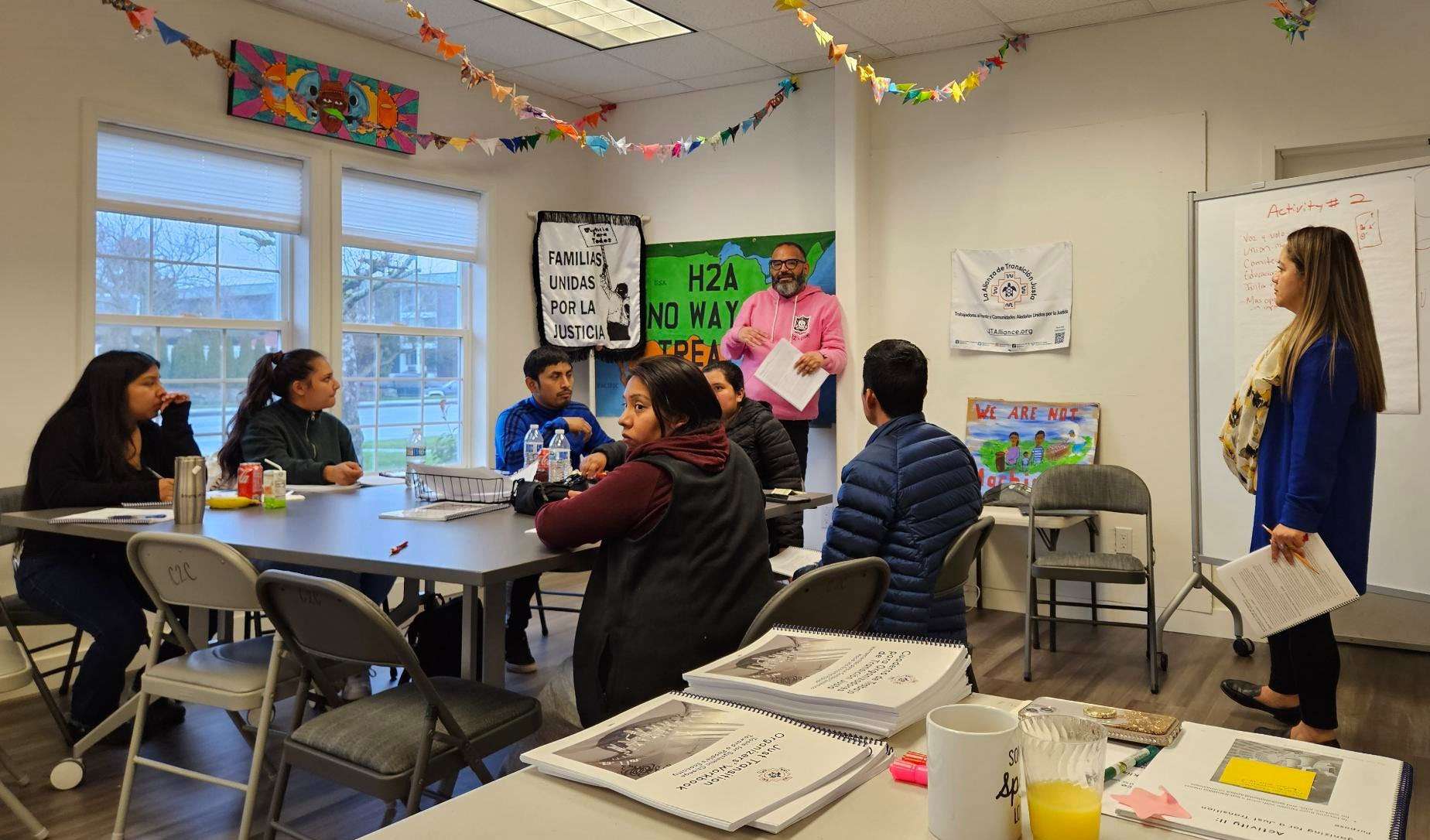
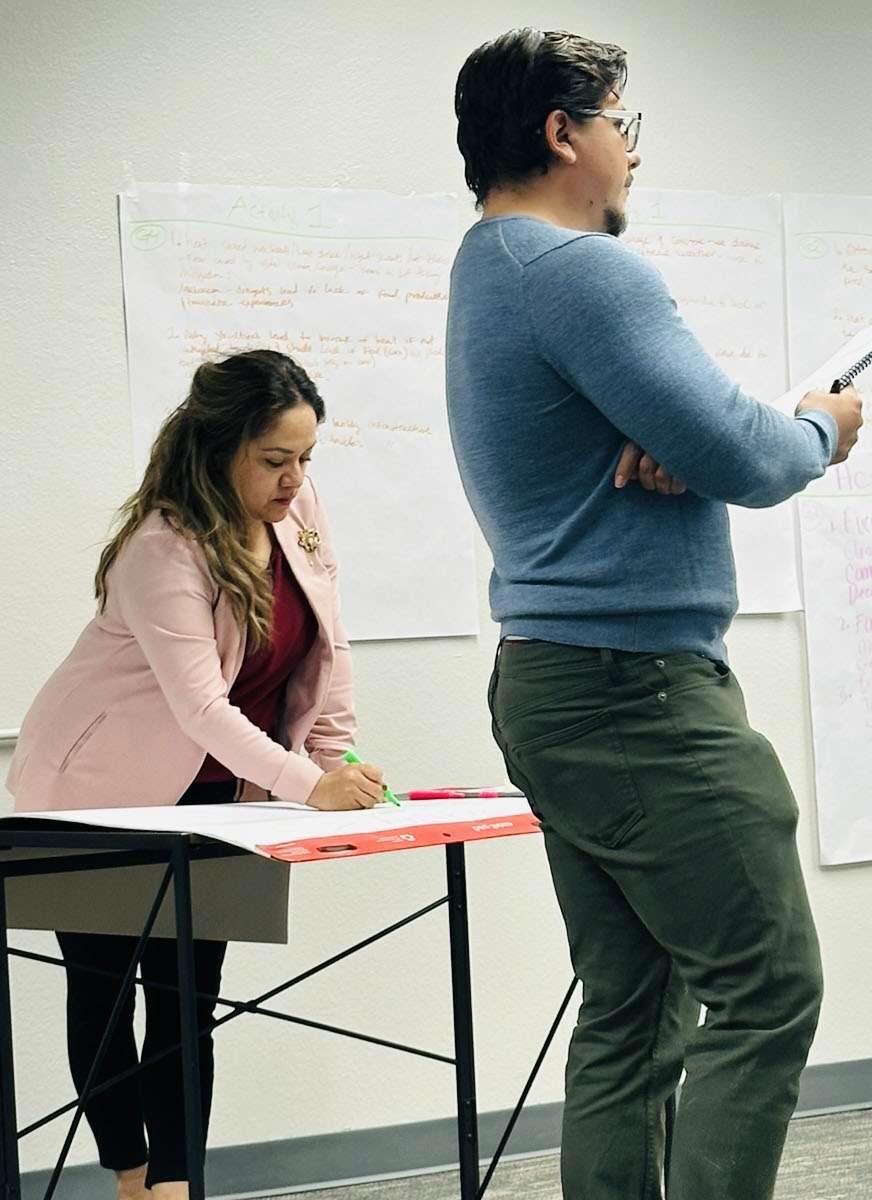
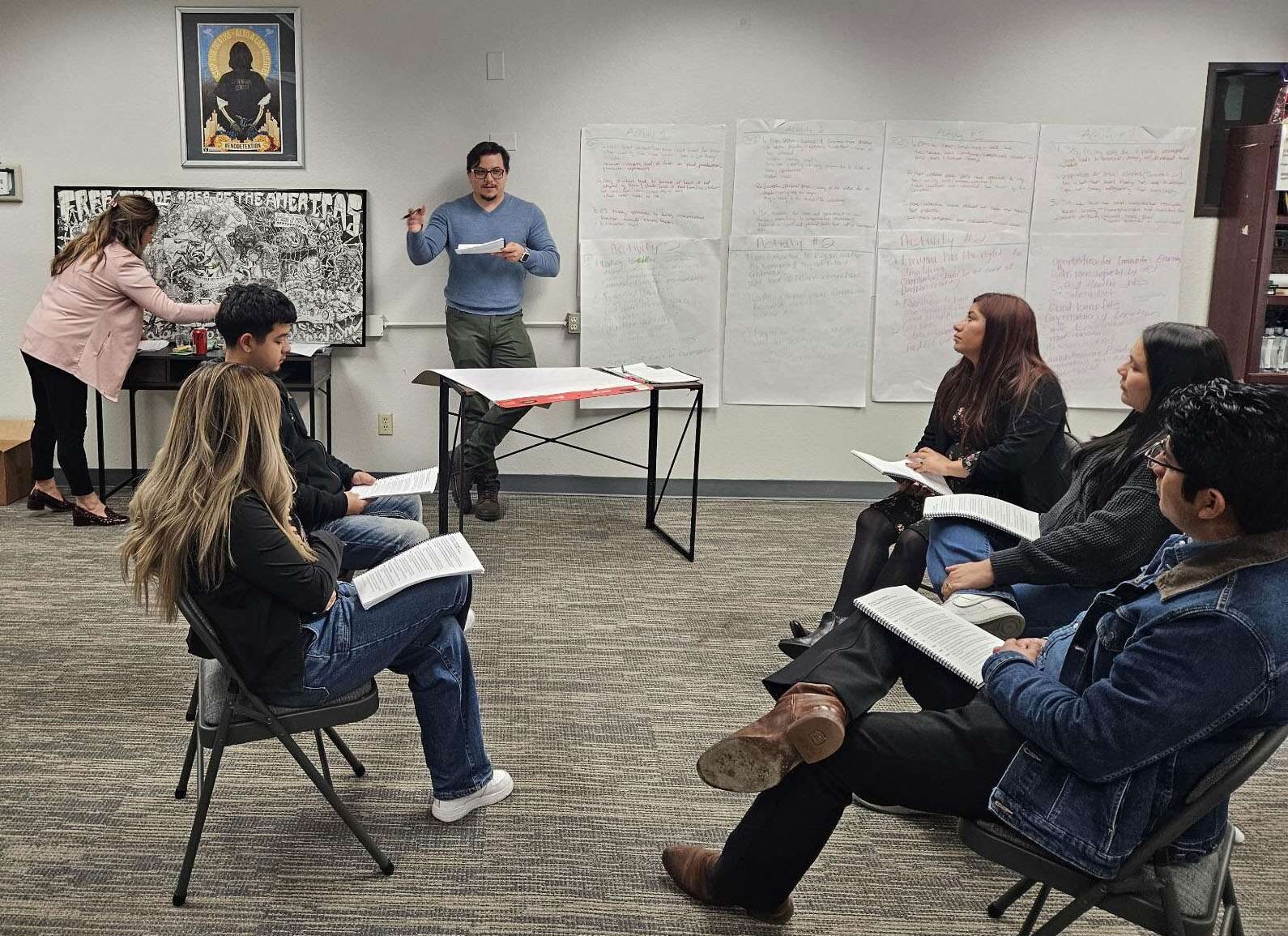
JTA’s José Bravo with trainers Edgar Franks of Familias Unidas por la Justicia and Elizabeth Martinez of Comunidades Aliadas Tomando Acción. Photo credit: José Bravo
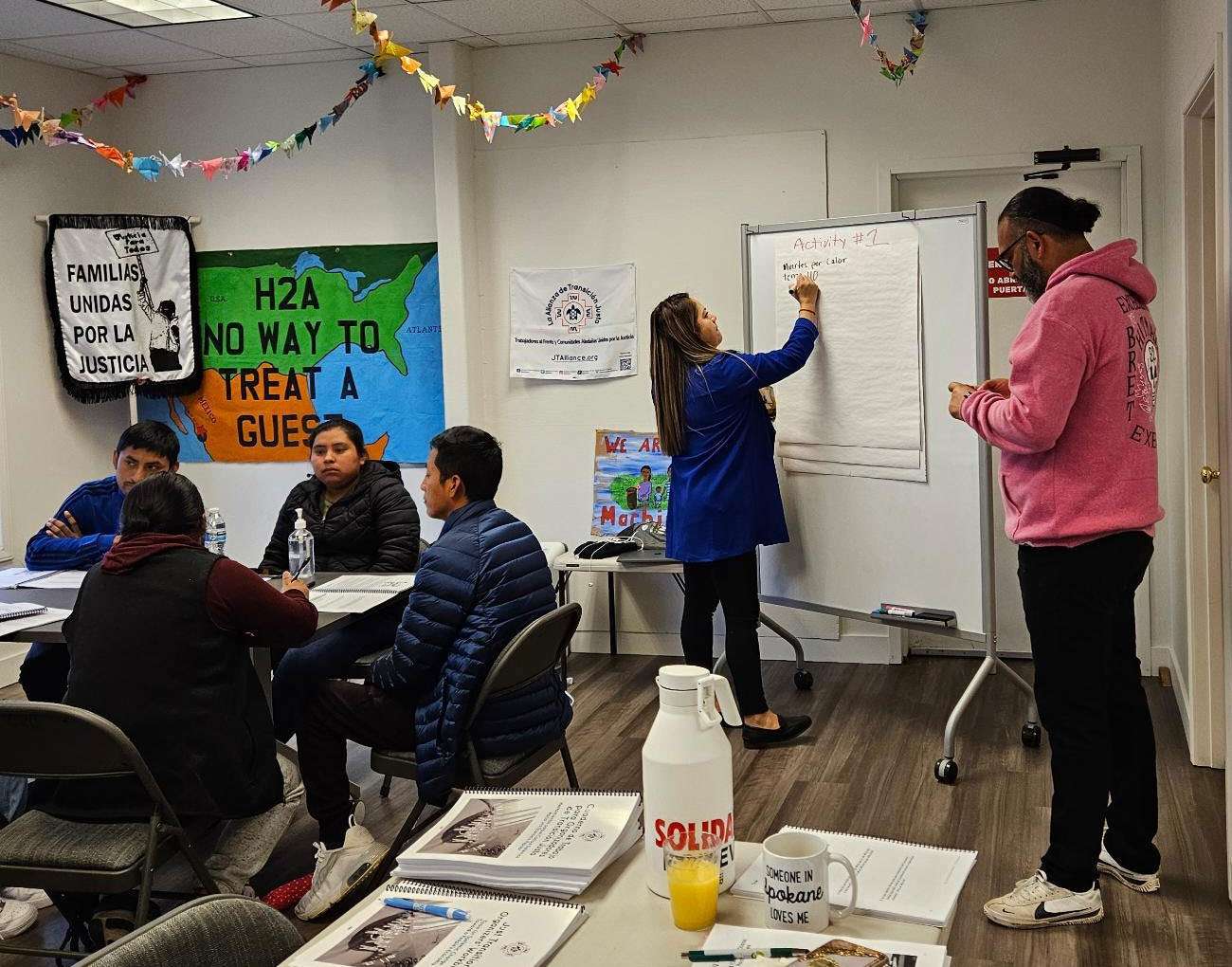
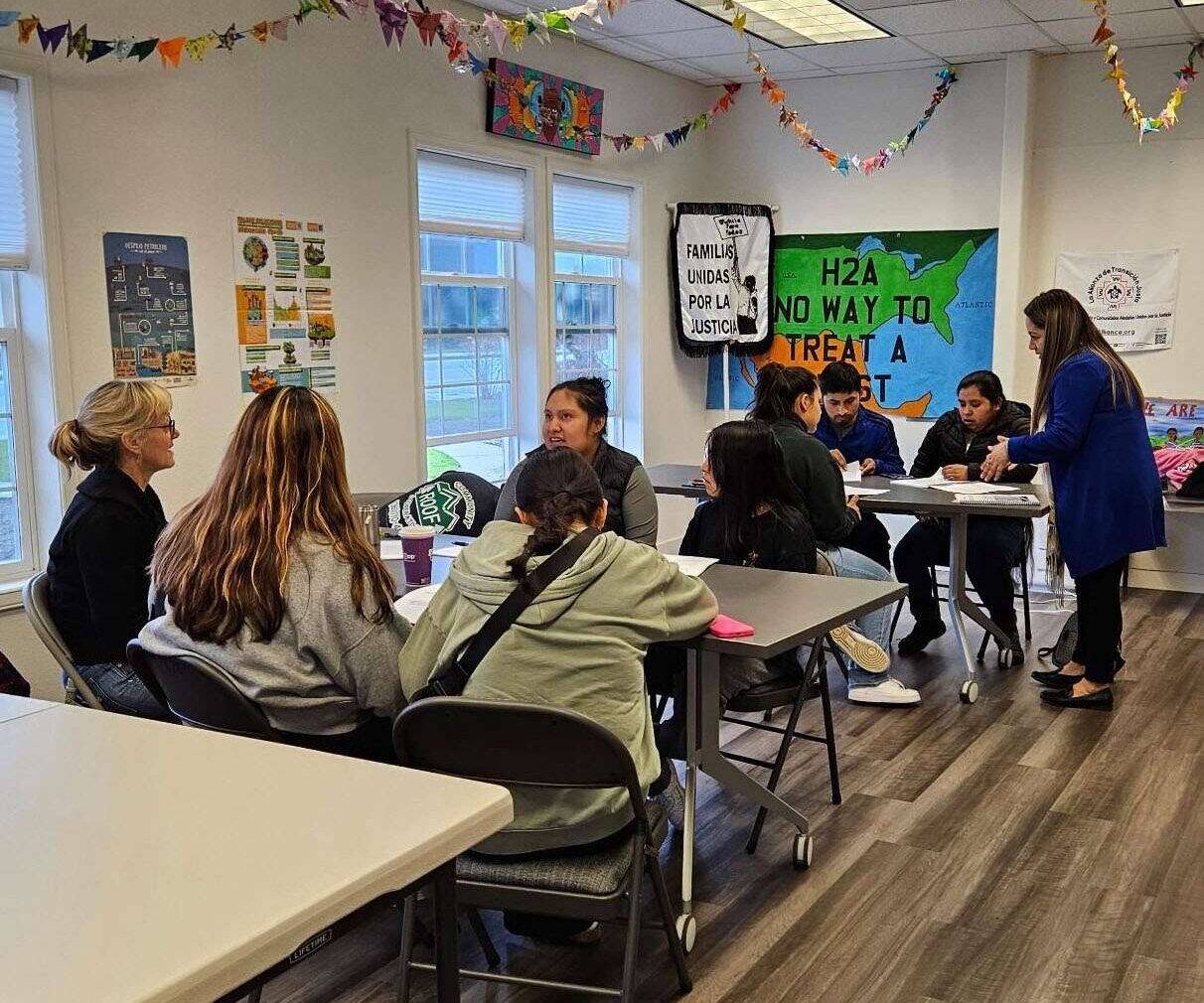
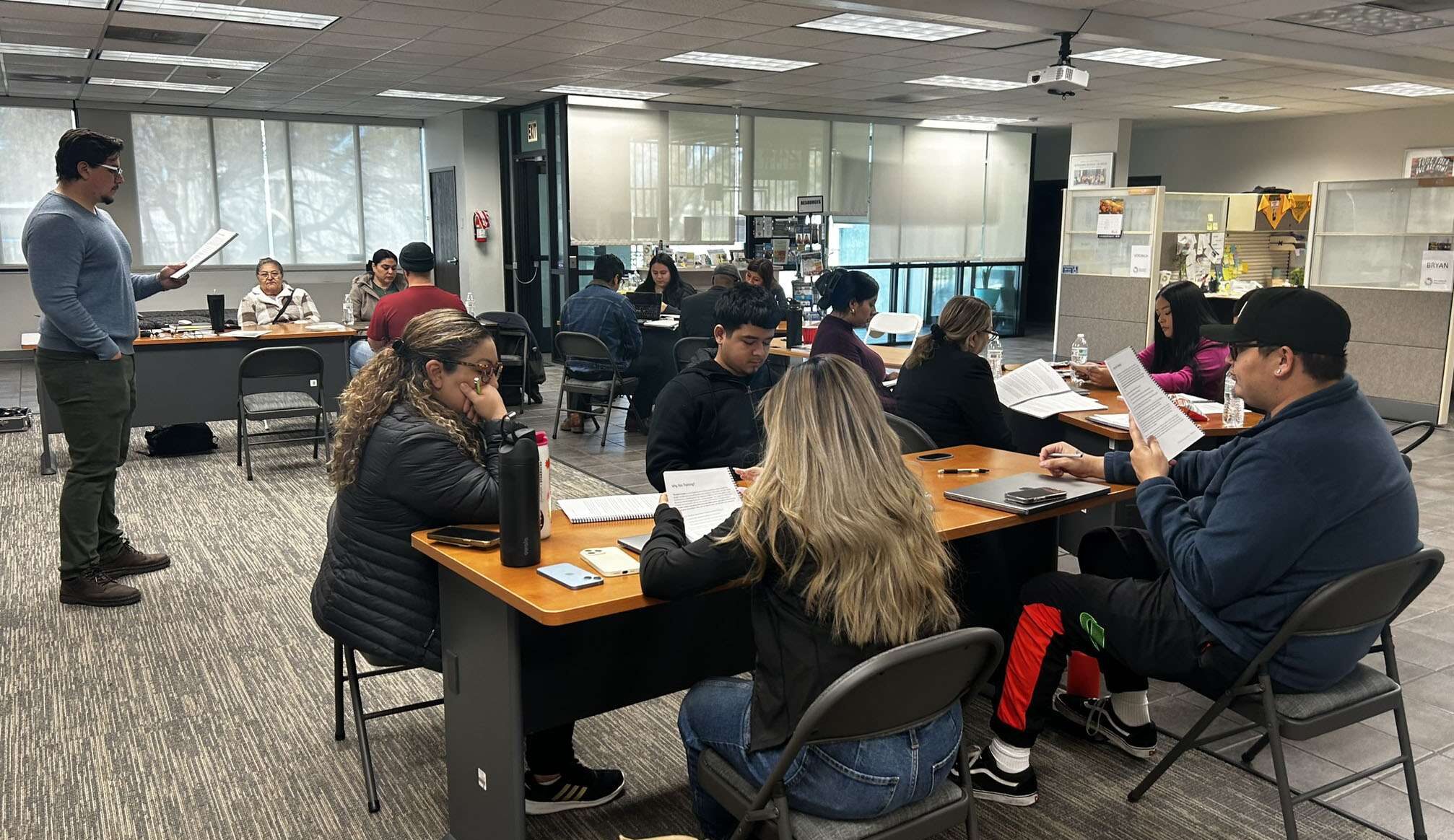
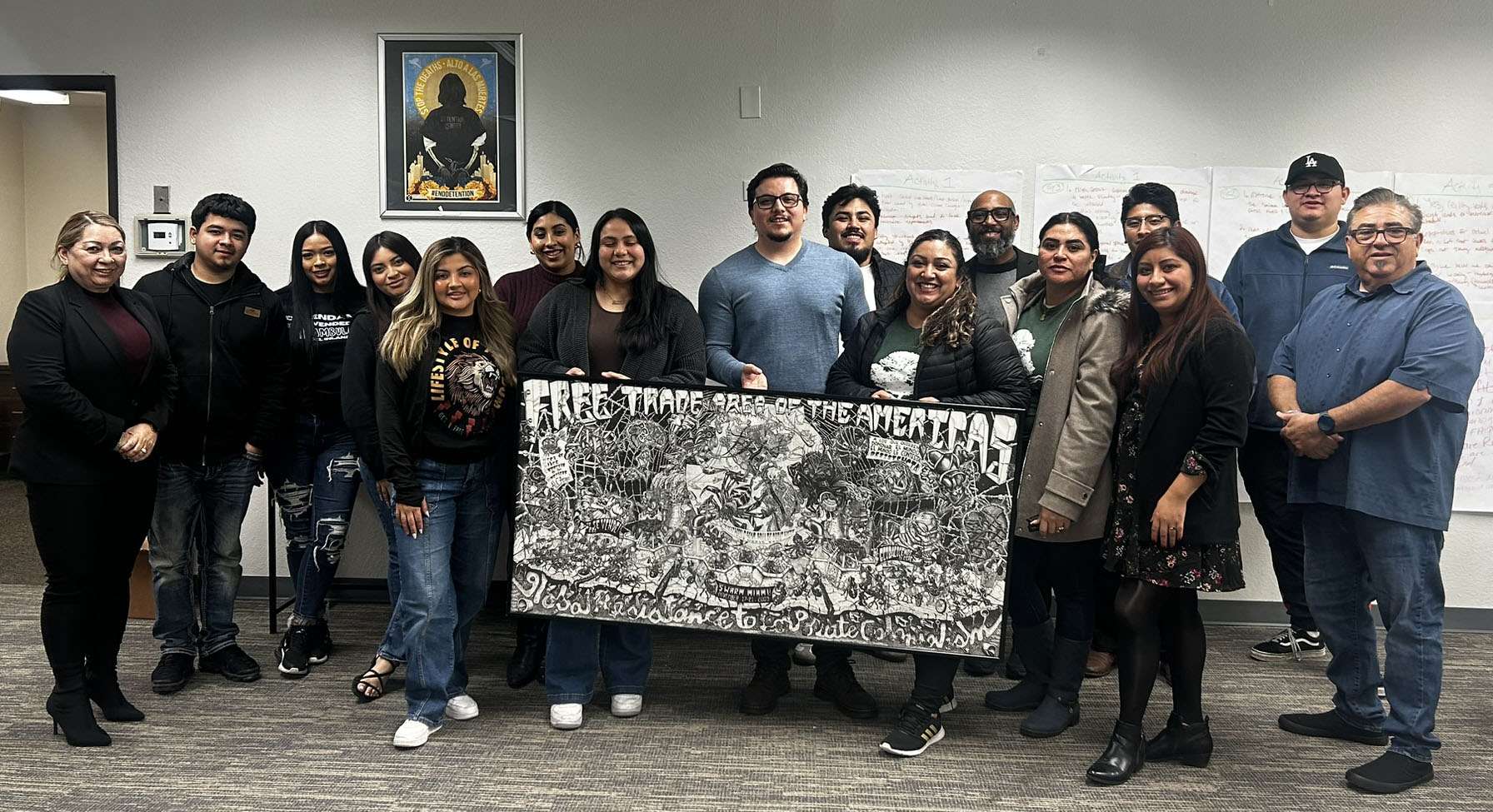
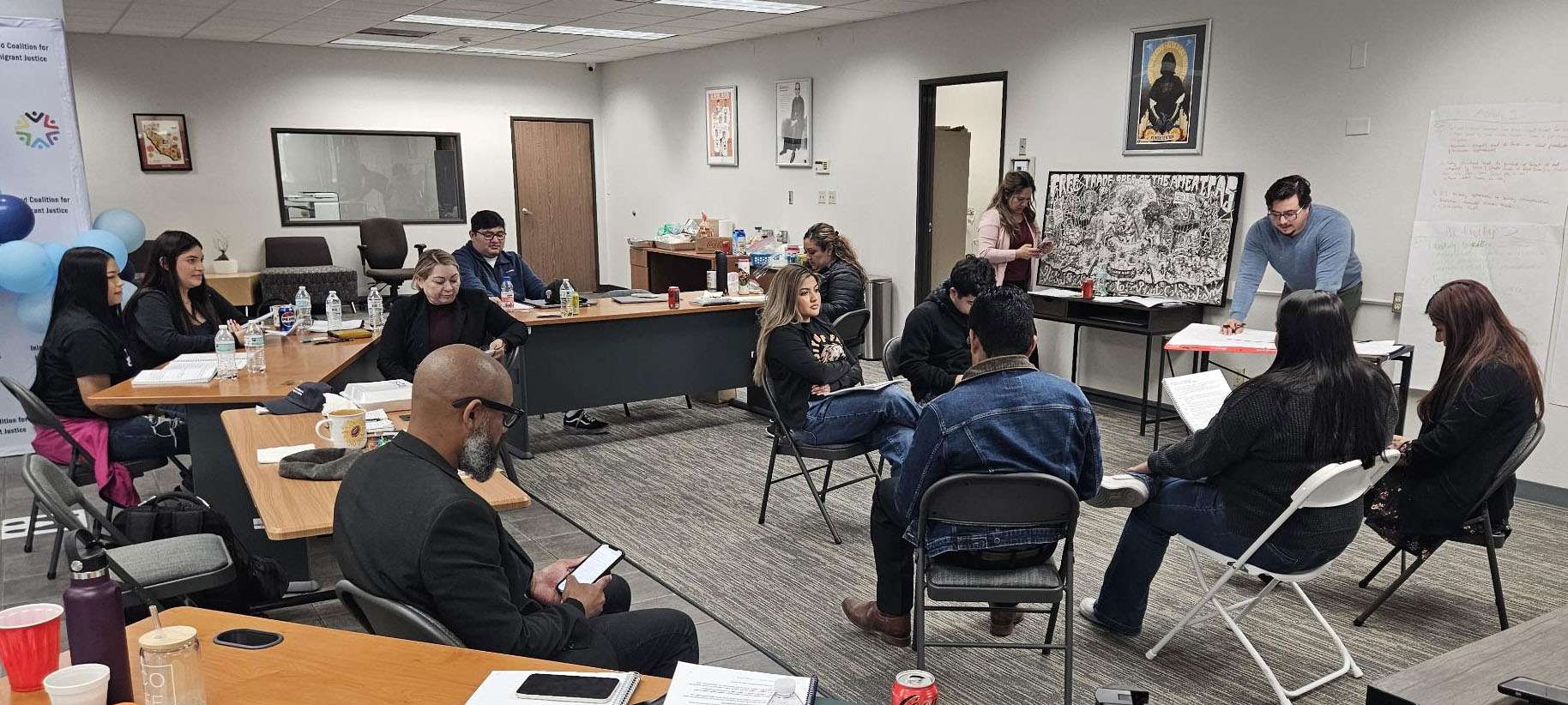
We are so pleased to celebrate our first two trainings of 2024, using our newly updated and expanded program Tools for Systemic Change Toward a People’s Economy. Our talented new cadre of popular education trainers are working together fabulously and raising the bar for engaging participant-driven education.
In February, Familias Unidas por la Justicia hosted a training in Mt. Vernon, WA. And just last week Inland Communities for Immigrant Justice held one in San Bernadino, CA. We have lots more trainings planned throughout the year, so stay tuned for updates!
Scenes from the training with Familias Unidas por la Justicia. Photo credits: José Bravo
Scenes from the training with Inland Communities for Immigrant Justice. Photo credits: José Bravo and Elizabeth Martinez
Content Successful Trainings with JTA Partners appears first in Just Transition Alliance.
The Red Nation Podcast #Throwback
Reconciliation is dead. But how and why did it start in Canada? Kahnawake Mohawk scholar Audra Simpson argues reconciliation between settlers and Indigenous was meant only to heal the settler and to forever suspend the question of Indigenous revolution.
Listen to The Red Nation Podcast on Spotify, SoundCloud, and Apple Podcasts. Listen and download for free on Libsyn.
The Red Nation Podcast is produced by Red Media and is sustained by comrades and supporters like you, power our work here: www.patreon.com/redmediapr
@therednationpodcast #Throwback ♬ original sound – The Red Nation PodcastThe post The Red Nation Podcast #Throwback appeared first on The Red Nation.
From Burning to Building Our Future
Recently closed Covanta incinerator in Long Beach, CA. Photo credit: East Yard Communities for Environmental Justice
EJ Communities force California’s last two waste incinerators to shut downThese are historic times. As the world wakes up to the intersectional nature of environmental racism, climate chaos, genocide and war, thousands of frontline communities continue to engage in pitched battle against those who are destroying people and planet. And while stepping up efforts to stop colonial genocide, we also need to take the time to acknowledge some of our hard-fought movement victories against common foes.
This year marks a couple of historic victories for environmental justice (EJ) communities in the US. After over three decades of struggle, East Yard Communities for Environmental Justice (EYCEJ) and Valley Improvement Projects (VIP), in collaboration with numerous allies, have forced the closure of California’s two remaining waste incinerators. This marks a turning point in an age-old battle with an industry that still operates scores of garbage burning facilities that dump high levels of dioxins, heavy metals, acid gasses and particulate matter in Black, Brown, migrant and poor communities around the US.
Since the 1980s, EJ communities have been hugely successful in thwarting the waste incinerator industry, stopping hundreds of proposals to build these dioxin factories. Still, over a 100 were built in the late 80s and early 90s, predominantly in racialized and poor communities. Despite the severe lack of philanthropic support for EJ groups over the years, our struggles persisted. Between 2000 and 2023, our movement has been able to shut down a number of these incinerators, leveraging a growing public awareness that zero waste alternatives creates far more jobs for a fraction of the cost of building and running a billion dollar incinerator.
Detroit EJ groups and Michigan Teamsters protest the Detroit Incinerator, which was shut down in 2019. Photo credit: Brooke Anderson
In the early 2000s, in a desperate bid to survive such losses, the incinerator industry launched a clever campaign – rebranding their trash burners as “Waste to Energy” (WtE) facilities. This greenwashing ploy allowed the industry to access public subsidies by duping lawmakers into believing they produced renewable energy (RE). Despite the fact that these WtE incinerators are some of the most toxic, carbon intensive and costly energy facilities in the world, the industry has been able to keep over 66 incinerators burning, buoyed by RE subsidies from the federal government and a number of states.
Fifteen years ago, when I worked with the Global Alliance for Incinerator Alternatives (GAIA), I facilitated a workshop for EYCEJ who (at the time) were a relatively young collective of community organizers committed to EJ principles and serving their communities in East Los Angeles and the City of Commerce, CA. At this workshop we discussed the state and federal subsidies that had propped up the incinerator industry, and how Covanta, the largest incinerator company in the US, had been accessing energy and waste policy subsidies by targeting gullible lawmakers and even big green NGOs. East Yard organizers had long been inspired by campaigns led by veteran EJ groups, such as the Mothers of East Los Angeles, who had successfully stopped a number of incinerator proposals back in the day. Some East Yard organizer’s mothers and grandmothers had led these campaigns, so they were inspired to carry on the struggle against polluting corporations like Covanta. A similar story was playing out in Stanislaus County, where a decades-long fight against a Covanta waste incinerator had been taken up in recent years by a young EJ formation – VIP.
The intergenerational leadership of our EJ movement: Juana Beatriz Gutiérrez of the Mothers of East Los Angeles and grandson mark! Lopez, organizing to protect their communities for over 4 decades. Photo credit: mark! Lopez
In 2018, EYCEJ, GAIA and other allies were able to stop the State of California from providing RE credits to incinerators, which forced the closure of the Commerce incinerator. Then, in 2022, EYCEJ, VIP, EarthJustice and other allies, successfully passed a state bill (AB 1857) that removed waste diversion credits from the last two incinerators in Long Beach and Stanislaus County. This removal of state subsidies has forced Covanta to announce the closure of these final two facilities this year. This is a huge win for EJ communities everywhere, and a highly instructive victory, especially since 26 of the 42 state Renewable Portfolio Standards continue to incentivize waste burning.
If EJ groups and their allies in these states were to go after those perverse subsidies, we could see this dinosaur fleet of toxic smoke stacks finally toppled in the coming years! And along with reducing these pollution burdens, this direction could see communities working with local governments and waste and recycling workers to build reuse, recycling and composting infrastructure that could provide millions of well-paying jobs through local, regenerative, zero waste economies. EYCEJ and VIP and other EJ communities are presently leading the way, by working with allies to develop zero waste plans to move away from burning precious resources and move towards long-term community solutions. Now, elected officials and government agencies need to stop giving public dollars to such polluting corporations, and start following the lead of communities and workers on the frontlines of such transformative change!
Content From Burning to Building Our Future appears first in Just Transition Alliance.
Exciting Developments in Building a Just Transition for Adelanto
In 2022, JTA joined a toxic tour of the Adelanto immigrant detention facility organized by the Shut Down Adelanto (SDA) coalition where we learned about the use of a toxic pesticide called HDQ neutral inside the facility and the myriad chronic health conditions afflicting those exposed. According to SDA’s quarterly report from May 2022, “Advocates, the California Department of Justice, and the Department of Homeland Security’s Office of Inspector General have documented the long list of human rights abuses at Adelanto, including inadequate health care, sexual assault, use of solitary confinement, and mistreatment.”
As of January 17th, 2024, ICE decided to extend their decision on the Adelanto facility contract to June 19th, 2024. At that point, they can either decide to close the facility or file for another extension through the end of this year. The move to extend the decision comes as a result of a court injunction (Roman v. Wolf) against GEO Group (which operates the Adelanto ICE facility) led by Inland Coalition for Immigrant Justice (ICIJ) and others: GEO hopes to buy more time for the court to potentially lift this court order. The injunction has prevented GEO from transferring people in or out of Adelanto and facilitated the release of 60,000 people around the country. Because of the injunction, the number of immigrants detained at the Adelanto ICE facility has dwindled to six according to Eddie Torres, Policy Coordinator for ICIJ.
Following the article we published last year detailing their work to close the Adelanto ICE facility, ICIJ and other members of SDA have seized upon the opportunity that the injunction presents. SDA found an ally in congresswoman Judy Chu, who is leading a sign on letter which 24 congressional members have endorsed. In June of 2023, the Dignity Not Detention (DND) coalition (which includes ICIJ) passed HEAL, a California budget initiative which “dedicates 5 million dollars to incentivize California localities to divest from immigration detention by providing them funding to invest in new industries and jobs.” What started as a bright idea in a San Diego retreat space blossomed into a just transition incentivization program to support the local workforce through the facility’s closure. In addition, ICIJ continues to advance its Participatory Action Research project, led by Movement Strategy Associate Esmeralda Santos, to document the community’s vision for a just transition. The community group also intends to strengthen collaborations with local officials aimed around backing alternative solutions to the private prison economy.
We can achieve a just transition for Adelanto by pushing for the closure of its ICE facility and supporting SDA’s efforts to cultivate a vibrant, regenerative local economy. If you’d like to support, ICIJ will host virtual Power Hours in March, April, and May to provide education on this issue and walk through 4 actions:
1) Call Secretary of Homeland Security Alejandro Mayorkas at 202-456-1111
2) Email Secretary Mayorkas at https://www.whitehouse.gov/contact/
3) Call representatives who haven’t signed on to Judy Chu’s letter. Find your local representative here.
4) Post about the issue on social media. Stay up to date by following @shutdownadelanto on Instagram.
Join Faith Power Hour–a collaboration between ICIJ and Interfaith Movement for Human Integrity–to advocate for closure and halt the incarceration of those seeking protection and the right to remain with their families.
Event Details:
- Date: March 22, 2024
- Time: 12 Noon – Pacific Time (US and Canada)
- Platform: Zoom Meeting
- REGISTER HERE
Please join us in calling on President Biden to release the last six men inside the center and the Secretary of Homeland Security and California Congressmembers to shut down the center. ACT TODAY and stay involved with ICIJ to learn more about how you can help.
Power Hour at 12pm, March 22 on Zoom; Register at bit.ly/PowerHourRSVP
Content Exciting Developments in Building a Just Transition for Adelanto appears first in Just Transition Alliance.
The Red Nation Podcast – YOTED: The settler spirituality to alt-right pipeline
Episode 349 of The Red Nation Podcast
The return of our miniseries YOTED! Jen and Justine discuss the New Age settler spiritualism to alt-right pipeline. The documentaries mentioned are Love Has Won: The Cult of Mother God (2023) and You Can’t Kill Meme (2021).
Watch the video edition on The Red Nation Podcast YouTube channel
Listen on Spotify, SoundCloud, and Apple Podcasts. Listen and download for free on Libsyn!
@therednationpodcastEpisode 349 of The Red Nation Podcast YOTED: The settler spirituality to alt-right pipeline The return of our miniseries YOTED! Jen and Justine discuss the New Age settler spiritualism to alt-right pipeline. The documentaries mentioned are Love Has Won: The Cult of Mother God (2023) and You Can’t Kill Meme (2021). Watch the video edition on The Red Nation Podcast YouTube channel! Listen on Spotify, SoundCloud, and Apple Podcasts. Listen and download for free on Libsyn! The Red Nation Podcast is produced by Red Media and is sustained by comrades and supporters like you. Power our work here: www.patreon.com/redmediapr https://therednation.org/the-red-nation-podcast-yoted-the-settler-spirituality-to-alt-right-pipeline/ Links in bio!
♬ original sound – The Red Nation Podcast @therednationpodcastThe Red Nation Podcast: YOTED: The settler spirituality to alt-right pipeline Jen and Justine explain the meaning of YOTED and why it’s the title of our miniseries. Listen to The Red Nation Podcast on Spotify, SoundCloud, and Apple Podcasts. Listen and download for free on Libsyn. https://therednation.org/the-red-nation-podcast-yoted-the-settler-spirituality-to-alt-right-pipeline/ The Red Nation Podcast is sustained by comrades and supporters like you. Power our work here: https://www.patreon.com/redmediapr Links in bio!
♬ original sound – The Red Nation PodcastThe Red Nation Podcast is produced by Red Media and is sustained by comrades and supporters like you. Power our work here: www.patreon.com/redmediapr
The post The Red Nation Podcast – YOTED: The settler spirituality to alt-right pipeline appeared first on The Red Nation.
Serving Frontline Communities with Humility and Grace
Our comrade Jacqui Patterson, of the Chisholm Legacy Project, was recently recognized by Time Magazine for her role as an outstanding Environmental Justice and Climate Justice champion. Jacqui has certainly been one of the most tireless and dedicated changemakers I have witnessed serving our movements over the years
It’s worth noting that Time Magazine recognized the “revolutionary” nature of her intersectional practice, an approach our EJ movement has always espoused as essential to serving communities on the frontlines of multiple and intertwined forms of harm. Honoring the quiet, selfless way that Jacqui has served impacted communities over the years, I thought I’d share some pivotal moments when she helped lift up the hundreds of organizations that make up our community-rooted movement:
Nearly two decades ago, when she discovered that a climate funders group was hosting a national strategy summit on coal power without inviting any of the communities most impacted by coal mining and power plants, Jacqui convinced these funders to host their first ever panel of EJ leaders from the Navajo Nation, Chicago, New York and Appalachia, whose groups had been effectively organizing and taking direct action against these dirty energy and mining industries.
Then in 2013, Jacqui, drew the attention of environmental funders to the massive, racialized funding disparity between the $billions given to a handful of big green policy NGOs versus the pittance scattered across tens of thousands of grassroots groups working on a myriad of environmental struggles across the US. This exploration helped pave the way for the launch of Building Equity & Alignment for EJ, one of the few participatory grant-making initiatives that continues to bridge the funding gap today.
Following the People’s Climate March in NYC, when a large, new funder emerged to engage big greens in a market-based model for regulating climate pollution, Jacqui (once again) helped open doors for EJ groups to get involved and prevent another “cap and trade” debacle. Working quietly in the background, she helped us push this climate funder to support a wide array of grassroots alliances and networks to carry on our core work, while allowing us to draw some of the big greens into alignment with our fights against various climate false solutions.
Working quietly and diligently in these ways to serve the broader landscape of those first and most harmed, Jacqui has embodied the principles of environmental justice in all aspects of her practice. Thanks Jacqui – for being such an inspiration!
Content Serving Frontline Communities with Humility and Grace appears first in Just Transition Alliance.
The Red Nation Podcast #Throwback
TRN Podcast hosts Nick Estes and Jen Marley are joined by Onyesonwu Chatoyer from Hood Communist and the All African Peoples Revolutionary Party and Austin Gonzalez from the DSA’s International Committee to discuss the Ukraine war.
Watch on Youtube:
Listen to The Red Nation Podcast on Spotify, SoundCloud, and Apple Podcasts. Listen and download for free on Libsyn.
The Red Nation Podcast is produced by Red Media and is sustained by comrades and supporters like you, power our work here: www.patreon.com/redmediapr
@therednationpodcast #Throwback ♬ original sound – The Red Nation PodcastThe post The Red Nation Podcast #Throwback appeared first on The Red Nation.
The Red Nation Podcast – From Hawai’i to Palestine, occupation is a crime w/ Mikey
Episode 348 of The Red Nation Podcast
TRN Podcast co-host Jen Marley speaks to filmmaker and organizer Mikey (@karaokecomputer) on the overlapping histories of military occupation between Hawai’i and Palestine.
Watch the video edition on The Red Nation Podcast YouTube channel
Listen on Spotify, Soundcloud, and Apple Podcasts. Listen and download for free on Libsyn.
The Red Nation Podcast is produced by Red Media and is sustained by comrades and supporters like you. Power our work here: www.patreon.com/redmediapr
The post The Red Nation Podcast – From Hawai’i to Palestine, occupation is a crime w/ Mikey appeared first on The Red Nation.
Meet Chris Furino, Central Florida Jobs with Justice’s Newest Co-Executive Director!
JTA congratulates our comrade Chris Furino on their promotion to Co-Executive Director of Central Florida Jobs with Justice (CFJWJ)!
CFJWJ coalesces the power of labor unions, community based organizations, faith based and student groups to organize for worker rights. Our work with CFJWJ began through collaborative strategies to bring the Just Transition framework to climate organizing in Florida and then through delegations around the United Nations climate conference. Since then, Chris has joined our all-star team of Just Transition trainers. Chris and their Co-Director Jonathan Alingu have huge plans in the works, and we’re excited to deepen our collaboration to support workers and communities on the frontlines and fencelines of toxic production.
Even before becoming staff with the organization in 2018, Chris had found their organizing home in CFJWJ. They flourished under the mentorship of Jonathan and Denise Diaz (CFJWJ’s founder) and grew through election work and campaigns focused on building grassroots leadership capacity, earning them the role of CFJWJ’s lead organizer. When Chris joined us in Egypt as part of the just transition delegation to COP27, this constituted a major step in the progression of their training for co-executive directorship. After gaining a variety of politicizing experience through their organizing over the years, Chris became Co-Executive Director in January of 2024.
According to Chris, CFJWJ’s trajectory for the coming years supports a massive strengthening in labor and just transition organizing in Florida. The organization started the year with a momentous win: Orange County allocated 4.5 million to CFJWJ’s medical debt forgiveness project, and CFJWJ continues to push their initial request for 8.7 million. Over the coming years, CFJWJ will prioritize coalition building across Florida, primarily in the state’s south. The organization plans to build with labor around key program areas–including climate, health care, and education–and continue to develop grassroots leaders through their campaigns. Moreover, CFJWJ recently hired a Just Transition Organizer to cultivate allied rank-and-file leadership within the building trades, and the organization also plans to build community-labor, co-led energy and utility campaigns.
Chris’ intentions for their new role inspire our radical imaginations around just transition: “I believe a lot in Florida. I don’t want to give up on it. We can shift the trajectory of our state and power and how power is wielded in it to create a world where everyone’s needs are met and people are able to thrive. This position is a way to make that vision a reality,” they shared. Their visionary thinking aligns perfectly with our conception of just transition as a body of principles and practices which supports collective thriving in safe living and working environments. Chris is excited for JTA’s new training curriculum (which they improved through revisions), and they’re gearing up to host a just transition training in Florida, possibly later this year.
Given the strong alignment between our missions, JTA and CFJWJ have many opportunities to collaboratively sharpen our assessments of the labor and environmental justice movements, share our experiences around organizing at the intersection of labor and EJ, and strategize against petrochemical production in the Florida panhandle. We congratulate our friend Chris on this invigorating new chapter in their organizing and look forward to engaging together in the work ahead.
Content Meet Chris Furino, Central Florida Jobs with Justice’s Newest Co-Executive Director! appears first in Just Transition Alliance.
Shut it down for Palestine – Albuquerque, NM
The Red Nation joined the international day of action with the Southwest Coalition For Palestine in Albuquerque, NM.
“On March 2, millions across the world will march for Gaza! The Israeli government is planning to have a full-scale invasion of Rafah one week later, on March 9, one day before the start of Ramadan. Today, the United States vetoed a UN resolution that insisted that Israel immediately cease its mass killing spree in Gaza.
Now is the time to act! People around the world are going into the streets in cities and towns, including in the United States, as part of the global day of protest on Saturday, March 2.
Gaza is facing famine, its hospitals are besieged, threats of ground invasion in Rafah loom near, and Israel continues its onslaught on the over 2 million Palestinians in the Gaza Strip.
The mass movement for Palestine has led to the isolation of the US and Israel on the world stage. With growing internal divisions and heightened political pressure on Israel and the United States, it’s time to push even harder. Our mobilizations at this moment can be more decisive than ever, and we must show our full strength now to ensure a lasting ceasefire and an end to the siege on Gaza.
Act now, and mobilize in your communities and institutions, everyone must be on the streets on March 2nd! All out for Rafah! All out for Gaza! Stop the genocide!”
Hands off Rafa march for Palestine: @therednationpodcastHands off Rafa march for Palestine The Red Nation joined the international day of action with the Southwest Coalition For Palestine in Albuquerque, NM.
♬ original sound – The Red Nation PodcastThe post Shut it down for Palestine – Albuquerque, NM appeared first on The Red Nation.
Pages
The Fine Print I:
Disclaimer: The views expressed on this site are not the official position of the IWW (or even the IWW’s EUC) unless otherwise indicated and do not necessarily represent the views of anyone but the author’s, nor should it be assumed that any of these authors automatically support the IWW or endorse any of its positions.
Further: the inclusion of a link on our site (other than the link to the main IWW site) does not imply endorsement by or an alliance with the IWW. These sites have been chosen by our members due to their perceived relevance to the IWW EUC and are included here for informational purposes only. If you have any suggestions or comments on any of the links included (or not included) above, please contact us.
The Fine Print II:
Fair Use Notice: The material on this site is provided for educational and informational purposes. It may contain copyrighted material the use of which has not always been specifically authorized by the copyright owner. It is being made available in an effort to advance the understanding of scientific, environmental, economic, social justice and human rights issues etc.
It is believed that this constitutes a 'fair use' of any such copyrighted material as provided for in section 107 of the US Copyright Law. In accordance with Title 17 U.S.C. Section 107, the material on this site is distributed without profit to those who have an interest in using the included information for research and educational purposes. If you wish to use copyrighted material from this site for purposes of your own that go beyond 'fair use', you must obtain permission from the copyright owner. The information on this site does not constitute legal or technical advice.
 This site is not the official webpage of the Industrial Workers of the World.