You are here

Big Green

The Ecosocialist Imperative

By Hannah Holleman - Left Voice, October 13, 2016

Her work has appeared in numerous publications on subjects including imperialism and colonialism, political economy ecology, ecological justice, feminism, advertising and propaganda, financialization, mass incarceration, and social theory.

She is a featured speaker at a regional socialist educational conference, The Solution is Socialism, to be held at Central Connecticut State University, New Britain, Connecticut on October 22.

David Kiely, a socialist youth organizer in Connecticut, interviews Hannah Holleman on the ecosocialist imperative.

1. You argue in a recent article,“De-naturalizing Ecological Disaster: Colonialism, Racism, and the Global Dust Bowl of the 1930s”, that predominant conceptions of environmental justice are too shallow and that the environmental movement needs at its center a deeper understanding of, and commitment to, real ecological justice. Can you explain what you mean and why this is so important?

Many focus on environmental injustice as the unequal distribution of outcomes of environmental harm. Colonized or formerly colonized peoples are homogenized and described as “stakeholders” in environmental conflicts. Mainstream environmental organizations, those on the privileged side of the segregated environmental movement globally, and more linked to power, are encouraged to diversify their staff and memberships and pay attention to issues of “justice.” However, the deeper aspects of social domination required to maintain the economic, social, and environmental status quo often are denied, minimized, or simply ignored.

Ignoring the systemic and historical injustice that makes current inequalities possible allows environmentalists and other activists, as Roxanne Dunbar-Ortiz writes, “to safely put aside present responsibility for continued harm done by that past and questions of reparations, restitution, and reordering society,” when discussing current, interrelated environmental and social problems.[i] Superficial approaches to addressing racism, indigenous oppression, and other forms of social domination preclude the possibility of a deeper solidarity across historical social divisions. However, this kind of solidarity is exactly what we need to build a movement capable of challenging the status quo and making systemic, lasting change that is socially and ecologically restorative and just.

EcoDefense Radio: Alex Lotorto on Supporting Frontline Communities

By Ryan Clover - Eco Defense Radio, September 8, 2016

Audio File

Bio:

Alex has been the Shale Gas Program Coordinator for Energy Justice Network since 2011. Outside of his professional capacity, he has worked extensively as a volunteer organizer fighting for environmental justice in communities facing rural poverty.

Alex also has a labor union background and has been a union activist in both the private and public sectors, is a union delegate for the Industrial Workers of the World, and represents workers in unemployment compensation appeal hearings on a volunteer basis.

Main Message :

Foundations and major environmental groups (Big Greens) aren’t situated to help the people most in need and Organizers need to build their own support network if the most difficult and important work is going to get done.

What we talked about :

In this conversation Alex shares his experience working with his friends in Northeastern Pennsylvania. From working in rural communities, and with a history in labor organizing, Alex understands the importance of building support networks of our own – and not relying on large foundations or major environmental groups (Big Greens).

At first I was uncomfortable when Alex started sharing examples of how organizations like the Sierra Club can actually perpetuate the problems of fracking – I didn’t want this episode to come across as cynical. But Alex’s message isn’t cynical, it’s critically important – it’s empowering. He shares some concrete examples about how we can build support networks of our own, and has suggestions for how people working within large environmental organizations can help steer them toward supporting the front lines.

Links to stuff we talked about:

Why We Withdrew Sponsorship from the Sierra Club’s Rally in Hartford, CT: Comfort Letter, Censorship, and Compromise!

A Statement by Capitalism vs. the Climate, April 21, 2016

We reluctantly withdrew our sponsorship from an April 20th rally against fracked-gas infrastructure in Connecticut, organized mainly by the Sierra Club. While we found actions by the national Sierra Club leading up to the rally to be inexcusable, this statement should not be seen as a criticism of the Connecticut state chapter or its volunteer members. We have reached out to the national Sierra Club and chapter staff and attempted to discuss our concerns regarding the rallies mentioned below in Bridgeport and Hartford, but we have only received evasive responses and claims that our concerns are misled.

The Sierra Club’s call for an April 20th rally against fracked-gas infrastructure in Connecticut said:

“…methane gas is worse at causing climate change than burning oil or coal, because methane produces more global warming than carbon dioxide does. We MUST convert to 100% renewable energy immediately”.[1]

But… the Sierra Club does NOT speak out against PSEG’s proposed fracked-gas plant in Bridgeport, CT.

The Sierra Club campaigned for several years against a coal plant in Bridgeport operated by PSEG. When PSEG offered to switch from burning coal to burning fracked gas, the Sierra Club decided to tacitly accept this awful compromise and not speak out loudly against construction of the gas plant, abandoning local residents and grassroots campaigners who wanted to keep fighting fracked gas. Of the Bridgeport residents who testified on the issue at city hall on February 1st, all but one of them strongly opposed the gas plant.[2]

The Sierra Club admits that they sent a “comfort letter” to PSEG in January that promised they will not take legal action against PSEG’s proposed gas plant.[3] To this day, the Sierra Club refuses to share a copy of the letter with local residents affected by the compromise.

The Sierra Club has also been censoring its own members who try to protest PSEG. According to an email we received from an executive committee member, the Connecticut chapter has been “muzzled” and “can only very quietly and not publicly fight the B-port gas plant.”[4]

  • Earlier this month, likely because of pressure from the national Sierra Club, the Connecticut chapter would not endorse an environmental justice rally organized by residents of Bridgeport. When the chapter did circulate an invitation to the event, they edited out the mention of “PSEG’s proposed fracked-gas plant” from the original event description.[5] Connecticut chapter members say the national Sierra Club pressured them to make such redactions.
  • Our press release on the February 1st public hearing (correctly) stated that “members of…the Connecticut Sierra Club also showed up to support Bridgeport residents fighting PSEG’s coal and gas power plants.”[6] Shortly afterwards, another member of the chapter’s executive committee emailed us and said that due to pressure they receive from the national Sierra Club, the chapter should not be publicly named as protesting the gas plant.[7]

We do not claim to speak for Connecticut Sierra Club members, and they have not asked us to make this statement. Nonetheless, looking in from the outside, we see the national organization interfering with local members who want to support Bridgeport residents fighting against environmental injustice. We see similarities to troubling instances in the past when the national Sierra Club has tried to silence principled chapters who dared to speak out against the Iraq War and against the greenwashing of Clorox.[8]

When it comes to Bridgeport, the Sierra Club’s silence and censorship reveals an ugly double standard. While the Sierra Club devotes resources to supporting campaigns against fracked-gas infrastructure in Connecticut’s wealthy and white communities, they will not vocally oppose fracked gas in the predominantly low-income, black and brown city of Bridgeport. Even if the Sierra Club’s legal agreement with PSEG was not motivated by racist intentions, we are concerned that the Sierra Club’s double standard, on where they will and will not protest fracked gas, could deepen Connecticut’s racial and class disparities in pollution. Since the Sierra Club would not endorse anti-gas testimonies and protest in Bridgeport, we could no longer in good conscience support the Sierra Club’s own anti-gas rally.

That’s not all… the Sierra Club kicked Beyond Extreme Energy out of the rally.

Beyond Extreme Energy (BXE) has been taking admirable direct action to stop fracking and plans to protest outside the homes of FERC’s pipeline rubber-stampers. BXE was originally one of the co-sponsors of the rally in Hartford. Against the wishes of the CT Sierra Club members, the national Sierra Club gave an ultimatum: either kick out BXE or the Sierra Club would withdraw their sponsorship (effectively canceling the rally). The Sierra Club believes (as stated in a conference call[9]) that BXE’s non-violent tactics are too confrontational… in fighting the biggest existential threat to our planet.

While non-violent home demonstrations are controversial, various campaigns have found the tactic very effective in the past (for example, in confronting animal cruelty and the logging of old growth forests[10]). The protests do not physically harm anyone, whereas the same cannot be said about high-level FERC officials who approve flammable fracked-gas pipelines in human and nonhuman communities and even adjacent to the Indian Point nuclear power plant, despite severe social, ecological, and climate risks.

It is appalling that a powerful Big Green group tried to use the Hartford rally to pressure BXE’s courageous campaigners into watering down their tactics. This is especially true at a time when a rapidly warming planet reminds us how insufficient (at best) the Big Greens’ prevailing tactics of compromise and capitulation have been. We believe that environmental organizations with different strategies and tactics should find ways to work together rather than take deliberate actions to exclude and marginalize activists. We felt that withdrawing from the rally was necessary in order to not be complicit in the exclusion of BXE.

The Sierra Club’s kind of green…

As mentioned earlier, the Sierra Club itself admits that fracked gas is not an acceptable bridge fuel. Some scientists say that fracked gas cooks the climate significantly more than coal and oil do. Surveying water contamination, air pollution and ecosystem destruction, a recent report by Environment America found that “fracking poses grave threats to the environment and public health”.[11]

We are concerned, therefore, that the Sierra Club has put money before social justice and climate protection. From 2007 to 2010, the Sierra Club took $25 million from the fracked gas industry. Since 2011, the Sierra Club has taken $80 million from the pro-fracking billionaire Michael Bloomberg. Bloomberg’s fortune is managed by Willet Advisors, which according to BusinessWeek, “invests in real assets focusing on oil and natural gas areas.”[12] Because of this funding, it is not surprising to us that the national Sierra Club has been very slow to protest consistently against fracked gas.

Real solutions will not come from alliances with the richest 1%, no matter how much money they contribute. There is no time to waste compromising core values as the planet burns and communities of color suffocate.

Cultural shifts in the climate justice movement

Kevin Buckland - ROARMag, March 22, 2016

hundred days on, as the climate justice movement looks back to the COP21 Climate Summit to see what may be learned, we reflect on the context of the violent attacks of November 13, 2015 that foreshadowed the unstable and volatile world we will all inhabit for the rest of our lives.

The ensuing crackdown on climate protesters sent shock waves through the Climate Coalition’s (CC21) plans for a series of mass climate mobilizations around the COP21 UN climate summit. This opened fissures at every weak point, revealing the political values dormant beneath and bringing to the front cultures of resistance that had the structural integrity and coherence to be able to thrive under the Parisian “State of Emergency”.

Several underlying trends that characterized successful activism during COP21 indicate an emerging cultural shift in climate activism, especially in places where the call for “system change” was not just being demanded, but enacted by the movements themselves. Three trends in particular can be identified:

  1. The spread and increased role of creativity in activism;
  2. The deepened commitment to indigenous leadership; and
  3. The evolving tensions between rhetoric and form among different organizational models.

What these trends may portend for the future of this growing movement as it begins to inhabit its politics, is that it is tilting from a protest movement towards being a truly revolutionary force.

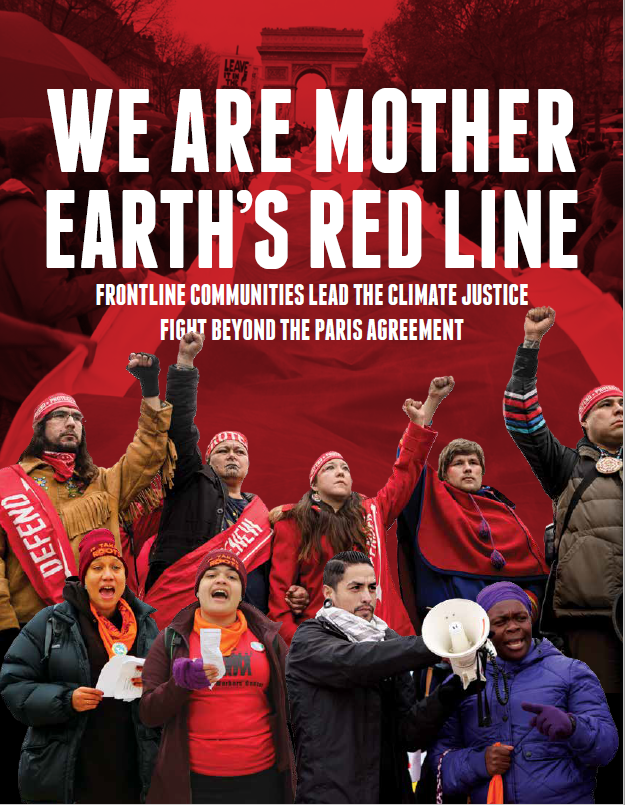
We Are Mother Earth’s Red Line: Frontline Communities Lead the Climate Justice Fight Beyond the Paris Agreement

By staff - It Takes Roots to Weather the Storm - January 2016

The Paris Climate Agreement of December 2015 is a dangerous distraction that threatens all of us. Marked by the heavy influence of the fossil fuel industry, the deal reached at the United Nations Framework Convention on Climate Change (UNFCCC) never mentions the need to curb extractive energy, and sets goals far below those needed to avert a global catastrophe. The agreement signed by 196 countries does acknowledge the global urgency of the climate crisis, and reflects the strength of the climate movement. But the accord ignores the roots of the crisis, and the very people who have the experience and determination to solve it.

Around the world, negotiators use the term “red line” to signify a figurative point of no return or a limit past which safety can no longer be guaranteed. Our communities, whose very survival is most directly impacted by climate change, have become a living red line. We have been facing the reality of the climate crisis for decades. Our air and water are being poisoned by fossil fuel extraction, our livelihoods are threatened by floods and drought, our communities are the hardest hit and the least protected in extreme weather events—and our demands for our survival and for the rights of future generations are pushing local, national, and global leaders towards real solutions to the climate crisis.

We brought these demands to the UNFCCC 21st Conference of Parties (COP21) as members of the delegation called “It Takes Roots to Weather the Storm.” Grassroots Global Justice Alliance (GGJ), the Indigenous Environmental Network (IEN), and the Climate Justice Alliance (CJA) organized the delegation, which included leaders and organizers from more than 100 US and Canadian grassroots and Indigenous groups. We helped to mobilize the thousands of people who took to the streets of Paris during the COP21, despite a ban on public protest—and amplified the pressure that Indigenous Peoples, civil society, and grassroots movements have built throughout the 21 years of UN climate talks.

The Paris Agreement coming out of the COP21 allows emissions from fossil fuels to continue at levels that endanger life on the planet, demonstrating just how strongly world leaders are tied to the fossil fuel industry and policies of economic globalization. The emphasis within the UNFCCC process on the strategies of carbon markets consisting of offsets and pollution trading created an atmosphere within the COP21 of business more than regulation. The result is a Paris Agreement that lets developed countries continue to emit dangerously high levels of greenhouse gasses; relies on imaginary technofixes and pollution cap-and-trade schemes that allow big polluters to continue polluting at the source, and results in land grabs and violations of human rights and the rights of Indigenous Peoples. Our analysis of the Paris Agreement echoes critiques from social movements around the world, led by those most impacted by both climate disruption and the false promises that governments and corporate interests promote in its wake.

“Frontline communities” are the peoples living directly alongside fossil-fuel pollution and extraction—overwhelmingly Indigenous Peoples, Black, Latino, Asian and Pacific Islander peoples in working class, poor, and peasant communities in the US and around the world. In climate disruption and extreme weather events, we are hit first and worst.

We are Mother Earth’s red line. We don’t have the luxury of settling for industry or politicians’ hype or half measures. We know it takes roots to weather the storm and that’s why we are building a people’s climate movement rooted in our communities. We are the frontlines of the solution: keeping fossil fuels in the ground and transforming the economy with innovative, community-led solutions.

Paris climate agreement: a terror attack on Africa

By Patrick Bond - Climate and Capitalism, December 17, 2015

Patrick Bond is director of the Centre for Civil Society at the University of KwaZulu-Natal in Durban, South Africa

Paris witnessed both explicit terrorism by religious extremists on November 13 and a month later, implicit terrorism by carbon addicts negotiating a world treaty that guarantees catastrophic climate change. The first incident left more than 130 people dead in just one evening’s mayhem; the second lasted a fortnight but over the next century can be expected to kill hundreds of millions, especially in Africa.

But because the latest version of the annual United Nations climate talks has three kinds of spin-doctors, the extent of damage may not be well understood. The 21st Conference of the Parties (COP21) to the UN Framework Convention on Climate Change (UNFCCC) generated reactions ranging from smug denialism to righteous fury. The first reaction is ‘from above’ (the Establishment) and is self-satisfied; the second is from the middle (‘Climate Action’) and is semi-satisfied; the third, from below (‘Climate Justice’), is justifiably outraged.

Guzzling French champagne last Saturday, the Establishment quickly proclaimed, in essence, “The Paris climate glass is nearly full – so why not get drunk on planet-saving rhetoric?” The New York Times reported with a straight face, “President Obama said the historic agreement is a tribute to American climate change leadership” (and in a criminally-negligent way, this is not untrue).

Since 2009, US State Department chief negotiator Todd Stern successfully drove the negotiations away from four essential principles: ensuring emissions-cut commitments would be sufficient to halt runaway climate change; making the cuts legally binding with accountability mechanisms; distributing the burden of cuts fairly based on responsibility for causing the crisis; and making financial transfers to repair weather-related loss and damage following directly from that historic liability. Washington elites always prefer ‘market mechanisms’ like carbon trading instead of paying their climate debt even though the US national carbon market fatally crashed in 2010.

In part because the Durban COP17 in 2011 provided lubrication and – with South Africa’s blessing – empowered Stern to wreck the idea of Common But Differentiated Responsibility while giving “a Viagra shot to flailing carbon markets” (as a male Bank of America official cheerfully celebrated), Paris witnessed the demise of these essential principles. And again, “South Africa played a key role negotiating on behalf of the developing countries of the world,” according to Pretoria’s environment minister Edna Molewa, who proclaimed from Paris “an ambitious, fair and effective legally-binding outcome.”

Arrogant fibbery. The collective Intended Nationally Determined Contributions (INDCs) – i.e. voluntary cuts – will put the temperature rise at above 3 degrees. From coal-based South Africa, the word ambitious loses meaning given Molewa’s weak INDCs – ranked by Climate Action Tracker as amongst the world’s most “inadequate” – and given that South Africa hosts the world’s two largest coal-fired power stations now under construction, with no objection by Molewa. She regularly approves increased (highly-subsidized) coal burning and exports, vast fracking, offshore-oil drilling, exemptions from pollution regulation, emissions-intensive corporate farming and fast-worsening suburban sprawl.

A second narrative comes from large NGOs that mobilized over the past six months to provide mild-mannered pressure points on negotiators. Their line is, essentially, “The Paris glass is partly full – so sip up and enjoy!”

This line derives not merely from the predictable back-slapping associated with petit-bourgeois vanity, gazing upwards to power for validation, such as one finds at the Worldwide Fund for Nature and Climate Action Network, what with their corporate sponsorships. All of us reading this are often tempted in this direction, aren’t we, because such unnatural twisting of the neck is a permanent occupational hazard in this line of work.

And such opportunism was to be expected from Paris, especially after Avaaz and Greenpeace endorsed G7 leadership posturing in June, when at their meeting in Germany the Establishment made a meaningless commitment to a decarbonized economy – in the year 2100, at least fifty years too late.

Perhaps worse than their upward gaze, though, the lead NGOs suffered a hyper-reaction to the 2009 Copenhagen Syndrome. Having hyped the COP15 Establishment negotiators as “Seal the Deal!” planet-saviours, NGOs mourned the devastating Copenhagen Accord signed in secret by leaders from Washington, Brasilia, Beijing, New Delhi and Pretoria. This was soon followed by a collapse of climate consciousness and mobilization. Such alienation is often attributed to activist heart-break: a roller-coaster of raised NGO expectations and plummeting Establishment performance.

Possessing only an incremental theory of social change, NGOs toasting the Paris deal now feel the need to confirm that they did as best they could, and that they have grounds to continue along the same lines in future. To be sure, insider-oriented persuasion tactics pursued by the 42-million member clicktivist group Avaaz are certainly impressive in their breadth and scope. Yet for Avaaz, “most importantly, [the Paris deal] sends a clear message to investors everywhere: sinking money into fossil fuels is a dead bet. Renewables are the profit centre. Technology to bring us to 100% clean energy is the money-maker of the future.”

Once again, Avaaz validates the COP process, the Establishment’s negotiators and the overall incentive structure of capitalism that are the proximate causes of the crisis.

The third narrative is actually the most realistic: “The Paris glass is full of toxic fairy dust – don’t dare even sniff!” The traditional Climate Justice (CJ) stance is to delegitimize the Establishment and return the focus of activism to grassroots sites of struggle, in future radically changing the balance of forces locally, nationally and then globally. But until that change in power is achieved, the UNFCCC COPs are just Conferences of Polluters.

Via Campesina was clearest: “There is nothing binding for states, national contributions lead us towards a global warming of over 3°C and multinationals are the main beneficiaries. It was essentially a media circus.”

Asad Rehman coordinates climate advocacy at the world’s leading North-South CJ organization, Friends of the Earth International: “The reviews [of whether INDCs are adhered to and then need strengthening] are too weak and too late. The political number mentioned for finance has no bearing on the scale of need. It’s empty. The iceberg has struck, the ship is going down and the band is still playing to warm applause.”

Paris deal: Epic fail on a planetary scale

By Danny Chivers and Jess Worth - New Internationalist, December 12, 2015

Image, right: 'D12' day of action in Paris, France, 12 December 2015. by Allan Lisner, Indigenous Environment Network

Today, after two weeks of tortuous negotiations – well, 21 years, really – governments announced the Paris Agreement. This brand new climate deal will kick in in 2020. But is it really as ‘ambitious’ as the French government is claiming?

Before the talks began, social movements, environmental groups, and trade unions around the world came together and agreed on a set of criteria that the Paris deal would need to meet in order to be effective and fair. This ‘People’s Test’ is based on climate science and the needs of communities affected by climate change and other injustices across the globe.

To meet the People’s Test, the Paris deal would need to do the following four things:

  • 1. Catalyze immediate, urgent and drastic emission reductions;
  • 2. Provide adequate support for transformation;
  • 3. Deliver justice for impacted people;
  • 4. Focus on genuine, effective action rather than false solutions;

Does the deal pass the test? The 15,000 people who took to the Paris streets today to condemn the agreement clearly didn’t think so. Here’s New Internationalist’s (NI) assessment.

Why NGOs and Leftish Nonprofits Suck (4 Reasons)

By Stephanie McMillan - Skewed News, October 15, 2015

Disclaimer: The views expressed here are not the official position of the IWW (or even the IWW’s EUC) and do not necessarily represent the views of anyone but the author’s.

About 20 years ago, in a conversation with a Bangladeshi organizer, the topic of NGOs* came up. He spat in disgust: “I hate NGOs.” At the time, I didn’t really get why he was so vehement about it. I knew NGOs had negative aspects, like siphoning off some revolutionary energy from the masses, but I also still half-believed their claims that their work was more helpful than not. Didn’t you have to be kind of a dogmatic asshole to denounce free health care and anti-poverty programs? But I didn’t yet fully appreciate how terrible they really are.

Since that conversation, NGOs have proliferated like mushrooms all over the world. First deployed in social formations dominated by imperialism, they’ve now taken over the political scene in capital’s base countries as well. They’ve become the hot new form of capital accumulation, with global reach and billions in revenue. So while ostensibly “non-profit,” they serve as a pretty sweet income stream for those at the top, while fattening up large layers of the petite bourgeoisie and draping them like a warm wet blanket over the working class, muffling their demands.

After much observation and experience both direct and indirect, I now understand and share that long-ago organizer’s hatred of NGOs. Just how terrible are they? Let us count the ways:

Greenpeace Workers Strike Amid Claims of Exploitation

By Cyrus Ward - Young Progressive Voices, August 16, 2015

Disclaimer: The views expressed here are not the official position of the IWW (or even the IWW’s EUC) and do not necessarily represent the views of anyone but the author’s.

Workers at two California Greenpeace offices have gone on strike amid concerns over an unjust quota system that creates a zero-sum, high pressure environment which puts canvassers in risk of being fired, every 3 weeks.

According to a press release sent by a new organization named “Greenpeace on Strike,” many the environmental organization’s canvassers with over 1 year experience regularly raise nearly 6 to 7 times as much money as they are paid. Despite the significant payday for Greenpeace, the organization uses a quota system that doesn’t take into account the lifetime fundraising totals of canvassers. The system runs on a 3 week quota that means that canvassers can be fired for short-time lull in fundraising even if the canvassers’ lifetime totals are still above the 3 week average.

In response to the strike, 16 of the Greenpeace workers in San Diego were delivered with letters of intent to terminate by Greenpeace under a claim of job abandonment. Greenpeace On Strike’s press release claims that these letters are a direct violation of section 7 & 8 of the National Labor Relations Act.

Despite the threatening response by Greenpeace, one of the striking canvassers said “by no means are we doing this to bash Greenpeace. We love Greenpeace, and we are Rainbow Warriors. That’s why we want to make Greenpeace better.”

Regardless of the outcome, it is abundantly clear that despite its leftist political ideology, Greenpeace’s workplace is far from democratic.

Senate Bill 4 Regs Will Expand Fracking in California

By Dan Bacher - IndyBay, July 2, 2015

Disclaimer: The views expressed here are not the official position of the IWW (or even the IWW’s EUC) and do not necessarily represent the views of anyone but the author’s.

The Governor Jerry Brown administration, known for its subservience to Big Oil, is gearing up for a massive expansion of fracking and other extreme oil drilling techniques that will contaminate California's groundwater supplies, pollute rivers and streams, and devastate coastal ecosystems, including so-called "marine protected areas" implemented under his helm.

On July 1, anti-fracking, environmental and watchdog groups responded to the release of final fracking regulations developed under Senate Bill 4, pointing out that the rules promote more fracking and pollution of water supplies in the drought-plagued state.

Senate Bill 4, the green light for fracking bill, was signed by Governor Jerry Brown on September 20, 2013. The Natural Resources Defense Council (NRDC), the California League of Conservation Voters, the Environmental Defense Fund and other corporate "environmental" NGOs provided green cover for the odious legislation. They backed the bill until the very last minute when they finally decided to withdraw support because of amendments from the Western States Petroleum Association and other Big Oil interests that further weakened the already weak legislation.

In a statement, Food and Water Watch said, "Today the Brown Administration finalized regulations on fracking and other dangerous oil extraction techniques that will allow oil and gas companies to continue to conduct these techniques at the expense of California’s water, air, agriculture and public health."

Pages

The Fine Print I:

Disclaimer: The views expressed on this site are not the official position of the IWW (or even the IWW’s EUC) unless otherwise indicated and do not necessarily represent the views of anyone but the author’s, nor should it be assumed that any of these authors automatically support the IWW or endorse any of its positions.

Further: the inclusion of a link on our site (other than the link to the main IWW site) does not imply endorsement by or an alliance with the IWW. These sites have been chosen by our members due to their perceived relevance to the IWW EUC and are included here for informational purposes only. If you have any suggestions or comments on any of the links included (or not included) above, please contact us.

The Fine Print II:

Fair Use Notice: The material on this site is provided for educational and informational purposes. It may contain copyrighted material the use of which has not always been specifically authorized by the copyright owner. It is being made available in an effort to advance the understanding of scientific, environmental, economic, social justice and human rights issues etc.

It is believed that this constitutes a 'fair use' of any such copyrighted material as provided for in section 107 of the US Copyright Law. In accordance with Title 17 U.S.C. Section 107, the material on this site is distributed without profit to those who have an interest in using the included information for research and educational purposes. If you wish to use copyrighted material from this site for purposes of your own that go beyond 'fair use', you must obtain permission from the copyright owner. The information on this site does not constitute legal or technical advice.