You are here

wind power

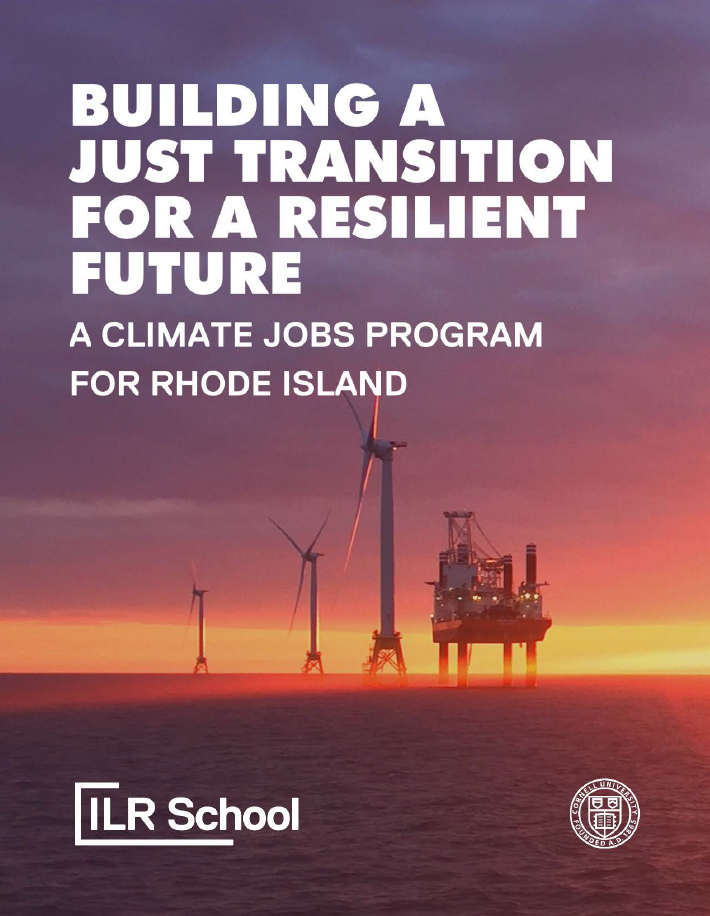
Building a Just Transition for a Resilient Future: A Climate Jobs Program for Rhode Island

By Lara Skinner, J. Mijin Cha, Avalon Hoek Spaans, Hunter Moskowitz, and Anita Raman - The Worker Institute and The ILR School, January 2022

A new report released today by climate and labor experts at Cornell University in collaboration with the Climate Jobs Rhode Island Coalition outlines a comprehensive climate jobs action plan to put Rhode Island on the path to building an equitable and resilient clean-energy economy.

The report lays out a series of wide-ranging policy recommendations to transition the Ocean State’s building, school, energy, transportation, and adaptation sectors to renewable energy with the strongest labor and equity standards. Core provisions of the plan include decarbonizing the state’s K-12 public school buildings, installing 900 MW of solar energy statewide, 1,300 MW of offshore wind energy, and modernizing the state’s electrical grid by 2030. 

“Rhode Island is in a unique position as a state, in 2019 it had the lowest energy consumption per capita across all the United States. Rhode Island can use climate change as an opportunity to eliminate carbon emissions, increase equity, and create high-quality jobs that support working families and frontline communities,” says Avalon Hoek Spaans, Research and Policy Development Extension Associate for the Labor Leading on Climate Initiative at the Worker Institute, Cornell ILR School and one of the authors of the report.

The Worker Institute’s Labor Leading on Climate Initiative in partnership with the Climate Jobs National Resource Center, and Climate Jobs Rhode Island, began a comprehensive research, educational, and policy process in early 2021 to develop an implementation framework to drastically reduce emissions in the state while creating high-quality union family sustaining jobs.

Over the past year, the Labor Leading on Climate team has conducted outreach to numerous leaders of the labor and environmental movements as well as policymakers and experts in the climate, energy, and labor fields to better understand the challenges and opportunities that climate change and climate mitigation and adaptation presents to Rhode Island workers and unions.

“With Rhode Island on the frontlines of the climate crisis, it will take bold, ambitious action to combat climate change and reduce greenhouse gas emissions and pollution to the levels that science demands. Fortunately, tackling climate change is also an opportunity to address the other crises Rhode Island is facing: inequality and pandemic recovery,” says Lara Skinner, Director, Labor Leading on Climate Initiative, at the Worker Institute, Cornell ILR School and one of the authors of the report.

“As a small state with one of the lowest emissions in the country, Rhode Island can be innovative and efficient, employing cutting-edge approaches to reverse climate change and inequality. Rhode Island has the potential to be the first state in the country to fully decarbonize and build out a net zero economy with high-quality union jobs. This would make Rhode Island's economy stronger, fairer, and more inclusive,” says Lara Skinner, Director, Labor Leading on Climate Initiative, at the Worker Institute, Cornell ILR School and one of the authors of the report.

Read the text (PDF).

Climate Ventures Conversations: Bruce Wilson from Iron & Earth

Wind and solar companies perform poorly re labour and human rights

By Elizabeth Perry - Work and Climate Change Report, November 17, 2021

On November 1, the Centre for Business and Human Rights Resource Centre released the 2nd edition of its report: the Renewable Energy & Human Rights Benchmark 2021 Report. Although the report notes some improvements from the inaugural 2020 edition, the Centre states that the “ overall results remain profoundly concerning, with companies scoring an average of just 28%.” In the past 10 years, the Centre has recorded over 200 allegations linked to renewable energy projects, including land and water grabs, violation of the rights of Indigenous nations, and the denial of workers’ rights to decent work and a living wage. Only 2 companies in the survey guaranteed the right to a living wage.

The wind and solar sectors accounted for 44% of the total allegations of abuse. The Key Findings for the Wind and Solar sectors report includes analysis, and makes recommendations for corporations and investors. For corporations, the key recommendation is: “Set a clear and urgent goal to implement human rights and environmental due diligence in operations and supply chains, alongside access to remedy, with special emphasis on land and Indigenous rights risks.”

Union Struggles Against Climate Change

Climate Jobs: Building a Workforce for the Climate Emergency

By Suzanne Jeffery, editor, et. al - Campaign Against Climate Change, November 2021

This report was written by the Campaign Against Climate Change Trade Union Group (CACCTU). It builds on and develops the earlier work produced by CACCTU, One Million Climate Jobs (2014). The editorial group and contributors to this report are trade unionists, environmental activists and campaigners and academics who have collaborated to update and expand the previous work. Most importantly, this updated report is a response to the urgency of the climate crisis and the type and scale of the transition needed to match it.

This report shows how we can cut UK emissions of greenhouse gases to help prevent catastrophic climate change. We explain how this transformation could create millions of climate jobs in the coming years and that the public sector must take a leading role. Climate jobs are those which directly contribute to reducing emissions. This investment will give us better public transport, warmer homes, clean air in our cities and community renewal in parts of the country which have long been neglected. Most importantly, it will give us a chance for the future, avoiding the existential threat of climate breakdown.

Read the text (Link).

Clean Power to the People

By Al Weinrub - Organizing Upgrade, October 27, 2021

As predicted, the climate has been screaming out with intensified ferocity at the assault on the earth by the global fossil fuel economy. Extreme weather conditions are wreaking havoc on communities across the world, leading many climate activists in the U.S. and elsewhere to declare a climate emergency, requiring an urgent, intensified transition from fossil fuels to renewable energy.

But thinking of this transition as mainly a shift in energy technology, as de-carbonizing the economy, is to misunderstand the deep roots of the climate crisis in an extractive economic system based on racialized social and economic inequality.

Emphasizing de-carbonization of energy without broad institutional transformation—an approach called carbon fundamentalism—leaves us still at the mercy of the corporate energy establishment. That approach, as we shall see, is actually amplifying the already devastating impacts of the climate crisis. “It ignores the specific needs of people of color, it promotes programs that force low-income people to pay unfairly for carbon reduction, it exposes our communities to increased risks, and it sacrifices justice in the urgent rush to reduce carbon,” says Jessica Tovar of the Local Clean Energy Alliance. “Time and again, it ends up throwing people of color under the bus.”

We need more than clean energy to address the climate crisis. We need to move from a large, centralized private utility model to a locally based, decentralized energy model. We need an energy system centered on democracy and justice.

Renewable energy jobs continue steady growth to 12 million jobs worldwide, but more government intervention is recommended

By Elizabeth Perry - Work and Climate Change Report, October 26, 2021

In its first annual review published in 2013, the International Renewable Energy Association (IRENA) estimated 7.3 million people were directly and indirectly employed in the industry in 2012. According to the latest newly-released edition Renewable Energy and Jobs – Annual Review 2021, that number has grown to 12 million people employed in 2020. Solar PV, both large and small-scale, is the largest sector, providing 4 million jobs. Wind energy now employs 1.25 million people, with an increasing number of people in operations and maintenance and in offshore wind energy sector. Only a fifth of wind energy workers are women, compared to 32% women in the whole renewable energy sector. In addition to detailed information about jobs, skills, and demographics, the report discusses policy needs, particularly for a just energy transition, and highlights IRENA’s modeling of the employment implications of energy transition scenarios to 2050. 

The report concludes with the policy discussion of what kinds of jobs and skills will be required, the need for decent jobs, and for urgency: “A speedy and co-ordinated approach requires governments to take on a much more proactive role, acting in the public interest and safeguarding broad social imperatives. This may occur through regulations and incentives, public investment strategies, and public ownership of transition-related assets and infrastructure (both at national and community levels).”

Energy transition or energy expansion?

By Sean Sweeney, John Treat, and Daniel Chavez - Trade Unions for Energy Democracy and Trans National Institute, October 22, 2021

From politicians to corporate executives, media commentators to environmental campaigners, narratives evoking the “unstoppable” progress of a global transition from fossil fuels to renewable energy have grown increasingly commonplace.
However, in reality, the global shifts in energy production, energy usage and greenhouse gas emissions we urgently need are not happening:

  • In 2019, over 80% of global primary energy demand came from fossil fuels, with global greenhouse gas emissions at record levels.
  • In 2020, wind and solar accounted for just 10% of global electricity generated.
  • Despite stories of its decline, coal-fired power generation continues to rise globally. In 2020, global efforts to decommission coal power plants were offset by the new coal plants commissioned in China alone, resulting in an overall increase in the global coal fleet of 12.5 GW.

Recently, some have argued that the Covid-19 pandemic and subsequent contraction in economic activity signal a turning point. Indeed, global energy demand fell by nearly 4% in 2020, while global energy-related CO2 emissions fell by 5.8% — the sharpest annual decline since the second world war.

Despite these short-term shifts, the pandemic has failed to result in any significant long-term changes for the energy sector or associated emissions:

  • Global energy-related CO2 emissions are projected to grow by 4.8% in 2021, the second highest annual rise on record.
  • Demand for all fossil fuels is set to rise in 2021.6 A 4.6% increase in global energy demand is forecast for 2021, leaving demand 0.5% higher than 2019 levels.
  • By the end of 2020 electricity demand had already returned to a level higher than in December 2019, with global emissions from electricity higher than in 2015.
  • By the end of 2020, global coal demand was 3.5% higher than in the same period in 2019. A 4.5% rise in coal demand is forecast for 2021, with coal demand increasing 60% more than all renewables growth combined and undoing 80% of the 2020 decline.
  • Oil demand is forecast to rebound by 6% in 2021, the steepest rise since 1976. By 2026, global oil consumption is projected to reach 104.1 million barrels per day (mb/d), an increase of 4.4 mb/d from 2019 levels.

As such, an energy transition with the depth and speed necessary for meeting the 2015 Paris Agreement shows no sign of materializing. Indeed, most of the world’s major economies are not on track to reach their Nationally Determined Contributions (NDCs) on emissions reductions.

These facts point to a clear conclusion: the dominant, neoliberal climate policy paradigm, which deploys a “sticks and carrots” approach that attempts to disincentivize fossil fuels through carbon pricing, while promoting low-carbon investment through subsidies and preferential contractual arrangements has been completely ineffective. This policy paradigm positions governments as guardians and guarantors of the profitability of private actors, thus preventing them from addressing social or environmental challenges head-on.

Read the text (PDF).

How Green is Blue Hydrogen?: Study Finds Hydrogen Produced with CCS Produces High Emissions

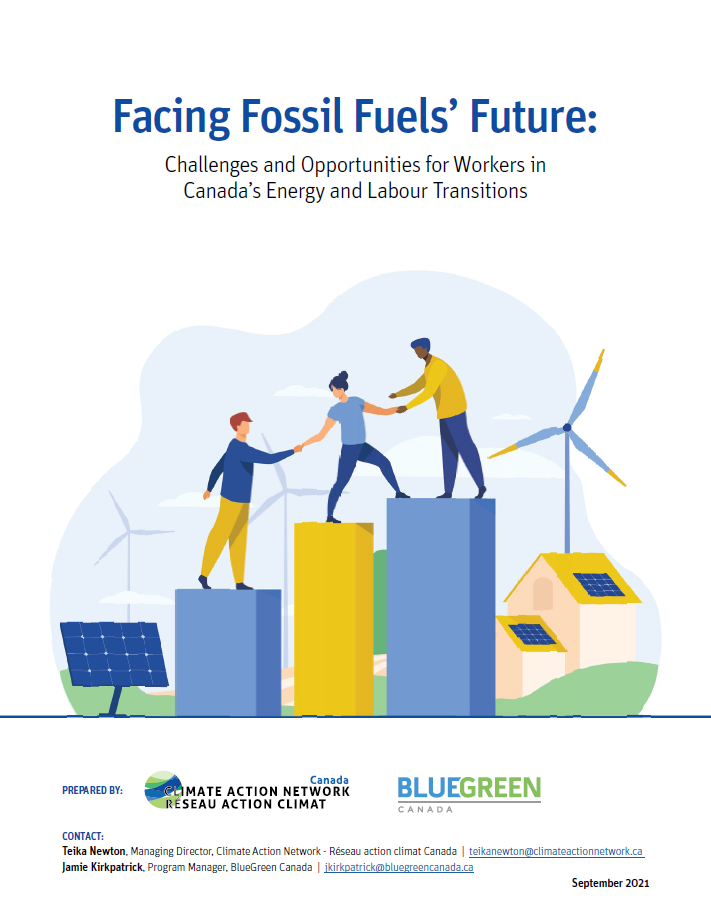
Facing Fossil Fuels’ Future: Challenges and Opportunities for Workers in Canada’s Energy and Labour Transitions

By Teika Newton and Jamie Kirkpatrick - Climate Action Network and BlueGreen Canada, September 2021

Canada has a climate plan but it does not lay out a plan for the future of oil and gas extraction that aligns with the goal to limit global warming to 1.5°C, leaving workers and communities with an uncertain future. The Canada Energy Regulator warns that the future of oil sands extraction, which makes up 62 percent of Canada’s oil output, is uncertain due to the projected drop in the future oil demand as the global pace of decarbonization increases.

Meanwhile, a study backed by the UN Environment Programme further states that global oil and gas output would have to decline by over one third by 2030 and over one half by 2040 to achieve the goal of limiting warming to 1.5°C. In early 2021, the International Energy Agency, one of the world’s foremost authorities on global energy forecasting, published a landmark report, Net Zero by 2050, in which the agency declared that oil and gas output should be constrained to existing operations in order to meet the 1.5°C temperature goals articulated in the Paris Agreement. Constraining Canadian oil and gas output to existing fields approximates a similar rate of phaseout to that proposed by the UNEP-backed report.

he Canadian oil and gas industry, including upstream activities, pipelines, and services, provides approximately 405,000 jobs - 167,000 direct jobs and 238,000 jobs across supply chains. In response to oil price crises, industry’s solution to protect profits has historically been to slash jobs while maintaining output. As a result the number of jobs per barrel of output has already fallen by 20% since 2000.

While oil and gas jobs have significantly better compensation and training provisions than most sectors in the economy, these jobs are also somewhat more precarious and have higher health and safety risks. Union density is higher but is also falling at a more rapid rate than in oth-er industries.8 Finally, automation is projected to threaten between 33%-53% of Canadian oil and gas jobs by 2040.

Read the text (PDF).

Pages

The Fine Print I:

Disclaimer: The views expressed on this site are not the official position of the IWW (or even the IWW’s EUC) unless otherwise indicated and do not necessarily represent the views of anyone but the author’s, nor should it be assumed that any of these authors automatically support the IWW or endorse any of its positions.

Further: the inclusion of a link on our site (other than the link to the main IWW site) does not imply endorsement by or an alliance with the IWW. These sites have been chosen by our members due to their perceived relevance to the IWW EUC and are included here for informational purposes only. If you have any suggestions or comments on any of the links included (or not included) above, please contact us.

The Fine Print II:

Fair Use Notice: The material on this site is provided for educational and informational purposes. It may contain copyrighted material the use of which has not always been specifically authorized by the copyright owner. It is being made available in an effort to advance the understanding of scientific, environmental, economic, social justice and human rights issues etc.

It is believed that this constitutes a 'fair use' of any such copyrighted material as provided for in section 107 of the US Copyright Law. In accordance with Title 17 U.S.C. Section 107, the material on this site is distributed without profit to those who have an interest in using the included information for research and educational purposes. If you wish to use copyrighted material from this site for purposes of your own that go beyond 'fair use', you must obtain permission from the copyright owner. The information on this site does not constitute legal or technical advice.