You are here

climate emergency

Climate Change Is About to Cause a Viral Explosion

By Abdullah Farooq - Jacobin, August 23, 2022

As climate change disrupts migration patterns, animals and the viruses they carry will come into unusual contact with each other — and inevitably with humans, unleashing new pandemics. The only thing that can stop this unfolding nightmare is a mass movement.

When animals migrate, be they butterfly kaleidoscopes or elk herds or bat cauldrons, they do so in response to ecological cues, which guide the manner and extent of the migration process. As climate change disrupts those cues, so too will it disrupt the migration of animals.

Climate change will thus deal a horrible blow to butterflies, bats, elk, and all manner of migratory animals. That’s tragic enough, but it gets worse: according to a recent study in Nature, this disruption will result in unusual interspecies contact, which will in turn cause new transmissions and mutations of viruses.

Through extensive modeling work, the study’s authors show that climate change will lead to altered migration patterns for thousands of animals, resulting in close to fifteen thousand new interspecies viral transmission events by the year 2070. In addition to having a massive ecological impact on the global fauna, this trend is of critical public health importance to us as humans, given that the majority of emerging infectious disease threats are zoonotic (transmitted by animal-to-human contact) in origin. The authors are cautious about predicting the probability of zoonoses into humans, but predict that geographies that are densely populated with humans will be future hot spots for interspecies viral transmission.

The study’s findings suggest that we are on the precipice of this mass-scale viral transmission event. The authors predict that the majority of these transmission events will happen between 2011 and 2040, indicating that many of them may already be taking place. While keeping temperature increases to within or below 2 degrees Celsius is a necessary goal, the authors predict that the accomplishment of this goal itself will not result in reduced viral sharing. In short, we’re probably stuck with massive changes in animal migration and vast quantities of viral transmission even if we slow climate change. However, there are other interventions we can make to stop the worst from happening.

In their model, the authors rely on a variety of land use scenarios — including alterations in deforestation, agricultural land usage, and human settlements — due to the uncertainty of how land is going to be used over the next fifty years. But none of that is inevitable. We can ensure that our land usage mitigates the impacts of climate change and prevents the emergence of the next pandemic. This can only happen if we’re able to take back control over how land is used, and democratically determine the best way to use it instead of leaving the decision up to capitalist markets.

Currently, our governments are beholden to corporate interests, which means that real estate and agribusiness have outsized influence over where and how land is developed. This has led to the unmitigated proliferation of sprawling housing developments, which often push deep into important ecological niches. This trend has already directly led to the destruction of 67 percent of coastal wetlands, which play a critical role in supporting local ecosystems, flood mitigation, carbon sequestration, and erosion control. In Brazil, Jair Bolsonaro’s far-right government has facilitated the rapid destruction of the Amazon rainforest to facilitate increased agricultural land usage. The Amazon is a massive carbon sink, and its destruction could make it impossible for the rest of the world to keep global warming from rising faster than 1.5-2 degrees Celsius.

IPCC Report Calls for “Just Transition”

By Staff - Labor Network for Sustainability, May 2022

The latest report of the Intergovernmental Panel on Climate Change emphasizes the need for immediate action to protect the climate and lays out detailed strategies for how to do it. The report includes a lengthy analysis of ‘just transitions’ in countering climate change. A just transition could entail that

the state intervenes more actively in the eradication of poverty, and creates jobs in lower-carbon sectors, in part to compensate for soon-to-be abandoned fossil-fuel-based sectors, and that governments, polluting industries, corporations and those more able to pay higher associated taxes pay for transition costs, provide a welfare safety net and adequate compensation for people, communities, places, and regions that have been impacted by pollution, marginalized or negatively impacted by a transition from a high- to low-carbon economy and society.

The just transition concept has become

an international focal point tying together social movements, trade unions, and other key stakeholders to ensure equity is better accounted for in low-carbon transitions and to seek to protect workers and communities.

 According to the IPCC, “just transition” also forms a central pillar of the growing movement for a “Green New Deal”—a “roadmap for a broad spectrum of policies, programs, and legislation that aims to rapidly decarbonize the economy while significantly reducing economic inequality.”

The US Green New Deal Resolution for example positions structural inequality, poverty mitigation, and a just transition at its center. In 2019, the European Green Deal proposed including a UDF100 billion “Just Transition Mechanism” to mitigate the social effects of transitioning away from jobs in fossil based industries. National level green new deals with strong just transition components have been proposed in South Korea, Australia, Spain, UK, Puerto Rico, Canada, as well as regional proposals across Latin America and the Caribbean.

The report provides a list of organizations supporting just transition, including the Labor Network for Sustainability.

The report treats a just transition as part of the broader question of climate equity. Its section on “Equity in a just transition” says,

Looking at climate change from a justice perspective means placing the emphasis on

  • a) the protection of vulnerable populations from the impacts of climate change;
  • b) mitigating the effects of the transformations themselves, including easing the transition for those whose livelihoods currently rely on fossil fuel-based sectors; and
  • c) envisaging an equitable decarbonized world. Neglecting issues of justice risks a backlash against climate action generally, particularly from those who stand to lose from such actions.

Climate Strike!

By Philly Metro Area WSA - Workers Solidarity Alliance, April 13, 2022

Philly Metro WSA was visited by Lucien-Charles Tronchet-Ridel, a Quebec-based WSA activist. He met with members of the branch last month to discuss his work in Quebec with Workers for Climate Justice, a network of union activists.

The “Earth Invites Itself to Parliament” in 2019 built solidarity between workers and students, and culminated in a mass climate march in September 2019. This climate march was not only the largest demonstration in Canadian history, but also one of the biggest climate-marches in world’s history..14 unions declared a climate strike, which was mostly carried out by teachers of various CEGEP (publicly funded colleges). CEGEPs have a tradition of organizing student strikes for social causes. 

Cédric Gray-Lehoux, spokesperson for the youth network of the Assembly of First Nations Quebec-Labrador, was one of three people to make a speech in September 2019. Before this, a training camp linked non-native activists with native activists during two days to share their knowledge and experiences. There is a growing concern in the Quebec ecological movement to connect itself to First Nation struggles. The student movement mostly works to build connections with Native people.

In 2021, Earth Invites Itself to Parliament created a separate network of green unionists: Workers for Climate Justice. This network decided to have another mass mobilization for fall of 2022, when they plan to be more oppositional than in the fall of 2019. The 2019 march was mainstream enough that even the prime minister of Canada marched. The Workers for Climate Justice, for their more oppositional march, have prepared a workshop for workers to present on the workshop floor. 

Waging a strike campaign outside of a bargaining period between two contract periods is technically illegal. Since it will be a social strike, a strike for bettering society, it will be a legitimate campaign even if not a legally sanctioned strike for collective bargaining.

Lucien-Charles is helping Workers for Climate Justice to get in touch with environmental and radical ecology groups in North America, and branch members of WSA were happy to put him in touch with their contacts in Philly and Delaware County. 

When asked what pro-IWA groups can offer to this work, Lucien-Charles replied,“the IWA, I feel, can provide a critical anti-capitalist and anti-statist viewpoint, which is lacking in the mainstream Climate movement, which is largely oriented toward the Green New Deal, and is limited to the UN Recommendations for Carbon Emissions.” He added, “IWA and the IWA Climate Committee can bring a much more radical viewpoint, grounded in the creative possibilities of workers’ direct action, to such as strikes and boycotts, and the ideals of anarcho-communism/anarcho-syndicalism.”

Branch members expressed interest in how to engage on a local level with IWA Climate committee work. When Lucien presented a small film from the mass mobilization of 2019, the visual effect of the never-ending march was inspiring..Branch members shared their reactions and reflections. 

2022 Global Climate Strike: Travailleuses et Travailleurs pour la Justice Climatique

By staff - Travailleuses et Travailleurs pour la Justice Climatique, April 10, 2022

Greetings to all climate conscious workers

Who are we?

We are Travailleuses et travailleurs pour la justice climatique (TJC, Workers for Climate Justice), a Québec-based network. As workers, we are union officers, union executive or rank-and-file union activists. We are conscious of the highest relevance of Climate Justice for the future of our species, all the biosphere and the welfare of our class. Therefore we want to put pressure on fossil fuel profiteers and their politician puppets to make sure greenhouse gas emissions are kept under a secure level.

What do we want?

Our demands are to ban fossil fuels in Québec and Canada by 2030, and tax the rich massively in order to reinvest in public services and social programs. That is why us rank-and-file and local union officers intend to take action in our workplaces. We are calling for nothing else but a Québec-wide social strike for Climate Justice in Autumn 2022!

Climate strike in the past

In September 2019, we organized our first climate strike, in which 14 local unions representing around 7,500 workers across Québec participated. The strike took place alongside the historic climate march of 500,000 people in Montréal on September 27, 2019 - the largest demonstration in our history. 

Climate strike in 2022

This year, we are organizing to mobilize a climate strike on an even greater scale, seeking at least 20 local unions with 10,000 workers to initiate the strike sometime this fall. We are also organizing in solidarity with student movements and community groups in order to build broader support across the province. We will be determining the date of the strike in collaboration with our comrades in the student movement. 

Our outreach intentions

We believe that in order to fight effectively against the climate catastrophe, we must build a movement for climate strike among workers across North America. The greenhouse gas emissions have no borders; it takes an international working-class to fight against them. While the concrete demands may be different in different places, we can support each other and pressure our respective strategic targets, and ensure international visibility and create bonds of solidarity for our common cause.

If your organization or anyone you know is interested in working with us, please let us know and one of us will be in touch with you shortly. Furthermore, please spread this message to as many labour groups in your area as possible. It’s up to us, workers of the world, to act for Climate Justice. Let’s build a Global Climate Strike!

In solidarity, 

Travailleuses et travailleurs pour la justice climatique (TJC)

Coordinating Committee of TJC.

https://justiceclimatique.org/

We WILL Fix Climate Change!

By staff - Kurzgesagt, April 5, 2022

Web Editor's Note: while there are a few debatable points made by this video (such as an overly rosy view of CCS, even though it's not a major focus of the presentation), its overall argument is entirely sound: doomism is the tool of the capitalist class. Already grassroots organizing (including union organizing) has made a difference. Wallowing in despair is not a solution; organizing is:

Our home is burning. Rapid climate change is destabilizing our world. It seems our emissions will not fall quickly enough to avoid runaway warming and we may soon hit tipping points that will lead to the collapse of ecosystems and our civilization.

While scientists, activists and much of the younger generation urge action, it appears most politicians are not committed to do anything meaningful while the fossil fuel industry still works actively against change. It seems humanity can’t overcome its greed and obsession with short term profit and personal gain to save itself.

And so for many the future looks grim and hopeless. Young people feel particularly anxious and depressed. Instead of looking ahead to a lifetime of opportunity they wonder if they will even have a future or if they should bring kids into this world. It’s an age of doom and hopelessness and giving up seems the only sensible thing to do.

But that’s not true. You are not doomed. Humanity is not doomed.

Aiming for the Sky: A Just Transition for the Aviation Industry

End the addiction to fossil fuel- support the Ukrainian resistance

By Alan Thornett - Red Green Labour, March 24, 2022

Putin’s merciless invasion of Ukraine – which is his next step in the restoration of the Russian empire – has been stalled by the remarkable popular resistance that has been mounted against it. The southern port city of Mariupol is been flattened by Russian artillery and is facing a humanitarian catastrophe but has refused to surrender. On the other hand, the invaders have been pushed back on several fronts.
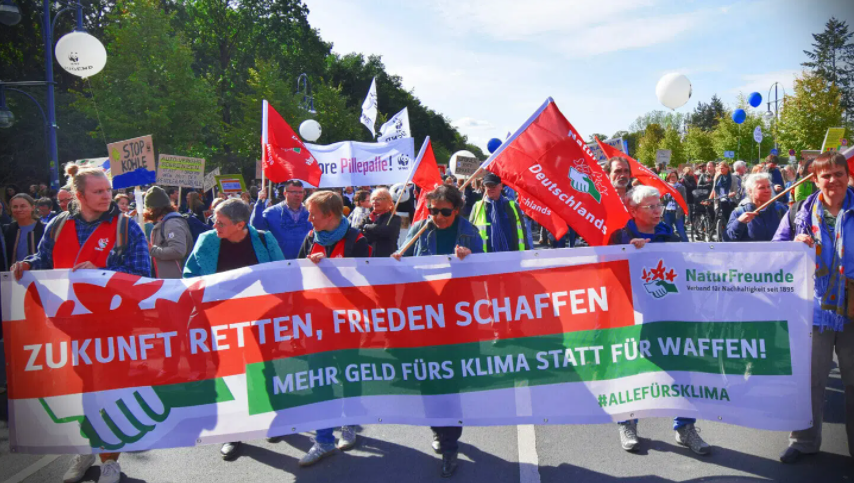
The Ukrainian resistance has relied heavily on both Western economic sanctions and Western military aid including hand-launched anti-tank and surface to air missiles without which Putin’s blitzkrieg might have been unstoppable. The economic sanctions have not just put Putin under pressure at home, but they have given the population the confidence to resist such an overwhelming force.

As the Russians have met much stronger resistance than they expected they have resorted to ever more indiscriminate, long-range bombardment of the civilian population with missiles launched from ships in the Black Sea and from Russia itself. The result of which has been a rapid escalation of civilian casualties. Putin has thousands of planes and missiles, of course, and could wipe Ukraine off the map. But whether that would be politically sustainable (or survivable for him at home) is another matter.

Russia is now a brutal kleptocracy, with Putin as the new Stalin. Anti-war demonstrators facing up to 16 years in jail and opposition politicians, who oppose war, driven into exile. Ten million people, a quarter of the population, are internally displaced and with almost five million already refugees abroad. Many thousands, mostly civilians, are dead. EU countries, to their credit, have opened their borders, suspended visa requirements, and taken in millions of people. This is in sharp contrast to Boris Johnson’s miserable Little Englander government that has been running around in circles in a (very successful) attempt to give refuge to as few people as possible.

How can the climate and anti‑war movements come together?

By Christian Zeller - Red Green Labour, March 23, 2022

Translated from the German- originally published here.

Exit from the fossil economy and rearmament, solidarity with the Ukrainian resistance

We live in a time of abrupt turns. [1]

Global warming is accelerating. The climate is changing faster than previously thought. The Russian war of aggression against Ukraine is largely aimed at the territorialconquest of a neighbouring state, the destruction of its army and the overthrow of its government. [2] This is something that has not existed in Europe in this way since 1945.

Even before this assault, the NATO countries, Russia and China started an arms race. The antagonisms between the various imperialisms intensified enormously. [3]The wave of rearmament that was already being prepared and launched before the war in Ukraine is an expression of intensifying competion for access to scarce resources that are so urgently needed in connection with the energy transition.

Global warming, this war and the danger of wars to come are interconnected and should be understood in a common context.

Another Silent Spring: Strategies for the Climate Struggle

By Paul Fleckenstein - Tempest, March 15, 2022

After the worst year yet of climate disruption, 2021 closed with another failure of international negotiations at COP26 and the slow death of President Biden’s meager legislative climate agenda.

North America faced heightened levels of drought, heat, fire, flooding, wind, climate-enhanced migration, and crop failures. Yet the climate movement’s support and campaigning for Biden and Democratic Party achieved little. Expectations are even lower for the next three years.

To respond to this impasse the climate movement, particularly the predominant organizations in the U.S., needs to reorient away from the over-emphasis on electoral politics, and toward protest and struggle as the priority strategy.

Fortunately, there are some glimpses at how to expand this potential, but the central question remains, what socialists and the Left, in general, can do now to best catalyze more disruptive, sustained, and mass-based climate action.

It's not over for COP26 as the Coalition builds for the future

By Skye Pepier - London Left Green Blog, March 12, 2022

The COP26 Coalition has continued to meet since the Glasgow Summit in November last year, and on 19th February there was a whole day of discussion about the future of the movement. The framing for the discussion was that Glasgow last year was just the start of the network’s activity, and that the work needed to build an effective climate movement on these islands should be continued and enhanced. 

There was a tremendous enthusiasm about the action and work that is being undertaken by the Coalition, despite the recognition that the COP26 summit was a failure and did not bring the action on climate change needed from our so-called world leaders. People from all corners of Britain, and the world, including the Caribbean and Africa participated in the COP26 Coalition meetings. 

Despite similar attempts of network building by Green Left, however, including its involvement of the Ecosocialist Alliance, there was a noticeable absence in the COP26 Coalition meetings, of anyone involved in Green parties, of either Scotland, or England and Wales. This doesn't necessarily mean that there weren't Green Party members present - but it was difficult to discover the presence of fellow Green Party members. 

After a brief introduction to the COP26 Coalition, there were discussions around the difference between organising and mobilising a diversity of tactics, as well as regional exercises to build up COP26 local hubs and the wider climate justice movement. 

The day then closed with an online rally for the year ahead, titled 'Movement Building & Collective Strategies', with speakers from Fridays for Future Scotland, Campaign Against Climate Change, Landworkers Alliance, as well as youth activist Aoife Mercedes Rodriguez-Uruchurtu from YouthStrike4Climate Manchester and Breathe.

Each speaker was able to say something quite different to the others, but without disagreement of any kind, which was a sign of the diversity of the COP26 Coalition movement, and arguably, also its strength. 

So, what is next for the COP26 Coalition? As the UK holds the presidency of COP26 until the start of COP27, it is still important to keep climate change on the agenda, just as it always has, but especially if we want to see continued action while the UK is in its current global position on it. There is also the matter of building towards COP27, despite it being in Egypt, where post-Arab Spring oppression has been brutal. 

Pages

The Fine Print I:

Disclaimer: The views expressed on this site are not the official position of the IWW (or even the IWW’s EUC) unless otherwise indicated and do not necessarily represent the views of anyone but the author’s, nor should it be assumed that any of these authors automatically support the IWW or endorse any of its positions.

Further: the inclusion of a link on our site (other than the link to the main IWW site) does not imply endorsement by or an alliance with the IWW. These sites have been chosen by our members due to their perceived relevance to the IWW EUC and are included here for informational purposes only. If you have any suggestions or comments on any of the links included (or not included) above, please contact us.

The Fine Print II:

Fair Use Notice: The material on this site is provided for educational and informational purposes. It may contain copyrighted material the use of which has not always been specifically authorized by the copyright owner. It is being made available in an effort to advance the understanding of scientific, environmental, economic, social justice and human rights issues etc.

It is believed that this constitutes a 'fair use' of any such copyrighted material as provided for in section 107 of the US Copyright Law. In accordance with Title 17 U.S.C. Section 107, the material on this site is distributed without profit to those who have an interest in using the included information for research and educational purposes. If you wish to use copyrighted material from this site for purposes of your own that go beyond 'fair use', you must obtain permission from the copyright owner. The information on this site does not constitute legal or technical advice.
