You are here

public transit

No Climate Justice Without Workplace Justice!

By Tahir Latif Secretary, Greener Jobs Alliance - Greener Jobs Alliance, June 23, 2022

The industrial action currently being taken by the RMT is a source of hope and inspiration for workers across the country. But it is also action aimed at a more sustainable transport system that works for people and planet. The Greener Jobs Alliance fully endorses the statement set out here, produced by the Climate Justice Coalition.

“The Climate Justice Coalition stands in solidarity with RMT members taking industrial action to protect their pay, jobs and working conditions, and the wider fight to protect a public transport system for people – social need – not private greed. Billions are being cut from our transport system at a time when we should be increasing investment to ensure a fully public, affordable, and integrated transport system. Rail is critical to decarbonising the transport sector; £27 billion for more new roads and cutting duty on domestic aviation is the wrong way round.

Our railways are already being impacted by the effects of climate change, putting additional demands on a stretched workforce providing an essential public service. This action by the Government is symptomatic of their disregard for the concerns of climate, environment and workers.

As a coalition representing groups within climate and environmental campaigns, faith, race and social justice groups, and trade unions, we call on you all to support this struggle. This includes adding our voices to resist the anti-trade union and worker narrative being driven by the Government in the mainstream media and publicise that it is their inaction and behaviour that is detrimental to people, not workers seeking justice.

Inaction on climate change is harming innocent people across the globe. Protecting the rights of workers and living standards must be a priority for the climate justice movement in fighting for a Just Transition to a zero-carbon economy.

We stand with the RMT to fight for their aims, and to campaign for a better deal for workers and a fairer, climate just, society.”

For a Living Wage and a Habitable Planet, We Need Climate Jobs Programs

By Paul Prescod - Jacobin, June 2, 2022

Climate and labor activists are coming together to hammer out ambitious but realistic plans for massively expanding the clean-energy sector in a way that also creates good union jobs. For both paychecks and the planet, it’s the only path forward.

The stalling of President Joe Biden’s “Build Back Better” agenda raises serious concerns for those looking to the federal government for strong action on climate change. Much of the more ambitious climate-related aspects of the legislation have already been gutted — and the fact that it still can’t pass a Congress with a Democratic majority is a worrying sign for the future.

But despite the dysfunction at the federal level, there are encouraging developments occurring at the state level. Increasingly, climate and labor activists are coming together to hammer out ambitious but realistic plans for massively expanding the clean-energy sector in a way that creates family-sustaining union jobs.

These state-based efforts are often facilitated by the Climate Jobs National Resource Center. States like New York, Connecticut and Maine have managed to get real buy-in from the building trades on a vision that defies the false jobs versus environment dichotomy. Recently, the Illinois legislature passed landmark climate legislation that puts the state on a path to reaching 100 percent clean energy by 2050, all with the full support of the Illinois AFL-CIO.

Rhode Island has now joined the party. Earlier this year Climate Jobs Rhode Island, a broad labor-environmental coalition, released a report titled “Building a Just Transition for a Resilient Future: A Climate Jobs Program for Rhode Island.” The report, compiled in partnership with the Worker Institute at Cornell, takes a comprehensive approach to limiting carbon emissions — containing recommendations on retrofits, public transportation, renewable energy, and climate resilience.

The Rhode Island initiative is a good model for activists in other states to consider. In addition to meaningfully addressing climate change, there’s no doubt that this program would result in the creation of tens of thousands union jobs. It points the way forward for both the climate and labor movements, which must join together in order for the working class to have any hope of a sustainable future.

Building Our New Electric Fleet

By Harold Meyerson - Resistance Committee, May 31, 2022

Today on TAP: In a signal victory last week, an activist group prevailed on a major bus manufacturer to hire its workers from local, historically disadvantaged communities.

In 1997, after a campaign of several years’ duration, the Los Angeles City Council voted to establish the nation’s first living wage ordinance. Under its terms, businesses with which the city had contracted to do its work—for which the city’s taxpayers were footing the bill—were required to pay their employees a specified, decent wage, as well as offering them a modicum of benefits.

The ordinance, and the campaign that pressured the council to enact it, were the brainstorm of Madeline Janis, the attorney who’d founded and led the Los Angeles Alliance for a New Economy (LAANE). “Taxpayers should not be subsidizing poverty-wage jobs,” Janis argued.

At roughly the same time, in tandem with another progressive community organization, LAANE also persuaded a number of local developers to sign community benefits agreements (CBAs), which obligated those developers to hire local residents—in effect, disproportionately minorities and women—on major construction projects. Previously, such projects were built by a heavily white male workforce that lived nowhere near the city’s center, even as those projects uprooted the self-same minority communities who’d lived and worked there. With the coming of CBAs, minorities began to gain much greater entry to union construction jobs that offered pay and benefits that otherwise would have remained out of reach.

Renewable Energy Materials: Supply Chain Justice

By staff - The Climate and Community Project, April 6, 2022

Sourcing materials for renewable energy, such as lithium for lithium-ion batteries, can create its own environmental justice problems. Check out this brief report from the Climate and Community Project.

The report addresses President Biden’s recent order invoking the Defense Production Act to ramp up domestic mining for “clean energy technologies,” particularly for lithium-ion batteries used to power electric vehicles and other renewable technologies.

The report points out that “mining is one of the most environmentally harmful industries, with multinational mining companies and their governmental allies subjecting communities to rights violations and outright violence.”

It outlines four policies needed to make sure the new push for renewable energy materials is just and sustainable:

  1. Reform the 1872 General Mining Law to recognize Free,
    Prior, and Informed Consent of Indigenous peoples. . . and amend to include environmental protections,
  2. Rapidly build out critical mineral recycling infrastructure.
  3. Invest in Independent and Publicly Funded Research and Development (R&D).
  4. Fund a Green New Deal for Transportation,

Download a copy of this publication here (PDF).

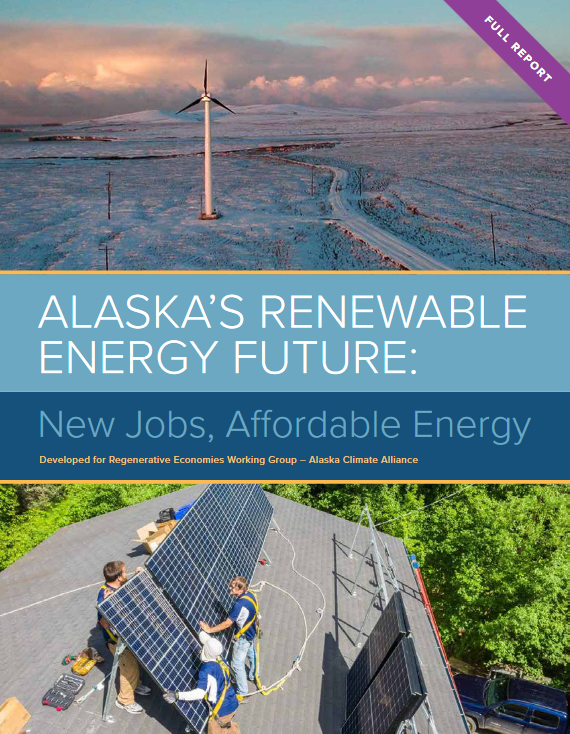
Alaska's Renewable Energy Future: New Jobs, Affordable Energy

By Kay Brown, Carly Wier, et. al. - Alaska Climate Alliance, March 21, 2022

Alaska has a vast endowment of renewable energy resources that can be tapped in its transition to a renewable energy future. Benefits of accelerating the energy transition in Alaska include more jobs, lower energy prices, higher energy security and the potential for renewable resources to support zero carbon hydrogen-based fuels for the aviation and maritime industries.

The state has already begun to develop its renewable energy resources and continues to support renewable technology development for Alaska’s challenging environment. The scale of Alaska’s vast undeveloped renewable energy resource endowment remains more than 14 times the total U.S. energy consumption.

Renewable energy technologies, including wind, solar, geothermal, and ocean and river hydrokinetic, along with complementary energy storage technologies, are continuing to exhibit declining costs which make them increasingly attractive as a primary energy source to substitute for fossil fuels in the electric sector and to support the electrification of buildings and the transformation of the transportation sector to electrification and renewable hydrogen-based fuels.

As local fossil fuel costs escalate across Alaska, from 2.5X higher in the Railbelt to as much as 4X higher in Rural Alaska (as compared to the U.S. average), renewable energy technologies are increasingly attractive investments and are poised to affordably replace legacy fossil fuel energy systems in the 2030-to-2050 time horizon while providing greater energy security, increased energy resiliency especially in rural Alaska, and broad environmental, economic and health benefits.

Independent studies have confirmed that the development of Alaska’s renewable energy potential will generate thousands of jobs – at least comparable in magnitude to the fossil fuel jobs that may be displaced by the transition to a clean renewable energy sector.

Read the report (PDF).

An alternative energy strategy to stimulate rapid transition

By Andrew Simms and Freddie Daley - Rapid Transit Alliance, March 21, 2022

All around the world, governments’ energy policies are at a crossroads. In order to insulate themselves from dependence on Russian oil and gas, tackle rising living costs and enact sanctions against Vladimir Putin, governments are collectively clamouring to diversify their energy supplies.

This will be easy for some nations, but more challenging for others. In the UK, Russian gas made up less than 4% of the total British gas supply in 2021, while in Germany just over 30% of primary energy input, across coal, oil and gas, comes from Russia. The varying degrees of dependence present both challenges and opportunities for the low carbon transition. 

The UK government is expected imminently to publish its Energy Strategy that will set out how it intends to reduce the nation’s reliance on energy imports and speed up the transition to net zero. It will be a test case for an economy still heavily hooked on fossil fuel use but with huge untapped renewable energy potential and an economic ‘levelling-up’ agenda for its regions that could benefit greatly from investment in low carbon transition.

Texas Union Activists Fight 'Microtransit' Privatization

By Joe DeManuelle-Hall - Labor Notes, March 8, 2022

When “microtransit,” the new rage in transit privatization, showed up in Denton, Texas, union activists decided to fight back.

Microtransit is a loosely defined term that combines on-demand service with flexible scheduling and routes—imagine replacing a bus system with shared Ubers. It is presented as a high-tech alternative to public transit, but in reality it’s an extension of the drive to privatize.

Some local governments around the country have already handed off operations of their public transit systems to large private operators like Keolis and MV Transportation. This move takes it one step further: dumping the buses and bus drivers altogether.

MICRO-PRIVATIZATION

Denton is a small city in the Dallas-Fort Worth metropolitan area, home to two universities. The Denton County Transportation Authority operates buses and a light rail line in Denton and two neighboring cities.

The mayor and the transit agency began exploring alternatives to the existing transit system several years ago, nominally to save money. In 2020, Dallas’s transit system adopted a microtransit pilot, contracting with Uber to provide the service. Following their lead, Denton sought out microtransit and decided to go with a company called Via, a former competitor to Uber and Lyft that got iced out of the rideshare market and rebranded itself as a microtransit company. It has since chased after cities and counties, offering to supplant their public transit systems.

And that’s exactly what Via set out to do in Denton: replace all fixed-route bus service with on-demand vehicles driven by independent contractors who are hailed by an app. Drivers operate rented vehicles that they’re responsible for. For the DCTA, this comes with the benefit of getting rid of the existing unionized workforce and the capital investment that comes with maintaining and operating a bus system.

(Video) A Climate Jobs Plan for Rhode Island

By various - ILR Worker Institute - March 4, 2022

On Friday, March 4, researchers from Cornell University joined with leaders of the Climate Jobs RI coalition, a group of labor, climate, and community groups in Rhode Island, and discussed a new report unveiled last month that outlined a comprehensive action plan to put RI on the path to becoming the first fully decarbonized state and building an equitable, pro-worker, clean energy economy.

Watch the panel here:

Shopfloor Ecosocialism: Pumping the Brakes on Fossil Fuels

By Nicole A. Murray - Partisan, March 3, 2022

How organized labor can shift us away from dominant car culture and turn the tides of climate crisis at the point of production:

Organized labor is currently faced with the most consequential question of its life: are oil and gas commodities that workers have a right to burn for their own material benefit; or should they be left in the ground?

As an ecosocialist, the answer is clear: no more burning fossil fuels. Organized labor is in the unique position to both disrupt the deep systems that perpetuate dependence on fossil fuels and the products that run on them, while also ensuring production pivots towards the greater public good over individual personal luxury.

One system ripe for disruption is car dependence. Car-centric living requires millions of gallons of fossil fuels be burned into the air, every day, just so people can participate in society. It is a structural problem that requires a large-scale, organized solution that is clear-eyed on both the source and the results of car dependency. 

The existing pattern of development in the US in our urban, suburban and peri-urban spaces reflects an intentional plan by petro-capitalists and the state to center life around the automobile. The Federal Housing Administration subsidized low-density suburban development from the 1930s through the post-war years. Ex-urban homeownership, largely enjoyed exclusively by white families, boosted demand for automobiles, consumer durables, and energy consumption, thereby absorbing overproduction from some of the biggest industries of the time: the oil and automotive industries.1 Indeed, the self-reinforcing and self-reproducing system of sprawl, cars, and gas make this system difficult to disrupt on a systemic level when the petro-capitalists are still many regions’ top employers and tax payers.

Today, car-centric systems seem fair and normal. Yet Americans collectively owe $1.37 trillion in auto loan debt — 10 times that of medical debt — to collectively burn about 350 millions gallons of finished motor gasoline into the air per day,2 dwarfing China in terms of both per capita and total gasoline use.3 Unlike in other sectors such as energy production, global emissions in road transportation are projected to grow, and grow fast.

Make no mistake: it’s the system of automobility as a whole that is unsustainable, not individual use and consumption. Even advances in efficiency, including electrification (electric vehicles) will be wiped out by more widespread adoption especially as auto manufacturers open up markets in the global south.

Maine Climate Jobs Report

By J. Mijin Cha, Hunter Moskowitz, Matt Phillips, and Lara Skinner - Maine Labor Climate Council, March 2022

This report, written in consultation with researchers at Cornell University’s Worker Institute, examines the interrelated crises of climate breakdown and inequality, and lays out an ambitious roadmap for how Maine can build a renewable energy economy, create good union jobs, and tackle racial and economic inequality.

The report’s science-based recommendations will broadly help our state achieve four goals: quickly decarbonizing Maine’s economy; ensuring that the tens of thousands of new jobs that get created as part of Maine’s energy transition adhere to high labor standards in terms of pay, benefits, training, and job security; bringing underrepresented workers into the clean-energy workforce through well-run apprentice and pre-apprentice programs; and ensuring a just transition for workers and communities most affected by these changes. 

The report sets bold objectives for building out Maine’s renewable energy economy, including:

  • Electrifying all state and local vehicles, including school and city buses, by 2040;

  • Building a high speed rail corridor from Bangor to Boston while connecting to Lewiston/Auburn;

  • Doing deep energy-efficiency retrofits and installing solar on all K-12 public schools and publicly owned buildings by 2035; and

  • Installing 3GW of renewable energy by 2030 and upgrading Maine’s energy transmission and storage capacity

Read the report (PDF).

Pages

The Fine Print I:

Disclaimer: The views expressed on this site are not the official position of the IWW (or even the IWW’s EUC) unless otherwise indicated and do not necessarily represent the views of anyone but the author’s, nor should it be assumed that any of these authors automatically support the IWW or endorse any of its positions.

Further: the inclusion of a link on our site (other than the link to the main IWW site) does not imply endorsement by or an alliance with the IWW. These sites have been chosen by our members due to their perceived relevance to the IWW EUC and are included here for informational purposes only. If you have any suggestions or comments on any of the links included (or not included) above, please contact us.

The Fine Print II:

Fair Use Notice: The material on this site is provided for educational and informational purposes. It may contain copyrighted material the use of which has not always been specifically authorized by the copyright owner. It is being made available in an effort to advance the understanding of scientific, environmental, economic, social justice and human rights issues etc.

It is believed that this constitutes a 'fair use' of any such copyrighted material as provided for in section 107 of the US Copyright Law. In accordance with Title 17 U.S.C. Section 107, the material on this site is distributed without profit to those who have an interest in using the included information for research and educational purposes. If you wish to use copyrighted material from this site for purposes of your own that go beyond 'fair use', you must obtain permission from the copyright owner. The information on this site does not constitute legal or technical advice.