You are here

California

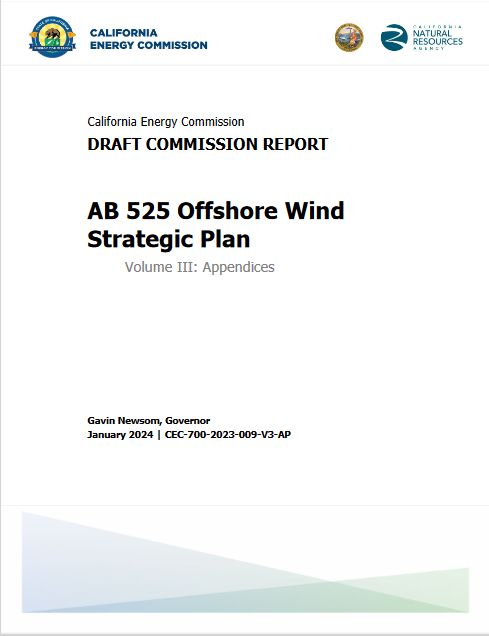
Assembly Bill 525 Offshore Wind Strategic Plan - Volume III: Appendices

By Melissa Jones, Jim Bartridge, and Lorelei Walker - California Energy Commission, January 2024

Assembly Bill 525 (AB 525, Chiu, Chapter 231, Statutes of 2021) directs the California Energy Commission (CEC) to complete and submit a strategic plan for offshore wind development in federal waters off the California coast to the Natural Resources Agency and the relevant fiscal and policy committees of the Legislature.
This strategic plan is the last of four work products the CEC is directed to prepare by AB 525. The strategic plan consists of three volumes: Volume I is an overview report, Volume II is the main report, and Volume III contains the technical appendices.

In preparing the strategic plan, the CEC coordinated with federal, state, and local agencies and a wide variety of stakeholders. As required by AB 525, this strategic plan identifies suitable sea space to accommodate the offshore wind planning goals, includes a discussion of economic and workforce development and port space and infrastructure, and assesses transmission investments, upgrades, and associated costs. In addition, this strategic plan discusses the permitting processes for offshore wind facilities and identifies potential impacts on coastal resources, fisheries, Native American and Indigenous peoples, national defense, and underserved communities. The plan also includes a discussion of strategies that could address those potential impacts such as avoidance, minimization, monitoring, mitigation, and adaptive management.

For more details, see: AB 525 Reports: Offshore Renewable Energy

Download a copy of this publication here (PDF).

Dying in the Fields as Temperatures Soar

By Liza Gross and Peter Aldhous - Inside Climate News, December 31, 2023

Scores of California farmworkers are dying in the heat in regions with chronically bad air, even in a state with one of the toughest heat standards in the nation.

For most of July 2019, stifling heat hung over the agricultural fields of California’s Central Valley, as farmworkers like William Salas Jiminez labored under the sun’s searing rays. Temperatures had dipped from 99 to 95 degrees Fahrenheit the last day of the month, when the 56-year-old Puerto Rico native was installing irrigation tubing in an almond orchard near Arvin, at the valley’s southern edge. 

Around 1:30 that afternoon Salas sat down to rest. When he stood up to go back to work, he suddenly collapsed. An hour and a half later, he was dead. Reports filed with the U.S. Department of Occupational Health and Safety, or OSHA, say Salas died of a heart attack.

Salas’ death certificate lists atherosclerotic heart disease as the immediate cause of death. But it also lists “extreme heat exposure” and obesity as significant contributors. Both heart disease and obesity increase the risk of fatal heatstroke.

Labor unions are still giving Democrats climate headaches

By Alex Nieves - Politico, December 4, 2023

One of California’s most powerful unions is not loosening its grip on oil jobs.

Despite the Biden administration and California lawmakers pouring billions of dollars into new climate-friendly industries like electric vehicles, hydrogen and building electrification, a key player in state politics is still defending fossil fuel interests that provide thousands of well-paying jobs.

President Joe Biden’s investment in clean energy sectors through a pair of massive spending bills — which promise lucrative tax credits for projects that pay union wages — was supposed to speed up the labor transition away from oil and gas. That hasn’t happened in deep-blue California, home to the country’s most ambitious climate policies — and most influential labor unions.

“We believe we’re still going to be working in the oil and gas space for the foreseeable future,” said Chris Hannan, president of the State Building and Construction Trades Council of California, which represents nearly 500,000 members across dozens of local unions, from pipefitting to electrical work.

Unions’ longstanding — and well-founded — distrust of the renewable energy industry as a reliable source of labor-friendly jobs is slowing the “just transition” that Biden, Gov. Gavin Newsom and Democratic leaders around the country have pushed.

With federal officials trying to get clean energy funding out as fast as possible ahead of the 2024 election, and California politicians cracking down on the fossil fuel industry, unions’ reluctance to relinquish fossil fuel jobs undermines Democrats’ aggressive climate targets, according to a lawmaker who serves both a union- and oil-rich area of the state.

While the union embrace of fossil fuels is unique to California — one of the few blue states with significant oil production — the struggle highlights a larger question over how states can quickly build massive amounts of clean energy infrastructure without undercutting labor.

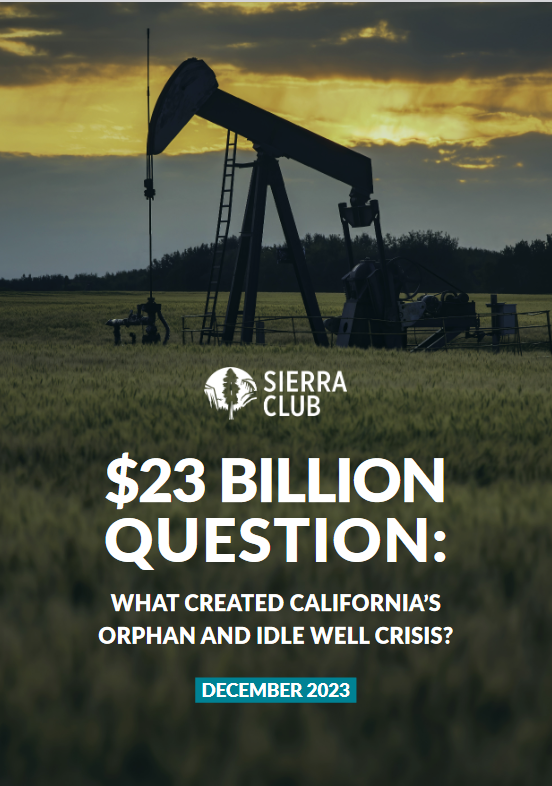
The $23 billion question: What created California’s orphan and idle well crisis and how to solve it

By staff - Sierra Club, December 2023

California is facing an urgent climate and public health crisis: 41,568 oil wells currently sit orphan or idle, leaking methane and volatile organic compounds into the air, water, and soils in our communities. These wells are overwhelmingly located in rural and predominantly Latino counties with household incomes that are far lower than the state average.

The operators of these wells frequently attempt to delay or evade responsibility for cleaning up their wells entirely, despite enjoying extreme profits from extracting California’s natural resources for almost a century. Three oil companies- Chevron, Aera Energy, and California Resources Corporation- are responsible for 68% of the state's current idle wells.

A new Sierra Club report shows that these companies have more than enough money to pay to clean up their mess, and we present policy recommendations on how the state can ensure these costs don’t fall on taxpayers. “The $23 billion question: What created California’s orphan and idle well crisis” also shows that plugging these wells can catalyze economic revitalization through the creation of tens of thousands of jobs.

California needs to hold oil companies accountable for cleaning up and capping these wells as quickly as possible. Immediate policy action is needed from the state legislature and Gov. Gavin Newsom to close industry loopholes and mandate an urgent timetable for plugging these wells.

If California fails to act, billions of our tax dollars will have to foot the bill for a mess created by hugely profitable multinational corporations, and our neighborhoods will suffer chronic, life threatening health impacts of continued inaction.

Download a copy of this publication here (PDF).

A New California Coalition of Labor Unions for Climate Jobs

By staff - Labor Network for Sustainability, December 2023

In October this year, California Labor for Climate Jobs (CLCJ) launched as a new, state-wide coalition of fourteen California labor unions with express intent to promote a worker-led transition to a just and climate-safe economy. As a coalition of unions, CLCJ is uniquely pro-worker and pro-climate, and represents teachers, oil workers, utility workers, domestic workers, healthcare workers, city, county and state employees, farmworkers, janitors, autoworkers and more. CLCJ unions include a broad array of workers who are experiencing the impact of climate change. 

“As a home childcare provider in Fairfield, I have worked through power outages, extreme heat, and hazardous smoke that endangered me and the kids I care for,” said Allison Davis, a member of United Domestic Workers. “We are calling for strong smoke and heat standards, disaster insurance and rights for workers in disaster zones so that these conditions don’t become the new normal for workers.”

Climate also impacts airport workers, for example, who clean airplane cabins between flights, toiling in tight spaces with no air conditioning, which increases their vulnerability to illness and death in extreme heat. And at the same time, oil workers face job loss as climate policies move to phase out the fossil fuel sector and shift to renewable energy. With 2023 as the hottest summer on record, the region’s first-ever National Weather Service tropical storm watch, and billions of dollars lost annually to floods and wildfires, more action is needed in Sacramento to reach the state’s climate goals and protect workers.

 This fall, CLCJ released the California Worker Climate Bill of Rights, calling on legislators to enact policy solutions that will protect workers from climate hazards such as extreme heat, fires, smoke and floods that have endangered the livelihood and health of a broad cross section of California workers. Members in the coalition have pledged to stand in solidarity with each other as they fight for a worker-led transition to be able to make a living on a healthy, living planet. 

LA Times Coverage by Sammy Roth: https://calaborforclimatejobs.org/boiling-point-can-climate-activists-and-labor-unions-find-common-ground/ 

For more on California Labor for Climate Jobs: https://calaborforclimatejobs.org/

For the California Worker Climate Bill of Rights: California Worker Climate Bill of Rights

The Green New Deal and the Politics of the Possible

Another Exciting Victory! California Selected for Regional Clean Hydrogen (H2) Hub

By Eli Lipmen - Move LA, November 30, 2023

As Californians, ARCHES will enable us to meet two major environmental priorities regarding the ARCHES proposal: abating climate change and potentially ending diesel air pollution. 

Renewable hydrogen, when used with fuel cell technologies, may be the only alternative that can do both.

Renewable green Hydrogen (H2), when used in fuel cells is a zero-emission source of power that creates the opportunity to reduce, perhaps even eliminate, the use of diesel fuel--a dangerous source of pollution that causes lung disease, heart disease, asthma, and cancer, devastating low-income communities along goods movement corridors.

Hydrogen has many applications in heavy-duty transportation--heavy-duty long-haul trucks, locomotives, airplanes, ocean-going vessels, off-road construction equipment--applications that can not easily be electrified.

Click here to learn more about OCED’s H2Hubs program and click here to read the White House’s H2Hubs press release. It is important to understand that this is the first in a multi-step process by which ARCHES can be awarded as much as $1.2 billion for the creation of a green Hydrogen Hub in California.

Move LA played a pivotal role in developing the application for this award, bringing together key allies in the Labor movement with government and nonprofit partners. The results are made clear in the White House announcement on the award to California, which is “committed to requiring Project Labor Agreements for all projects connected to the hub, which will expand opportunities for disadvantaged communities and create an expected 220,000 direct jobs—130,000 in construction jobs and 90,000 permanent jobs.”

Extreme Heat Pushes More Farmworkers to Harvest at Night, Creating New Risks

By Kristoffer Tigue - Inside Climate News , October 31, 2023

American farmworkers are increasingly at risk of heat-related illness and death as climate change drives temperatures around the world to record highs. That’s pushing more and more workers to harvest crops at night to avoid extreme heat, according to recent reports, which is creating a host of new risks that experts say need to be more thoroughly studied.

More than 2 million U.S. farmworkers, who typically toil outdoors under a hot summer sun, are exceptionally at risk of succumbing to heat-related illness, the Environmental Defense Fund warned in a July report, with heat-related mortalities 20 times higher for crop workers than in other private industries, as well as employees in local and state government. About three weeks of the summer harvest season are now expected to be too hot to safely work outdoors, the report’s authors added, and that number will only increase as global warming continues.

Government data and other studies have found that an average of 43 farmworkers die every year from heat-related illness. But top officials with the Occupational Safety and Health Administration, which oversees U.S. working conditions, say that number is significantly undercounted, largely because heat doesn’t get factored into deaths from cardiac arrests and respiratory failures. One advocacy group estimated that heat exposure could be responsible for as many as 2,000 worker fatalities in the U.S. each year.

In fact, this summer was the hottest on record for the entire northern hemisphere, federal scientists announced in September, in large part because of climate change. Parts of the Midwest and large regions of Europe are also experiencing record hot Octobers.

As the daytime heat has gone up, a growing number of agriculture workers—many of whom are Latino and undocumented—now work while it’s still dark out. But that could be trading one risk for a set of others, labor and safety advocates are warning.

Ignoring Climate Scientists and Environmental Justice Advocates, DOE Awards Billions to Fossil Fuel Hydrogen

By Abbe Ramanan - Linked In, October 30, 2023

On October 13th, the U.S. Department of Energy announced the recipients of the Regional Clean Hydrogen Hubs (“H2Hubs”) funding. H2Hubs will award up to $7 billion to seven regional hydrogen hubs around the country. Disappointingly, more than half of the money from this massive federal investment will go towards Hubs producing hydrogen from fossil fuels with carbon capture and storage (CCS), also known as blue hydrogen. This massive investment ignores major concerns cited by climate scientists, environmental justice advocates, and clean energy experts.

One major concern identified by climate scientists is especially worrying: hydrogen gas leaked into the atmosphere is an indirect greenhouse gas that extends the lifetime of methane in the atmosphere, which means hydrogen has 35 times the climate warming impacts of CO2. A massive buildout of hydrogen infrastructure at this scale, without further research into how to safely and securely transport and store hydrogen, will almost certainly lead to significant short-term warming.

Although DOE has stated that each Hub’s projected benefits played a large role in determining awards, the H2Hubs process has suffered from a lack of transparency. Prospective awardees were not required to publish their proposals publicly, so while many of the Hubs promise community benefits, how these community benefits will be generated – and how those benefits will outweigh the potential harms of each Hub – remain opaque. DOE is hosting a series of local engagement opportunities for each Hub, which will hopefully provide opportunities to cut through the hype and learn more about what these projects will mean for the communities impacted.

While we don’t know much about these Hubs, what we do know suggests that most of these projects will do more harm than good:

Unions Launch California Worker Climate Bill of Rights

By Web Admin - Sunflower Alliance, October 25, 2023

California Labor for Climate Jobs (CLCJ), a coalition of California unions, has released its state policy platform, the California Worker Climate Bill of Rights, calling on the state to support a “worker-led transition to a just and climate-safe economy.”

The bill of rights calls for:

  • Protections from climate hazards
  • Safety nets for impacted workers and communities
  • Good jobs in the low-carbon economy
  • A strong public sector — adaptive services for all.

Their vision also includes:

  • Universal health care/the caring economy
  • Reliable and accessible public transportation
  • Expanded public education and job training.

Pages

The Fine Print I:

Disclaimer: The views expressed on this site are not the official position of the IWW (or even the IWW’s EUC) unless otherwise indicated and do not necessarily represent the views of anyone but the author’s, nor should it be assumed that any of these authors automatically support the IWW or endorse any of its positions.

Further: the inclusion of a link on our site (other than the link to the main IWW site) does not imply endorsement by or an alliance with the IWW. These sites have been chosen by our members due to their perceived relevance to the IWW EUC and are included here for informational purposes only. If you have any suggestions or comments on any of the links included (or not included) above, please contact us.

The Fine Print II:

Fair Use Notice: The material on this site is provided for educational and informational purposes. It may contain copyrighted material the use of which has not always been specifically authorized by the copyright owner. It is being made available in an effort to advance the understanding of scientific, environmental, economic, social justice and human rights issues etc.

It is believed that this constitutes a 'fair use' of any such copyrighted material as provided for in section 107 of the US Copyright Law. In accordance with Title 17 U.S.C. Section 107, the material on this site is distributed without profit to those who have an interest in using the included information for research and educational purposes. If you wish to use copyrighted material from this site for purposes of your own that go beyond 'fair use', you must obtain permission from the copyright owner. The information on this site does not constitute legal or technical advice.