You are here

System Change not Climate Change (SCnCC)

Bay Area IWW Environmental Unionism Caucus: Three Years and Going Strong

By x344543 - IWW Environmental Unionism Caucus, May 3, 2016; image by Jon Flanders.

The Bay Area IWW Environmental Unionism Caucus was cofounded in February 2013 by three members of the Bay Area IWW General Membership Branch. The group also helped launch the IWW EUC proper shortly after that.

The Bay Area IWW EUC quickly launched ecology.iww.org as well as the EUC social media presence on Facebook & Twitter.

Initially, the group joined in anti-Keystone X-L protests in the Spring of 2013, but also played a minor role in helping organize a labor contingent at the August 6, 2013 "Summer Heat" protest against Chevron in Richmond, CA (on the one year anniversary of the refinery fire which injured several union workers and sent 15,000 residents to the hospital seeking medical care).

Following that event, members of the Bay Area EUC helped launch the Richmond based Sunflower Alliance with several other local working class climate justice and frontline community activists. That group focuses primarily on climate & environmental justice campaigns in the Contra Costa County (northeast Bay Area) refinery corridor, which is one of the most industrial communities in all of California. That group--thanks in part to the presence of IWW members (but also do to the contributions of others) remains very class conscious and continually reaches out to the workers in the fossil fuel projects that it targets, with some degree of success.

Likewise, the Bay Area EUC also helped found and remains active in the Bay Area chapter of System Change not Climate Change (SCnCC). Thanks to open and friendly dialog, that group which is predominantly Eco-socialist is still inclusive of and welcoming to green-syndicalists and remains nonsectarian and inclusive. That group has organized several climate justice marches and rallies (with the help of others) which have included substantial rank & file Union member participation.

In February 2015, the Bay Area EUC, along with the aforementioned groups, Communities for a Better Environment, Movement Generation, the California Nurses Association, and the local chapter of the Sierra Club organized community support for striking refinery workers at the Tesoro refinery in Avon, CA (near Martinez) in Contra Costa County. There was a substantial "green" solidarity presence on the picket lines due to these efforts.

While this was happening, Bay Area IWW EUC members, along with Railroad Workers United, 350, the Sunflower Alliance, and SCnCC helped organize three "Railroad Workers Safety Conferences" that included railroad workers, striking refinery workers, and climate justice activists dialoging on common issues. The conferences were held in Richmond, Olympia, and the Great Lakes region, and were very successful. The website railroadconference.org has the information. More conferences may follow.

Since the conclusion of the railroad conferences, members of the Bay Area EUC have been involved in the "No Coal in Oakland" campaign, which seeks to prevent coal from being exported from a new bulk exports terminal being developed in Oakland by anti-Occupy capitalist, Phil Tagami (that group doesn't oppose the terminal or export of other (non fossil fuel) commodities; just coal). That group has a very strong union member participation, and has managed to get 21 unions (including four ILWU locals, the SEIU port workers local, and Bay Area IWW) to oppose coal exports. These efforts led to the Alameda County AFL-CIO CLC passing a resolution against coal exports (in the face of Teamsters and Building Trades support for coal exports) and the subsequent creation of a "green caucus" of the CLC.

The Bay Area EUC has also participated in conferences organized by the group "Bay Localize" that seek to have unions and clean power advocates work together on Community Choice Aggregation campaigns that challenge the dominance of capitalist investor owned utilities (primarily PG&E).

Bay Area EUC members have also participated in campaigns to save Knowland Park (in the southeast Oakland hills) from creeping privatization); to prevent the eviction of a homeless encampment at the Albany Bulb on the east bay shore; and in the "Occupy the Farm" campaign in the Gill Tract of Albany (northwest of Berkeley).

With the support of Bay Area EUC members, Railroad Workers United passed a resolution on "Just Transition"; those same members are hoping to get the ILWU to pass a similar resolution.

Finally, our group has participated in or organized several showings of Darryl Cherney's film, "Who Bombed Judi Bari?"

Most of these groups, campaigns, and efforts have been well covered on ecology.iww.org.

Toward Democratic Eco-socialism as the Next World System

By Hans Baer - The Next System Project, April 28, 2016

This essay is guided by two imperatives: (1) how do we live in harmony with each other on a fragile planet of limited resources, which have become unevenly distributed; and (2) how do we live in harmony with nature, particularly as humanity lurches forward into an era of potentially catastrophic, anthropogenic climate change that to a large degree is a by-product of the capitalist world system. Social systems, whether they exist at the local, regional, or global levels, do not last forever. Capitalism, as a globalizing political economic system committed to profit making and continual economic growth, has created a treadmill of production and consumption that is heavily dependent upon fossil fuels and has resulted in greenhouse gas emissions that drive climate change.

While capitalism has produced numerous impressive technological innovations, some beneficial and others destructive, which are very unevenly distributed, it is a system fraught with numerous contradictions, including: growing social disparities within most nation-states, authoritarian and militarist practices, depletion of natural resources, environmental degradation, including global warming and associated climatic changes, species extinction, and population growth as a by-product of poverty. Even more so than in earlier stages of capitalism, transnational corporations and their associated bodies, such as the World Bank, the International Monetary Fund, and the World Trade Organization, make or break governments and politicians around the world, although the extent to which this is true varies from country to country. Although capitalism has been around for about 500 years, it manifests so many contradictions that it has become increasingly clear that it must be replaced by a “next system” or an alternative world system—one oriented toward social parity and justice, democratic processes, and environmental sustainability, which includes a safe climate.

Read the report (PDF).

Communities Unite to Fight Coal in Oakland

By Eric K. Arnold - Reimagine, March 2016

Coal, once the staple of American industrial production, may be on its last legs. With domestic production showing a long-term decline, the fossil fuel’s days appear to be numbered.

According to the most recent annual report [1] of the U.S. Energy Information Administration (EIA), in 2013, U.S. coal production fell below two billion short tons for the first time in two decades; coal mining capacity decreased, as did the average number of coal mine employees, the average sales price of coal, and total U.S. coal stocks. In April of 2015, the EIA projected coal would hit a 28-year low, reflecting significant drops in domestic demand and exports. In August, Goldman Sachs divested itself of its coal holdings; a month later, it issued a gloomy forecast[2] for coal’s future, stating, “the industry does not require new investment,” dashing hopes for a miraculous upturn in the coal market. A report[3] by the Carbon Tracker Initiative (CTI) noted that 26 domestic coal companies have recently gone into bankruptcy proceedings; and coal’s value on the Dow Jones index dropped by 76 percent between 2009-14 (a period when the overall Dow index went up 69 percent).

According to CTI, domestic energy generation has remained flat for the past decade but energy sources have shifted: coal and oil are down, but natural gas and renewable energy are up. America’s largest coal producers are recording annual losses in the billions of dollars, while Chinese coal demand has slumped and new environmental regulations[4] aimed at significantly reducing air pollution and increasing wind and solar consumption are being phased in by the Chinese government. Additionally, all federal coal leasing is currently under moratorium until a comprehensive review can be completed. As the Natural Resources Defense Council (NRDC) noted[5] in its online magazine, OnEarth, “it would be difficult to overstate the industry’s current distress.”

This is scary news for the coal industry, yet a welcome announcement for environmentalists who have waged national campaigns against coal for decades. These desperate times for coal producers have led to desperate measures. Their last hope, it would seem, is to increase coal’s export capacity by transporting the black gunk through West Coast ports. But even there the pro-coal forces have met with unexpected resistance, as city after city in Oregon and Washington have mounted grassroots campaigns to deliver an emphatic message: “Say no to coal.”

A few thoughts on studying the most radical social movement of the 21st century

By John Foran - Resilience, March 14, 2016

Introduction

We are living through an unprecedented crisis, in a world beset by massive social problems – the obscene poverty and inequality that neoliberal capitalist globalization has wreaked on at least two-thirds of humanity, the immobility of the political elite almost everywhere, and cultures of violence that poison our lives from the most intimate relations to the mass murder of the world’s wars.

These interconnected problems are rooted in long-standing processes of inequality – patriarchy, racism, colonialism, capitalism, and now corporate-controlled globalization – whose ongoing, overlapping legacies are making the early twenty-first century a crucial hinge of history.

And now, with climate change, we are facing a perfect storm of suffering. In fact, given the timeline that climate science is screaming at us, we confront a crisis of humanity and of all species that must be resolved for better or worse by those living on this precarious planet today.  We are called by the urgency of the crisis to “change everything” as Naomi Klein puts it, and to do so in something like the next two decades.

With other observers, activists, and scholars I believe that only the assembling of the broadest, most powerful social movement the world has ever seen has a chance of doing this in the narrow window the science imposes on us. The movements for environmental, climate, and social justice that I have spent my life studying and now participate in must become much stronger than at present.  But my reading of world history leads me to believe that they can succeed.  They must, if we are to safely navigate the present crisis and even come out of it living in ways that are far more egalitarian, deeply democratic, and fulfilling than the world we presently inhabit.

Those of us who are academics (or journalists, or writers and creators of culture of every kind) need to focus our minds now, I think, on the “wicked” problem of climate change, to reinvigorate our own disciplines and work on our interdisciplinary skills (another way of saying learning how to connect the dots) and bring all this into a wide open dialogue, in ways that are consistent with the first principle of sociology, of ecology, of systems thinking, and, ironically enough, of Buddhism, as I understand it (and of Gaia theory, for that matter):  everything is connected.

How Strong is the Climate Justice Movement?

The movement I study and am part of is growing, getting bigger, stronger, smarter, more diverse, and more creative with every passing year – and that’s important.

But it’s still not enough.

The task – and the question on every scholar-activist’s mind – is how do we get from where we are to where we need to be?  And how do we do that thoughtfully, quickly, and for the long haul?

If I had to try to sum up the broad outlines of what the climate justice movement is planning going into 2016, it would be something like Resist, Rethink, Retool, Re-imagine…

Towards Workers' Climate Action

By Traven Leyshon - Solidarity, March 2016

Workers and Trade Unions for Climate Solidarity:
Tackling climate change in a neoliberal world
By Paul Hampton
Rutledge, 2015, 211 pages, $54.95 kindle.

For Workers’ Climate Action:
Climate Change and Working-Class Struggle
By Paul Hampton
http://tinyurl.com/hl86nm4, 54 pages, £4.

[The workers had] “done more for the future of green energy and green jobs in the UK in two weeks than the government has done in 12 years.” — National Union of Rail, Maritime and Transport Workers President Bob Crow speaking of the Vestas factory occupation.
“The myth that the environment movement is the preserve of the do-gooding middle class must be exploded. It is, in fact, the workers who are most affected by the deterioration of the environment and it is therefore up to the trade union movement to give it a higher priority to fighting to improve it.” — Builders’ Labourers Federation Secretary Jack Mundey.

“The AFL-CIO Executive Council therefore calls upon the President to refrain from signing the proposed Kyoto Protocol to the U.N. Framework Convention on Climate Change.” — AFL-CIO Executive Council statement, January 30, 1998.

IN THE FACE of capital’s ecocidal embrace of extreme energy, unprecedented numbers of people are mobilizing in climate marches, bravely engaging in direct actions to stop the expansion of fracked gas pipelines. There is also a growing anticapitalist, climate justice wing, including an ecosocialist current.

While workers are participating in these “inter-classist” protests, we are told that “they do not participate as workers, with a consciousness of their specific role…the working class is now in the rearguard of the struggle over the climate, while peasants and indigenous peoples are in the front line with anticapitalist demands.” (Daniel Tanuro, Confronting the Ecological Emergency, http://www.solidarity-us.org/node/4521)

Paul Hampton, a trade union researcher in Britain, addresses these issues offering a Marxist perspective on the potential role of the working class in climate politics, as well as the tasks of revolutionaries, in this pamphlet and book (which originated as a PhD thesis on climate change and employment relations).

In his introduction Paul poses key questions for climate politics:

“Whether workers organized in trade unions possess the interest and power to tackle dangerous climate change, and whether unionised workers can become strategic climate actors.”

“Whether trade unionism in the twenty-first century can succeed in reinventing itself as a social movement capable of tackling climate change.”

Workers and Trade Unions for Climate Solidarity focuses primarily on the interrelation of climate and class politics; on union climate debates, policies and practices worldwide and in the United Kingdom; on UK workplace green reps; and on the 2009 Vestas occupation, in which workers at a wind turbine factory occupied the workplace to try to stop closure.

Nothing to do, nowhere to go, nothing to say: How the broad climate movement has failed us

By James Jordan - Links, January 13, 2016

Image: Activists deliver the Our Power Plan to the EPA’s regional office in San Francisco on January 19, 2016 (Facebook/CEJA)
It has been a month since the UN climate summit in Paris, aka COP 21. One might expect the kind of ebb and flow we often see in popular movements. Interest in climate issues, the cause of the day during the summit, might be expected to wane and move to the back burner of public discourse until such time as another development pushes it forward again.

However, climate change is fundamentally different. It is going to get worse — we will be getting slapped in the face with this one for a long, long time, even under the best scenarios. Only a few weeks after COP 21, the world experienced a wave of floods and extreme weather exacerbated by global warming. In the US, there were record-setting floods along the Mississippi River. In South America, floods caused the evacuation of 180,000 persons. In Scotland, floods cut across class lines to threaten a historic castle neighboring the Queen's Balmoral residence, its foundation being eaten away by the swollen Dee river. Meanwhile, oil wars and drought continue to drive an immigration crisis in Syria and throughout the Middle East and Northern Africa. The issue of climate is not the “struggle du jour” - it is going to be the main course for quite a while.

Shamefully, the broad, “mainstream” climate movement in the so-called “developed” world is woefully inadequate to address this concern. It is not producing the kind of real life strategies, analysis and resistance that current conditions call for. Right now, the dominant character of this movement is actually holding us back, not pushing us forward. It is a movement that trumpets ambiguous desires for sustainability, but is all too silent when it comes to meaningful demands.

What we got from COP 21 was an accord that set inadequate and unenforceable carbon emissions limits; failed to guarantee reparations or support for the poorest, most exploited nations to develop alternative technologies; adopted market-based schemes that entrench international inequality; ignored the demands of indigenous peoples; and refused to address the huge and negative climate impact of US militarism and resource wars. Of course, no one expected such measures to be passed, so it might be justly claimed as a victory that any kind of agreement or protocol was passed at all. As has been noted, had the agreement been enforceable, the Republican-dominated US Congress would have quashed that government's participation. But what victory there has been is a Pyrrhic one.

The good news from Paris was those groups that defied the ban on public marches and protests instated following the November 13 terrorist attacks. There were some 200 protesters arrested on November 29, the opening day of the summit, when they broke ranks with officially-tolerated activities and took to the streets, despite authorities having “preventatively” detained a number of activists before the summit began. There was also the December 6 flotilla of indigenous peoples protesting the exclusion of indigenous rights from the accord minus a brief mention in the preamble. The flotilla exposed the machinations of the US, European Union, Australia and others to exempt indigenous rights from the body of the agreement. It was refreshing to hear of these and others who refused to cooperate with this gag rule.

Around the world people are getting radicalized and making bold efforts to save this biosphere we know and love. In the US, Flood the System called for and carried out multiple climate justice actions. The Global Climate Convergence is continuing its work to build a Peoples Climate Strike. Groups like the Indigenous Environmental Network and Climate Justice Alliance are confronting the legacy of colonialism and its damage to land and water. Fossil Fuel Student Divestment Network is organizing to divest universities from the oil and coal companies. Still, the reality is that the broad climate movement in the “developed”world has mostly been a failure and an obstacle to building an effective and truly relevant movement.

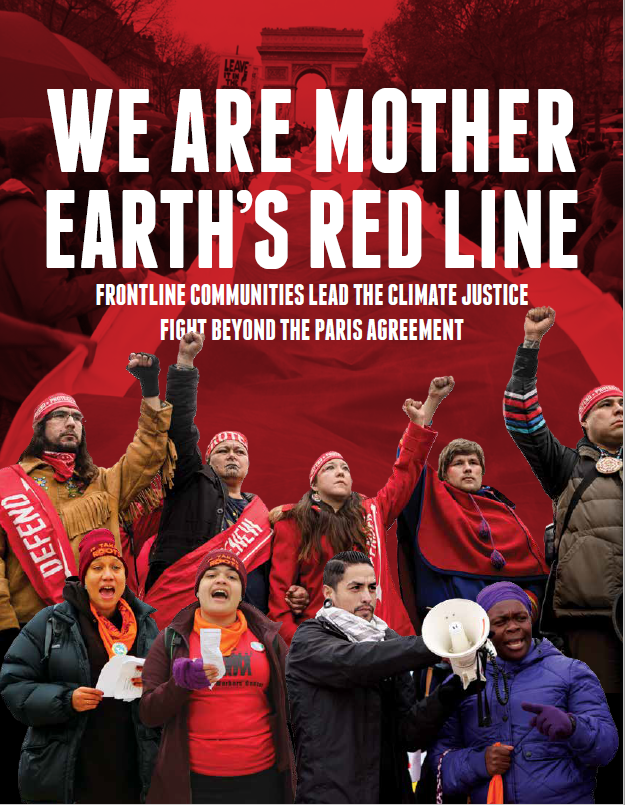
We Are Mother Earth’s Red Line: Frontline Communities Lead the Climate Justice Fight Beyond the Paris Agreement

By staff - It Takes Roots to Weather the Storm - January 2016

The Paris Climate Agreement of December 2015 is a dangerous distraction that threatens all of us. Marked by the heavy influence of the fossil fuel industry, the deal reached at the United Nations Framework Convention on Climate Change (UNFCCC) never mentions the need to curb extractive energy, and sets goals far below those needed to avert a global catastrophe. The agreement signed by 196 countries does acknowledge the global urgency of the climate crisis, and reflects the strength of the climate movement. But the accord ignores the roots of the crisis, and the very people who have the experience and determination to solve it.

Around the world, negotiators use the term “red line” to signify a figurative point of no return or a limit past which safety can no longer be guaranteed. Our communities, whose very survival is most directly impacted by climate change, have become a living red line. We have been facing the reality of the climate crisis for decades. Our air and water are being poisoned by fossil fuel extraction, our livelihoods are threatened by floods and drought, our communities are the hardest hit and the least protected in extreme weather events—and our demands for our survival and for the rights of future generations are pushing local, national, and global leaders towards real solutions to the climate crisis.

We brought these demands to the UNFCCC 21st Conference of Parties (COP21) as members of the delegation called “It Takes Roots to Weather the Storm.” Grassroots Global Justice Alliance (GGJ), the Indigenous Environmental Network (IEN), and the Climate Justice Alliance (CJA) organized the delegation, which included leaders and organizers from more than 100 US and Canadian grassroots and Indigenous groups. We helped to mobilize the thousands of people who took to the streets of Paris during the COP21, despite a ban on public protest—and amplified the pressure that Indigenous Peoples, civil society, and grassroots movements have built throughout the 21 years of UN climate talks.

The Paris Agreement coming out of the COP21 allows emissions from fossil fuels to continue at levels that endanger life on the planet, demonstrating just how strongly world leaders are tied to the fossil fuel industry and policies of economic globalization. The emphasis within the UNFCCC process on the strategies of carbon markets consisting of offsets and pollution trading created an atmosphere within the COP21 of business more than regulation. The result is a Paris Agreement that lets developed countries continue to emit dangerously high levels of greenhouse gasses; relies on imaginary technofixes and pollution cap-and-trade schemes that allow big polluters to continue polluting at the source, and results in land grabs and violations of human rights and the rights of Indigenous Peoples. Our analysis of the Paris Agreement echoes critiques from social movements around the world, led by those most impacted by both climate disruption and the false promises that governments and corporate interests promote in its wake.

“Frontline communities” are the peoples living directly alongside fossil-fuel pollution and extraction—overwhelmingly Indigenous Peoples, Black, Latino, Asian and Pacific Islander peoples in working class, poor, and peasant communities in the US and around the world. In climate disruption and extreme weather events, we are hit first and worst.

We are Mother Earth’s red line. We don’t have the luxury of settling for industry or politicians’ hype or half measures. We know it takes roots to weather the storm and that’s why we are building a people’s climate movement rooted in our communities. We are the frontlines of the solution: keeping fossil fuels in the ground and transforming the economy with innovative, community-led solutions.

Solidarity is the new I love you

By Dano T Bob - IWW Environmental Unionism Caucus, December 15, 2015

Hey Kentucky, I’ve got good news for ya! The death of coal companies has been largely exaggerated, it turns out your coal companies are fine, they are just busy destroying Utah and Oakland now. Oh, and New Mexico and Colorado, too, just as they have destroyed the health and environment of Appalachia for decades. Now, after destroying Kentucky’s economy and abandoning communities via a vanishing act, and leaving that mess behind, we’ve figured out where they are and what they are up to, well at least one of them.

Bowie Resource Partners, a decidedly non union company, based in Louisville, Kentucky, has recently popped up in Oakland, California, with a plan to ship in their Utah coal via rail through working class communities of color in West Oakland to a proposed coal export terminal to be built for shipping coal to China, India, etc. Far from going out business, Bowie is currently expanding and buying new mines out west, while coal field communities in Appalachia are suffering devastating economic times.

I’ve previously blogged about this for OVEC back during the last Oakland City Council hearing, which was jam packed with hundreds of residents waiting hours to speak. It turns out that hot button environmental justice issues will do that. Yeah, it turns out that the health and environmental impacts of breathing toxic coal dust has a lot of West Oaklanders pretty damn pissed off. These same communities fighting against police violence to let the world know that #blacklivesmatter, now need to tell Bowie Natural Resource to respect black lives, black health and black neighborhoods as well. West Oakland was the birthplace of the Black Panther party, afterall.

Louisville, Kentucky, with the largest black population in the state, with many historically living in West Louisville, is no stranger to environmental injustice as well. The West End is not only home to most of the environmental hotspots in the city, there is also currently “a campaign to block recycling food waste into methane at a facility in western Louisville.” So, black lives are being disrespected in a lot of the same ways by similar corporate assholes from Louisville all the way to Oakland, and this has to stop.

'Cowspiracy" or capitalism: what's causing the climate crisis?

By Dr J - Your Heart's on the Left, December 11, 2015

Cowspiracy shines a light on the carbon emissions of the animal agriculture industry, but its beam is so narrow that it leaves the rest of agriculture and the economy hidden from view, and elevates dietary choice to political strategy.

Like many people, Kip Anderson watched Al Gore’s An Inconvenient Truth and was frustrated by the limited lifestyle choices to stop climate change—like bike riding more often or using less water. He then found out that animal agriculture is responsible for significant emissions and is backed by major powers but is not the focus of many environmental NGOs. He then made a choice.

He could have made a film connecting animal agriculture to the rest of the oil economy, exposing the massive corporations who dominate the food supply and who have warped our relationships with animals. He could have called for vegans and non-vegans to unite, supporting front-line communities who bear the brunt of climate change, and integrating vegan concerns into a movement for system change and real control over food production and distribution.

But instead he chose to make a film that counterposes animal agriculture to the rest of the oil-dependent economy, dismisses the challenge to tar sands and fracking and the need for climate jobs, blames cows and those who consume animal products, shames environmental NGOs instead of agribusinesses, ignores traditional knowledge about how to live sustainably with animals, and calls non-vegan environmentalists hypocrites—while preaching veganism as the panacea for everything from climate change to world hunger.

The result: protesters inspired by his film denounced the recent People’s Climate March in Edmonton: “The organizers only wanted to focus on oil and gas, the safe climate topics and not ‘switch focus’ to address personal behaviors that can actually make difference.” There would not be a People’s Climate March and a climate justice movement were it not for Indigenous communities who have challenged tar sands and fracking, while defending their rights including hunting, fishing and trapping. It’s ridiculous to dismiss as “safe topics” the challenge to these powerful industries, and to blame diets that communities have followed sustainably for millenia. How do we place industrialized animal agriculture in its proper context so that the concerns of vegans can integrate with the climate justice movement?

What kind of "just transition"?

By Michael Ware - Socialist Worker, December 1, 2015

The climate justice movement knows what it is against, but what are we fighting for? Michael Ware, of System Change Not Climate Change, has some answers:

EVERYONE BUT a few Republican crackpots now acknowledge that the planet faces a climate emergency. But the bosses at ExxonMobil had a bit of a head start.

A company memo was unearthed this year showing that the oil giant knew since 1977 from its own scientists that burning fossil fuels contributed to global warming. But the findings were hidden, and Exxon continued to be climate change deniers for decades to come.

This revelation speaks volumes about how short-term profits trump everything under capitalism, even human survival. Exxon's research pointed toward what we are living through today: increased temperatures globally, drought, mass flooding, more intense hurricanes, crop failures, extinctions, melting polar regions, rising sea levels, ocean acidification, water scarcity, and on and on.

Already, climate change causes 300,000 to 400,000 deaths per year, mostly in the Global South, according to a study conducted on behalf of the UN several years ago.

In order to keep the increase in global temperatures under 1.5 degrees Celsius by mid-century and avoid catastrophic environmental changes, greenhouse gas emissions must be reduced by 5-10 percent each year. Already, the global temperature increase has been almost 1 degree Celsius.

The emergence of a green capitalism sector, increased energy efficiencies and limited expansion of renewable energy have done little to bring down the estimates of average temperature increases. Without a radical change of course, the increase will be between 4 and 6 degrees Celsius by the end of the century.

Clearly, just educating politicians and business leaders about the threat isn't enough. We need movements and protests strong enough to force big changes in the way humans produce and consume energy.

The urgency around halting climate change creates a unique political dynamic. The need for social change is always urgently felt by the oppressed, but for the first time, we have an environmental timer showing that the huge task of transitioning to a sustainable world must take place in this century, or humanity will face the consequences of an inhospitable planet.

Fighting for this kind of change will necessarily threaten capitalism. Yet it's hard for most people to envision a world without corporations, car culture, oil wars, oppression and a market for everything, including pollution.

Pages

The Fine Print I:

Disclaimer: The views expressed on this site are not the official position of the IWW (or even the IWW’s EUC) unless otherwise indicated and do not necessarily represent the views of anyone but the author’s, nor should it be assumed that any of these authors automatically support the IWW or endorse any of its positions.

Further: the inclusion of a link on our site (other than the link to the main IWW site) does not imply endorsement by or an alliance with the IWW. These sites have been chosen by our members due to their perceived relevance to the IWW EUC and are included here for informational purposes only. If you have any suggestions or comments on any of the links included (or not included) above, please contact us.

The Fine Print II:

Fair Use Notice: The material on this site is provided for educational and informational purposes. It may contain copyrighted material the use of which has not always been specifically authorized by the copyright owner. It is being made available in an effort to advance the understanding of scientific, environmental, economic, social justice and human rights issues etc.

It is believed that this constitutes a 'fair use' of any such copyrighted material as provided for in section 107 of the US Copyright Law. In accordance with Title 17 U.S.C. Section 107, the material on this site is distributed without profit to those who have an interest in using the included information for research and educational purposes. If you wish to use copyrighted material from this site for purposes of your own that go beyond 'fair use', you must obtain permission from the copyright owner. The information on this site does not constitute legal or technical advice.