You are here

Oil Chemical and Atomic Workers (OCAW)

Beyond Fossil Fuels: Planning a Just Transition for Alaska's Economy

By John Talberth, Ph.D. and Daphne Wysham - Center for Sustainable Economy, October 2017

Of the 50 United States, Alaska best exemplifies the types of problems the rest of the country may well face in a matter of decades, if not years, if we don’t wean ourselves from fossil fuels. The U.S. is in the middle of an oil and gas production boom, one that has caused oil and gas prices to plummet, with devastating consequences for Alaska, a state that has grown dependent on revenue from the oil and gas industry for its public funds.

However, if one only looked at the prominent outlines of the boom-and-bust, oil and gas economy in Alaska, one would miss a subtler shift happening on a much smaller scale: A more sustainable, self-reliant economy is beginning to take shape in remote villages and towns throughout the state.

While this sustainable economy is beginning to take root, it needs special care. In a report, commissioned by Greenpeace USA, entitled “Beyond Fossil Fuels: Planning a Just Transition for Alaska’s Economy,” CSE’s John Talberth and Daphne Wysham write that this nascent economy in Alaska shows great promise but will require investments in the following key sectors if it is to thrive:

  • human capital—particularly in computer literacy in rural areas;
  • sustainable energy, including wind, wave, tidal and solar energy;
  • greater local self-reliance in food including produce, which currently is imported at great cost, and fisheries, which is often exported for processing, and manufacturing;
  • the clean-up of fossil fuel infrastructure, including abandoned infrastructure sites;
  • the protection of ecosystems;
  • tourism led and controlled by Alaska Native communities;
  • and sustainable fisheries.

But investment in these key building blocks is only the first step. Also needed are policy changes at the state and federal level that would remove subsidies for the fossil fuel industry, begin to internalize the price of pollution, and make federal funds available that are currently out of reach for many Alaska Natives.

Read the report (PDF).

Victory Over the Sun

By Connor Kilpatrick  - Jacobin, August 2017

The greatest environmentalist of postwar America wasn’t a scientist or a wonk. He didn’t even finish high school.

Brooklyn native Tony Mazzocchi, who passed away in 2002, isn’t a household name — yet. But when a future socialist society on the other side of the climate crisis goes looking for statues to build and parks to name, he will be at the top of the list.

Today, the AFL-CIO lobbies Congress to pass the Keystone XL pipeline while noted NASA climate scientist James Hansen, one of the first to link global warming to fossil fuels, is repeatedly arrested for protesting such projects. And while in 2017, the idea that the interests between wonky environmentalists and jobs-focused trade unionists would diverge seems like common sense, it’s only because the bad guys won.

But it wasn’t a preordained victory. For nearly a decade in the 1960s and ’70s, environmentalism seemed to be on the cusp of a popular reckoning against the powers of capital. And it found an ally in the labor movement which, for a few years, looked like it might be able to not only cling to life but find a way back into the heart of American society.

Mazzocchi and his union, the Oil, Chemical and Atomic Workers International (OCAW), were the primary muscle behind the 1970 Occupational Safety and Health Act (OSHA), signed into law by Richard Nixon. Looking back on that victory, which mobilized both labor and the burgeoning environmental movement, Mazzocchi said: “We have demonstrated that an unpopular idea can be generated into a powerful political program that’ll reignite the consciousness of the American people.”

When the postwar boom was fizzling out, Mazzocchi — one of the few officials in the labor movement who bought into neither Cold War anticommunism nor business unionism — wanted to push harder: “workers should be ready to learn about the problems of capitalism.” And in the last decades of his life, Mazzocchi cofounded the Labor Party — whose 1996 convention saw Jeremy Corbyn taking the stage in Cleveland to declare it “one of the most hopeful and inspiring events I’ve been to in very many years.” Much like Sanders, Mazzocchi was a survivor of decades of left retreat — a Brooklyn Red from another era who, somehow, managed to stay fighting so that when the Left was ready, he was there. And with the appearance of the environmental movement, Mazzocchi saw an opening.

Well, if You Ask Me: Oil and Me

By Dano T Bob - IWW Environmental Unionism Caucus, January 14, 2016

So, a large part of my life has revolved around oil refineries.

I was born in Jeffersonville, Indiana, a suburb of Louisville , Kentucky in 1981. My father worked for Ashland Oil (now Marathon Oil) in their Louisville Refinery. This refinery was shut down in 1983, and my dad accepted a transfer to Ashland Oil’s main operation in Catlettsburg, Kentucky, where my family moved when I was 2 years old. Many other workers from Louisville, and from another shuttered refinery in Buffalo, New York were also relocated to the Ashland Oil refinery there.

So, my entire childhood, youth, life, etc. were directly affected by the flux of the industrial economy, one that is now dying or dead in most of the U.S., offshored to other places for higher profits and lax regulation. And as my life was affected by this move, I learned many things from this refinery, which still touches me in various ways.

The refinery is why I grew up in Appalachian, Kentucky, never knowing another place until traveling and moving around years later. Hell, the high school I went to was named after former Ashland Oil executive Paul G. Blazer, know for his pioneering work to seek federal subsidies for the domestic oil industry in the U.S. (ugh, I know, right?) This refinery paid for most everything in my life (my mother worked as well, but for minimal wages), clothes, school, cars, what have you. This refinery not only influenced me economically in a personal way, but it controlled the economy of the whole town and region, sponsoring events and filling city coffers with tax revenue and the like. When it was bought out in 1998 by Marathon Oil from Ohio, and the corporate office in Ashland closed and jobs were slashed, this decimated the area in a way that it has never recovered from. The NAFTA years, which also resulted in what has led to near death blows for the steel industry around Ashland as well, were not kind to the Appalachia Rust Belt on the Ohio River. People left, capital left, towns shrank in half, infrastructure crumbed and drugs arrived. For a good read about these years in Appalachia and how folks fought back, I highly recommend the book, “To Move a Mountain:Fighting the Global Economy in Appalachia.”

As industry fled, its residual pollution and the consequences remained. This refinery also not only affected my health and my families, but the health of the whole region, and still continues to do so. Beyond destroying my dad’s back, industry also worked over the air quality of the region. One gem from a few years ago, concerning the elementary school that I went to and that my mom worked at, is linked here: “Chemical found in air outside 15 schools” Oh, of those schools, three of them are in Ashland, and all of them were exposed to, “elevated levels of a substance that — in a more potent form — was also used as a chemical weapon during World War I.”

This link with Ashland Oil extends to my adult working life as well, again concerning not only air pollution but water pollution as well. The Ohio Valley Environmental Coalition, who used to employ your truly, fought its first big campaign back in the 1980’s and 90’s against Ashland Oil and their assault on the health and environment of the community. A summary of their great work on this can be found here. Highlights include: “in response to persistent (ten-years) and intense pressure from OVEC members and the organized surrounding communities, the US Department of Justice fined Ashland $5.8 million, and forced them to put aside over $30 million to bring their three US refineries into full compliance with pollution laws. Ashland was forced to install video cameras linked to regulators’ offices for pollution monitoring-the first such action taken in the United States.”

Ashland Oil later went on to spin off its nascent coal division into a separate company, which became Arch Coal, which is now the second largest supplier of coal in the U.S and the major proponent of Mountaintop Removal coal mining in Appalachia.

This oil refinery also shaped my views of organized labor and the power of a union. My father was a proud member of OCAW, the Oil, Chemical and Atomic Workers Union, which later became PACE and was eventually folded into the United Steelworkers union. These union wages and benefits are what prompted my father and my family to relocated for this job, and also made them able to pay for the things I mentioned previously. It was not just oil that enable me to have a middle class upbringing, and it was not just my father’s labor, it was the collective labor of all those at the refinery and their collective union bargaining for these wages and benefits. I distinctly remember a labor dispute in the early 90’s, the picket lines, the strike fund, the scabs and the solidarity. It gave me a profound respect for these brave workers and how the middle class was built in this country, which was not given to us by corporations but by us demanding our fair share. It was also great to see their successful labor action of last year as part of a nationwide refinery strike, speaking up for worker safety and winning.

How Do We 'Change Everything' without Pitting Workers against the Planet?

By Alexandra Bradbury; image by Sam Churchill - Labor Notes, September 8, 2015

Disclaimer: The views expressed here are not the official position of the IWW (or even the IWW’s EUC) and do not necessarily represent the views of anyone but the author’s.

As fights erupted in the Pacific Northwest this summer over fuel export terminals and Arctic drilling, the idea of a just transition has been on my mind.

The late Tony Mazzocchi of the Oil, Chemical, and Atomic Workers (now part of the Steelworkers) coined the term. A “just transition” away from fossil fuels wouldn’t pit workers against the planet. Those displaced should be able to count on decent new green jobs and retraining.

“There’s a Superfund for dirt,” Mazzocchi used to say. “There ought to be one for workers.”

SHELL NO?

As Shell Oil’s drilling rig and ice cutter churned toward the Arctic, activists in Seattle and Portland, paddling kayaks and dangling from cables, tried to block them. Some unions backed the protests, but not the usually progressive Longshore Workers (ILWU).

Servicing Shell’s fleet will provide “an awful lot of family-wage jobs,” said Justin Hirsch, an ILWU Local 19 executive board member—at a time when condo developers are eyeing the waterfront and longshore jobs are squeezed by shipping industry consolidation.

Don’t get him wrong. Hirsch also says “climate change is a massive issue, and it’s going to have to be dealt with by labor.”

But he’s worried the shift to a green economy offers employers an opportunity to destroy the pay, benefits, and workplace control it took generations of struggle to achieve. Will green jobs be lower-waged and nonunion?

Tony Mazzocchi's Spirit Haunts Big Oil Again

By Steve Early - CounterPunch and Beyon Chron, February 4, 2015

Disclaimer: The views expressed here are not the official position of the IWW (or even the IWW’s EUC) and do not necessarily represent the views of anyone but the author’s.

Twelve years ago, America’s leading advocate of occupational health and environmental safety succumbed to pancreatic cancer.

In the U.S., where the influence of organized labor has long been contracting, the death of a former trade union official is often little noted. Yet Tony Mazzocchi was no ordinary labor leader. His passing from the scene, at age 76, was widely recognized and correctly mourned as a great loss for the entire union movement.

As a top strategist for the Oil, Chemical and Atomic Workers (OCAW), Mazzocchi pioneered alliances between workers concerned about job safety and health hazards and communities exposed to industrial pollution generated by companies like Shell, Chevron, and Mobil.

In 1973, members of the OCAW (who are now part of the United Steel Workers) conducted a national contract campaign and four-month strike at Shell Oil over workplace safety rights and protections. As Mazzocchi’s biographer, Les Leopold notes, “the strike helped build a stronger anti-corporate movement” because OCAW members learned “that you can’t win these fights alone.” To win—or even just battle Big Oil to a draw—workers had to join forces with the very same environmental organizations long demonized by the industry as the enemy of labor and management alike.

Beating Climate Change by Retooling the Economy—The Story Begins in Navajo Country

A proposed community-owned solar project on an abandoned coal mine in Arizona illustrates how cooperative economics make it possible to stop extracting fossil fuels—without leaving workers behind.

By Mary Hansen - Yes Magazine, October 17, 2014

Disclaimer: The views expressed here are not the official position of the IWW (or even the IWW’s EUC) and do not necessarily represent the views of anyone but the author’s.

“I grew up without running water,” Nichole Alex, a young woman from Dilkon, Ariz., says in a video released by the activist group Black Mesa Water Coalition. Alex grew up on the Navajo reservation in the rural Black Mesa region of Arizona, where for decades a controversial coal mine emptied the region’s aquifer, leaving local wells dry.

“I grew up traveling 20 miles to gather water,” Alex continues. “That’s not fair, that my community is being sacrificed to power the valley here.”

In 1970, the Peabody Coal Company began mining on the reservation. Although tribal members were initially enthusiastic about the jobs the mine would provide, over time the relationship grew rocky. The company built a coal slurry pipeline that cut straight through the reservation and pumped billions of gallons of water from the Navajo Aquifer. Peabody mixed the water with coal and pumped the fluid mixture to a power plant in Nevada where the coal was burned to generate electricity for the nearby cities of Phoenix and Tucson, as well as other parts of the Southwest. But local people like Alex were left without access to water.

It’s a story echoed around the country: From the East Bay in California to the mountains of Appalachia, fossil fuel companies have drilled, burned, and mined their way into towns, cities, and rural areas—especially communities of color, as well as indigenous and low-income ones—disrupting the lives of people and damaging the environment.

But local residents have fought back. In 2001, Navajo and Hopi youth created the Black Mesa Water Coalition to stop the depletion of the Navajo Aquifer. They educated their peers and neighbors about the problem, and eventually persuaded the Navajo Tribal Council to cut off Peabody Coal’s access to the aquifer. That work, combined with a lawsuit that charged Peabody with violation of the Clean Air Act, helped to force the shutdown of the Black Mesa coal mine in 2005.

The problem with that outcome was that it left many residents of the reservation without jobs. About 300 Navajo and Hopi people had worked for Peabody, according to the advocacy group Cultural Survival . Efforts by the Black Mesa Water Coalition and its allies to create green jobs through traditional livelihoods, like wool-making and farming, have made only a small dent in the unemployment rate, which hovers around 50 percent. Furthermore, the land where the coal mine had been is not suitable for living or farming.

The story of Black Mesa illustrates a realization that is sweeping through the network of organizations, individuals, and coalitions working to fight global warming: While the burning of fossil fuels causes climate change, simply shutting down these industries leaves workers and their families behind, and often result in a familiar conflict over “jobs versus the environment.” That in turn prevents many workers and low-income groups from joining the fight against climate change—something movement leaders say they cannot afford.

Workers and Environmentalists of the World, Unite!

By Stefania Barca - RoarMag.org, June 3, 2014

Disclaimer: The views expressed here are not the official position of the IWW (or even the IWW’s EUC) and do not necessarily represent the views of anyone but the author’s.

The conflict between labor and the environment is a neoliberal construct. What we need is a broad coalition that can fundamentally transform production.

Nowadays it sounds so familiar, almost natural: the mutually exclusive demands and apparently opposing agendas of labor and the environmentalist movement. But in fact, this artificial division is nothing more than a crucial neoliberal strategy to divide two of the most powerful social movements of the industrial era, whose alliance could be a dangerous liaison with the capacity to call into question the very essence of the capitalist “treadmill of production.” It is thus essential that labor and environmental/public health organizations gain a historical perspective on their current state of conflict and become aware of the revolutionary potential of a common political project.

One place where this fact has become much clearer in recent years is the Italian city of Taranto, Apulia, where a number of citizens’ organizations and “committees” emerged in response to one of the most serious occupational, environmental and public health crises of the last decade. These organizations and committees have now begun mobilizing different resources and forms of action — from cyber-activism and film-making to street demonstrations and campaigning — to fight against the occupational blackmail of a local employer. At the last May Day celebrations, they managed to gather more than 100,000 people for a self-organized, crowd-sourced mass concert, held in open competition with the one traditionally organized in Rome by the trade unions confederation and RAI, the national public television.

Tony Mazzocchi Talks About Chemicals and the Workers: 1978 National Film Board of Canada

An answer to the jobs-environment conflict?

By Tony Mazzochi - Green Left - September 8, 1993

Our first concern is to protect the jobs, incomes and working conditions of our members. On the other hand, people who work in hazardous industries, as many union members do, want safe jobs and a healthy environment. We must do everything we can to provide a workplace and environment free from recognised hazards.

The only way out of the jobs versus environment dilemma is to make provision for the workers who lose their jobs in the wake of the country's drastically needed environmental clean-up, or who are displaced or otherwise injured by economic restructuring, or military cutbacks and shifts of manufacturing overseas.

It will take an ambitious, imaginative program of support and re-education — going far beyond the inadequacies and deceptive "job retraining" programs that really mean a downward spiral to low-paying service jobs or subsistence level unemployment income.

The GI Bill after World War II, an innovative and successful program, is the precedent upon which the Superfund for Workers is based. The GI Bill helped more than 13 million ex-servicemen and women between 1945 and 1972 make the transition from military service to skilled employment in the private sector. This program had a formidable price tag, but the country overwhelmingly approved it as an investment in the future. Education became the key to national economic recovery. Education remains just as powerful a force today and is the basis of a concept supported by OCAW called "The Superfund for Workers".

OCAW members are concerned with the environment — our record over the years demonstrates this very fundamental fact. However, our members also are concerned about their jobs. It is small comfort to know that the environment is improving, but our jobs no longer exist.

There is, obviously, a major contradiction to be overcome. We want jobs and a clean environment. Environmental organisations representing millions demand a clean-up of toxics and a halt to the continuing toxification of the environment. However, they lack a clear idea of how to accomplish that desirable goal without a loss in jobs or a mass movement into jobs that pay only the minimum wage.

Our Lives Are at Stake: Workers Fight for Health and Safety (the Shell Strike of 1973)

By Berry Weisberg - OCAW 1-591, July 1973
Background Information by Douglas W. Erlandson - USW Local 12-591
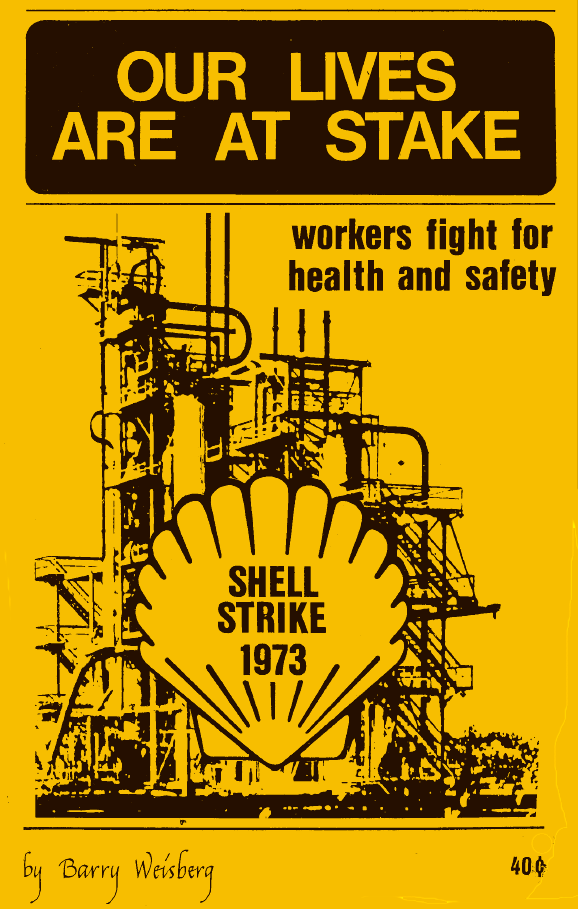
On January 21st, OCAWIU President Bob Grospiron called over 4000 Shell OCAW members from 5 oil refineries and 3 chemical plants, out on strike. Then made a nationwide appeal to the public to boycott Shell Oil while the union continued its fight over the right to bargain health and safety issues.

The union was seeking:

  • 1) The establishment of a Joint Union-Management Health & Safety Committee
  • 2) Wanted the Union committee workers paid while performing official committee duties
  • 3) The right to call in independant Health & Safety inspectors
  • 4) Access to all Company information on both death and disease rates
  • 5) Annual Company medical examinations provided at Company expense

As a tactic for the 1973 strike, OCAW employed the first major "corporate campaign" in U.S. history. OCAW forged alliances with the scientific, academic, environmental and labor communities to fight Shell’s position that it would not bargain over health and safety. The union spent nearly half a million dollars to advertise a nationwide boycott of Shell and to educate the public about the need to protect the health of workers and the communities.

Even though 12 other major oil companies had already signed contracts that provided for the new joint union- management health and safety committees, they assisted Shell by buying their gasoline and blacklisting Shell's strikers. The oil industry's thinking was the new joint H&S committees would get in the way of production and profits.

Shell's corporate spokesman, J.H. Walter called the unions joint H&S committee 'another attempt at featherbedding since the workers could then decide how long they could safely work in the refineries and chemical plants.

Moreover, Shell stated that health & safety was none of the oil workers' business: "We are legally responsible for the health and safety of Shell employees in the workplace and this responsibility cannot be shared". The truth was the oil companies didn't want to give up control in this area.

From 1963-1969, Shell used caged canaries as 'safety devices' at their Houston chemical plant.(true story, no joke!) The canary's job was to detect the presence of carbon monoxide. If the canary died, it was time for the workers to leave. Shell went through a lot of canaries, OCAW was claiming by the time the canary died, the workers would already have been exposed.

The union was also seeking the right to inspect company records and financial reports of the pension funds Shell administered and to be able to grieve the company's arbitrary actions with regard to disability pensions. (The union suspected Shell's pension fund was under funded.) One Anacortes member who worked for Shell for 17 years, was certified by two doctors as being disabled, yet Shell wouldn't allow him disabled benefits even though he met the 15 year employment requirement. For the union, this was an item that needed to be addressed.

The International Representative assigned locally was Virgil Coragliotti, with Representative Tom Burkholder assisting on occasion. Don Yates was the Shell unit chairman and the committee members were Gil Nuessen, Wes Shull, F. D. Ferguson, Bob Melton Sr. Jerry Vrooman was the Local President and Jim Burgess was the financial secretary.

Picket pay was $25 a week. The 1-591 union brothers at General Chemical and Texaco assessed their monthly dues to help support the Shell members. Financial support was also received regularly from the Ferndale OCAW 1-590 local. Because Shell Oil’s daily production was unaffected and they didn’t lose any profits during the strike, the strikers received unemployment benefits under what was then known as the ‘dark plant rule’. Not surprising, Shell Oil later lobbied to get that section of the unemployment law changed.

About a week before the strike Snelsons’ had contracted with Shell to do maintenance work on a recently shutdown furnace. Their plan was to use the Boilermakers union, Local 104 out of Seattle. OCAW had gotten wind of it and a group of about 60 Shell brothers were on site waiting for the 14 building trades members when they attempted to cross the picket line, being led through by Bill Snelson. Several Shell picketers became so upset that they turned over both of Snelsons’ trucks and trailers. At the same time, someone smashed out Snelson's rear window. Out of fear, Snelson romped on the gas throwing John Garner, who was standing in front of him, onto the hood of his car. Garner was able to roll off as Snelson bolted on through. The Sheriff was immediately called.

Fred Nelson, Bob Melton and Charlie Pyburn were identified as the lead individuals involved and were fired. Later, after two days in court, Judge Deierlein had Melton and Pyburn jailed, then sharply criticized Shell management for not maintaining better communications with the union and local law enforcement officials in trying to prevent emotional blow-ups. Later Snelson took OCAW 1-591 to court and won $6700 for the damage done to his vehicles. Shell also fired Virgil Avey for breaking windsphrlds with his picket sign. While the other three were unable to get their jobs back, Fred Nelson was eventually rehired. Old time Union members refer to this incidence as the "Day of the Windstorm."

OCAW also had trouble with the Teamster's Union from Seattle. The same teamster leadership that was scabbing on the United Farm Workers, had ordered their drivers to disregard the picket line established by OCAW. And since there was an injunction limiting the number of pickets to two per gate, the union was unable to do much about the Teamsters pushing through with their trucks.

To keep in the health and safety issue in front of the public, OCAW had teams that traveled the northwest speaking to the news media and public about the need for work place safety. Shell later admitted the mobile speakers bureaus were very effective.

Finally, Shell, in the face of public pressure, bargained a compromised health and safety clause as well as meeting the union's demand allowing the pension fund to be reviewed and grieved if necessary. On June 1st the strike was officially ended.

Download (PDF).

Pages

The Fine Print I:

Disclaimer: The views expressed on this site are not the official position of the IWW (or even the IWW’s EUC) unless otherwise indicated and do not necessarily represent the views of anyone but the author’s, nor should it be assumed that any of these authors automatically support the IWW or endorse any of its positions.

Further: the inclusion of a link on our site (other than the link to the main IWW site) does not imply endorsement by or an alliance with the IWW. These sites have been chosen by our members due to their perceived relevance to the IWW EUC and are included here for informational purposes only. If you have any suggestions or comments on any of the links included (or not included) above, please contact us.

The Fine Print II:

Fair Use Notice: The material on this site is provided for educational and informational purposes. It may contain copyrighted material the use of which has not always been specifically authorized by the copyright owner. It is being made available in an effort to advance the understanding of scientific, environmental, economic, social justice and human rights issues etc.

It is believed that this constitutes a 'fair use' of any such copyrighted material as provided for in section 107 of the US Copyright Law. In accordance with Title 17 U.S.C. Section 107, the material on this site is distributed without profit to those who have an interest in using the included information for research and educational purposes. If you wish to use copyrighted material from this site for purposes of your own that go beyond 'fair use', you must obtain permission from the copyright owner. The information on this site does not constitute legal or technical advice.