You are here

green industrial unionism

The Anti-Democratic Nature Of Big Unions

By Burkely Herrman - Industrial Worker, November 2013

Disclaimer: The views expressed here are not the official position of the IWW (or even the IWW’s EUC) and do not necessarily represent the views of anyone but the author’s.

Ten thousand times has the labor movement stumbled and fallen and bruised itself, and risen again; been seized by the throat and choked and clubbed into insensibility; enjoined by courts, assaulted by thugs, charged by the militia, shot down by regulars, traduced by the press,  frowned upon by public opinion, deceived by politicians, threatened by priests, repudiated by renegades, preyed upon by grafters, infested by spies, deserted by cowards, betrayed by traitors, bled by leeches, and sold out by leaders, but notwithstanding all this, and all these, it is today the most vital and potential power this planet has ever known.”  – American union leader and socialist Eugene Debs, 1904

In the age of Obama, unions have had an even more diminished role than before. Despite this, a recent poll from the Pew Research Center for the People and the Press has shown that a slim majority, or 51 percent, approves of “organized labor…up a full 10 percentage points from two  years ago” and also “labor unions had the highest approval ratings among women, people of color, and young people between the ages of 18 and 29 [but not] whites and retirees.” The right-wing has launched a massive attack on unions as can be seen in the “right-to-work” bills in recent  years and other measures. As a result, the  big unions, part of the labor aristocracy, like the AFL-CIO and the Change to Win Federation have backed the Democratic Party, the second-most capitalistic party in American politics. In electoral battles  with the Republicans, the unions fund ads to help out their favored candidates: big business Democrats. Along with the agents of oligarchy, these unions applauded when the Wall Street marketing creation named Barack Obama was elected as U.S. President in 2008, and continued to support him throughout his presidency. Some of the only sticking points have been the protectionist multinational-empowering investor-rights agreements that promote “trade” like the North American Free Trade Agreement (NAFTA), the United States-Dominican Republic-Central  America Free Trade Agreement (CAFTA), the United States–Republic of Korea Free Trade Agreement (KORUS FTA), the Panama–United States Trade Promotion Agreement (TLC), the upcoming Trans-Pacific Partnership (TPP) and the Transatlantic Free Trade Area (TAFTA), among many others. At the same time, these unions have not tried very hard to reverse trends that have caused unionization in the American economy to be on the decline. From here, it is important to discuss what the subservience of the labor aristocracy means to working-class and middle-class Americans.

Recall the Wisconsin uprising of 2011.  According to his website, Governor Scott  Walker wanted to “create an atmosphere  where business can thrive and success  will follow” and the unions were in his  way. One of the state’s biggest unions decided to back some of the cuts sought  by anti-union stalwart Governor Walker, in the infamous 2011 Wisconsin Act 10, also known as the Wisconsin Budget Repair Bill, at first, only opposing a provision limiting collective bargaining of public employees. Later, they changed their position after Walker rejected their compromise, as reported in the Milwalkee Journal Sentinel. Numerous protesters demonstrated a different view by calling for the defeat of the whole bill, not just one provision. Once Act 10 had passed, the unions pushed the next step: recalling Governor Walker. Almost a million signed a petition to recall him. However in the primaries, big labor’s favorite candidate Kathleen Falk was defeated by Tom Barrett. Barrett was a Democratic machine politician who Walker had defeated in 2010, but the unions backed him anyway along with corporatists like Barack Obama and Bill Clinton. The website watchdog.org reported that Barrett was “sticking  by a plan that could mean up to $14,000 in compensation cuts for state workers…[and] ‘rightsize’…state government and put public-worker pay and benefits more in line with private-sector compensation.” This follows what Barrett planned to do in 2010, as outlined in his report, “Tom Barrett’s Plan to Create Wisconsin Jobs”: “simplify[ing] regulations and streamline the regulatory process to lighten the burden on business.” Additionally, the report “Tom Barrett’s Plan to Put Madison on a Diet” was slated to “introduc[e]…technologies and revising processes to lessen the need for replacement employees…[and] keep…compensation and sick/leave accrual for state employees in line  with the private sector, including wages, health care, pension, retirement age, job security, and overtime pay.” Due to this, he only gave lip service to the unions, making protesters disenchanted along  with conducting a horrible campaign that didn’t mention Act 10. As a result, the propaganda machine, in part funded by the Koch Brothers, propelled Scott Walker to victory. The concentration of capital had sadly won against people power.

BART Strike Facts – 1% vs. the 99% – Again

By Armineh Megroian - Solidarity in Motion, October 6, 2013

Disclaimer: The views expressed here are not the official position of the IWW (or even the IWW’s EUC) and do not necessarily represent the views of anyone but the author’s.

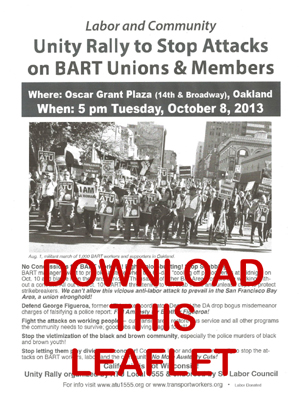
BART workers and their Unions are being forced into a strike which will begin on Thursday Oct. 11th.  This will cause congestion on roadways and bridges of Bay Area. But while you’re sitting in heavy traffic and stewing, don’t curse the so called overpaid, lazy Union workers. Acquaint yourself with a few facts first. Of course you know, that you will not get actual facts from the corporate media, only melodrama.

Fact: For BART workers, a strike is a last resort. They are more than willing to sit down and negotiate. It is the Board of Directors who refuses to negotiate.

Fact: BART’s General Manager Grace Crunican sits on the Board of directors of the “Bay Area Council”. A group of CEOs and managers dedicated to lowering wages and deteriorating working conditions for all workers. In short, to put profit before people.

Fact: The Board has spent $400,000 to hire a consultant turned negotiator from a private corporation named Veolia Transportation Services. Thomas Hock was brought in through the back door in an underhanded way. He has a reputation for Union-busting. His general strategy is to push Unions into a strike, provoke public anger and frustration against them, forcing them into taking concessions and pay cuts. That is 400K not spent on safety measures and upgrades for the paying public.

Fact:  Managements’ proposed “raise”, is actually a pay cut:

“According to BART’s analysis of its own proposal, utility workers, who currently take home $36,000 a year on average after taxes, would only see their pay increase to about $39,000 by 2017, after contributions to retirement and medical care are factored in. Train operators, who on average earn $44,000 a year after taxes, would only see their pay increase to $48,000 by 2017… That’s about an 8- to 9-percent increase in take-home pay for utility workers and train operators under the four-year BART contract proposal. But when you factor in an annual inflation rate of 2.5 percent, BART’s offer actually represents a pay cut of 1 to 2 percent over four years.” (Darwin BondGraham, “Why BART’s Wage Offer Doesn’t Include a Raise,East Bay Express.

How to Deflate the Carbon Bubble

By Truls Gulowsen - Originally published at OpenDemocracy.net, September 29, 2013

Disclaimer: The views expressed here are not the official position of the IWW (or even the IWW’s EUC) and do not necessarily represent the views of anyone but the author’s.

Last Friday, the Intergovernmental Panel on Climate Change went public with their Fifth Assessment report in Stockholm. The report supplied us with more reasons to dread the coming effects of global warming, and even more reasons to urge politicians to act.

One of the key new features in the IPCC report is the global accumulative “carbon budget”. The IPCC confirms earlier findings that there is an allowence for less than 1000 gigatons of CO2 in the atmosphere for the rest of the century, if we are to avoid dangerous climate change above two degrees warming. This is less than a third of proven fossil reserves, and will be consumed in less than 30 years at current emission levels.

In neighbouring Norway, often described as a “world-leader in the combat against climate change”, a population of just over 5 million reap the profits in being the world's second largest gas exporter and the sixth largest oil exporter. The investments in the sector are growing year by year.


Along with the rest of the world, we are debating how to manage a limited resource and how to achieve the necessary emission cuts to avoid disastrous global warming. 


Along with the rest of the world, we live in a carbon bubble, in which, despite increasingly urgent warnings from scientists and environmentalists, we keep pumping up fossil fuels at record speed, pushing greener industry aside as we do so. In Norway the fossil fuels industry is by far the country's largest, and our reliance on this industry is not just a threat to the green industry, but to our entire economy, as has lately been pointed out by various individuals and organizations, including the IMF.


Our goal is not to get rid of the oil industry tomorrow. Nor is it to set a date for when the last oil worker will be out of a job. On the contrary, we want to keep the industry going for generations, but at a significantly lower level than we see today. To achieve this in a way that does not lead to mass unemployment (an estimated 250,000 people - or one in twenty Norwegians - are involved in the fossil fuel industry) we need a plan that combines both environmental policy and the oil workers' interests. That was the starting point when labour unions and environmental NGOs sat down to draft a plan on how we might realistically deflate Norway's inflated oil industry in a way that also retains the interests of the industry's employees.

Why Environmentalists Need to Support Transit Workers' Struggles - Solidarity With Bay Area Transit Workers!

By x344543 and x363464 - October 1, 2013

Disclaimer: The views expressed here are not the official position of the IWW (or even the IWW’s EUC) and do not necessarily represent the views of anyone but the author’s.

In the San Francisco Bay Area union workers at BART and AC Transit are embroiled in bitter contract fights with their bosses. Details on these struggles can be found at the Transport Workers Solidarity Committee (TWSC) site: transportworkers.org

Without going into a long analysis why we know this to be true (TWSC has already done that) we simply assert that the demands for concessions by the BART and AC Transit bosses is a result of the austerity measures being demanded of the 99% by the employing class in order for the latter to shore up their sinking capitalist ship.

Rank and file transit workers are organizing a militant response in the face of repression from their bosses (and the wider capitalist class in general) as well as the class collaborationist bureaucrats in their AFL-CIO unions, who simply cannot accept that this assault on the basic rights and livelihoods of trhese workers is happening.

Environmentalists should support the transit workers and oppose the bosses for the following reasons:

  • (1) Contrary to the information you might get from the capitalist media, these workers are not greedy and overpaid. In the Bay Area, an urban megalopolis with one of the highest costs of living in the US, these workers--on average--are barely making enough to survive.
  • (2) The bosses' latest contract offers are full of concessionary demands, and their wage offer amount to a pay cut.
  • (3) The transit bosses are following a pattern being followed by public agencies around the US of funding cuts, union busting, service cutbacks, outsourcing, and privatization.
  • (4) All of these are linked and are part of the systemic functions of capitalism which demands that wealth be continually transferred from the working class to the employing class.
  • (5) Capitalism cannot be reformed and cannot be effectively regulated. Even if temporarily constrained as it was in the Keynesian era, it ultimately seeks a way out of those constraints. Only working class solidarity and organization can effectively check and overcome the power of the employing class.
  • (6) Capitalism is inherently anti-ecological.
  • (7) Because an attack on the transit workers by the employing class enables the latter further, the bosses' actions are also an attack on the environment.
  • Negative consequences to the environment from the bosses actions have and will continue to manifest themselves thusly:

    • Cuts in service (resulting in lower ridership and increased use of personal automobile usage);
    • Cuts in maintenance which risks the safety of workers and commuters as well as causing increased long term wear and tear;
    • Less expansion of service to much needed areas;
    • Anti environmental practices within each agency.
  • (9) The arguments made by the bosses that the above conditions are caused by "workers' greed" are bogus. The bosses make far more by comparison and the real issue is one of allocation of adequate public funds.

Capital Blight: The Yellow Unions' "Green Coalition" Blues

By x344543 - September 21, 2013

Disclaimer: The views expressed here are not the official position of the IWW (or even the IWW’s EUC) and do not necessarily represent the views of anyone but the author’s.

In a recent In These Times article, Rebecca Burns laments that the recent announcement by AFL-CIO president Richard Trumka to "open up the labor movement in order to regain political (sic) clout" by partnering with progressive NGOs, such as the Sierra Club, NAACP, and Council de la Raza, has not been well received by more conservative elements within the federation, namely the building trades.

“Giving people a seat where they have governance, and they don't represent workers--that was a bridge too far for lots of folks," Building Construction Trades Department (BCTD) union President Sean McGarvey told the (Wall Street) Journal. McGarvey, whose union has been a strong backer of the Keystone XL Pipeline because of the jobs it will create, also said that the Sierra Club’s attempts to dissuade the AFL-CIO from issuing a resolution supporting the pipeline last year “just highlighted the audacity of people in the radical environmental movement trying to influence the policy of the labor movement.”

There are so many problems with that statement (from McGarvey and Burns alike) it's difficult to know where to begin.

McGarvey's claim that Keystone XL Pipeline is being opposed by people in the "radical environmental movement" (and his identification of the Sierra Club of all organizations as being the leader of it) is absurd. The very idea that the Sierra Club is the leader of the "radical" environmental movement, or even radical at all is nonsense. The big NGOs opposing the project include Corporate Ethics International, Natural Resources Defense Council, Sierra Club, 350.org, National Wildlife Federation, Friends of the Earth, Greenpeace, and Rainforest Action Network, and as we have pointed out, these groups are anything but radical. Furthermore, Over 1,000,000 individuals have gone on record as opposing the Keystone XL pipeline, and it's highly unlikely that they're all "radical" in any sense, and don't get me wrong, it would be nice if they were, but I'm a realist! Does McGarvey understand that many of these people are union workers? Would McGarvey also include the growing number of unions who've gone on record opposing Keystone XL?

One might want to ask McGarvey to what extent the building trades themselves represent workers, because the evidence suggest that for the most part, they represent the capitalist class more than anything else. He also doth protest too much, because those so-called "radical" environmentalists, for the most part are fixated primarily on Keystone XL and ignoring the other pipelines--such as the Bluegrass Pipeline, Enbridge's Line 9, Transcanada East, and others--a strategy which Barack Obama might use to expedite the latter. Fortunately, the real radical environmentalists (who're not beyond criticism, certainly) are focused on those and doing quite well at fighting them.

In any case, McGarvey has little to worry about, because what Trumka is proposing is hardly anything close to a meaningful Blue-Green alliance and is, more likely than not, going to be more old wine in new bottles, namely building coalitions to keep the labor movement (and the progressive NGOs) firmly tied to capitalism and the Democratic Party. If the AFL-CIO's combined efforts with the Sierra Club et. al. amount to anything more than intensified lobbying and get-out-the-vote (for Democrats--and even occasionally Republicans) it will be a huge surprise.

A Workers’ ‘Green Ban’ on Fracking?

Ira Berkovic of Workers' Climate Action reports from a workshop at this summer's anti-fracking protest camp - Originally Published at Red Pepper Blog, 9 September 2013

Disclaimer: The views expressed here are not the official position of the IWW (or even the IWW’s EUC) and do not necessarily represent the views of anyone but the author’s.

A workshop on 'work and transition' at the Reclaim The Power protest camp in Balcombe, Sussex, was part of an ongoing conversation between the labour and climate movements. It is a conversation which, in Britain, has involved the historic links between the Reclaim the Streets movement and striking dock workers in the 1990s.  Lucas Aerospace workers’ transition plan in the 1970s, which proposed to repurpose their socially and ecologically unsustainable factories to produce socially necessary goods.

With the climate movement reviving in the context of the government’s newfound mania for expanding fossil fuel energy generation and 'extreme energy' solutions like fracking, it is a conversation which must be had again with a new generation of activists.

The workshop aimed to give activists who might not have engaged with the labour movement before to learn about trade unions and workers’ organisations, and to discuss questions around workers’ agency in fighting climate change and the potential for worker-led models of transition.

Manuel Cortes, general secretary of transport union TSSA, spoke about the links between the fight for a top-quality, publicly-owned transport system and the fight against climate change. Public and Commercial Services union (PCS) assistant general secretary Chris Baugh introduced the Campaign Against Climate Change’s 'One Million Climate Jobs' pamphlet, a campaigning publication which argues for investment in and expansion of 'green collar' jobs in sustainable, socially-necessary industries like transport, social housing construction, and renewable energy.

PCS officer Clara Paillard recounted her experiences as a workplace environmental rep fighting for sustainability in the workplace, making links with local environmental campaigners to fight the construction of a privately-operated, for-profit waste incinerator in their local area. Green Party activist Derek Wall discussed models from economic theory, including Karl Marx and Elinor Ostrom, which could help develop a vision for democratic collectivism and a sustainable future.

I spoke to tell the story of Workers’ Climate Action (WCA), a direct-action solidarity network active between 2006 and 2010 which aimed to bring a working-class political approach to the climate movement and radical ecological politics to the labour movement. WCA sought to make links with workers in high-emissions industries like energy and aviation, because we knew that a conversation about transition was only possible from within a framework of basic solidarity with workers’ day-to-day struggles.

Small-group discussion in the workshop covered a range of topics. It would be disingenuous to deny the difficulty of discussing the potential power of aviation, construction, and energy workers in a workshop made up of participants who had little or no experience of working in such industries. However, with participants working as teachers, journalists, and in local government – all sectors and industries with high levels of trade union organisation – there was plenty of opportunity to discuss applying workplace and union-focused models of environmental activism to participants’ own workplaces and experiences, rather than seeing them solely as something we can engage some alien worker 'other' with.

Green and Red in the Frame

By Ewan Kerr - Scottish Left Review #77, July & August 2013 (used by permission of the author).

“Outside party politics new social movements, including environmental, anti-cuts and feminist groups, have not come together sufficiently with the old, defensive organisations of the working class to produce the coalition that might make them an effective political force” (S Hall, The Guardian 2 April 2013)

As the above quote by Stuart Hall illustrates, contemporary social movements and progressive organisations face an on-going problem: they struggle to form effective and inter-movement forms of organisation and collective action. It is widely recognised now that the political left’s main failings are by in large a result of the often fragmented identities of different groups. This in itself should not be cause for concern, as left-wing political theory and action depends upon the mantra of unity in diversity. It can though prevent groups who share a natural affinity with each other from organising coalitions which are both effective and long term, while also limit the ability to develop strategies for deeper and more meaningful co-operation. Some explanation for such divisions I believe can be found through an examination of a well-established approach to coalition forming, that of framing. Framing, in essence, seeks to align values, ideology and activities in order to construct common viewpoints and form a stronger sense of collective identity.

Featured in the last issue of SLR was an excellent article by David Eyre, which offered a useful introduction to the idea of framing. The article provided a concise and tidy description and explanation of framing, although focused very much upon values on a national basis, and efforts to change people’s attitudes. This brief article seeks to build upon this, and offer an example drawn from labour-environmental coalition building. This will involve two distinct discourses which are used to frame such blue-green coalitions, that is the Jobs Vs. The Environment dilemma and Just Transition. Each illustrates that though the creation of frames groups can either be framed as having mutually exclusive or inclusive interests, which on one hand can act as a barrier to potentially prevent effective coalition work, or on the other facilitate co-operation though the creation of a discourse which appeals to the deep seated interests of both environmental organisations and organised labour groups. As Jakopovich (2009) states in his 2009 article Uniting to Win;

“The construction of shared experiences and common or complementary perceptions of interest… is at the heart of more successful and permanent coalition building.”

That past efforts towards co-operation between environmental and labour organisations have often been characterised by conflict and distrust is an unfortunate reality. On the face of it, it’s difficult to understand how two groups who subscribe to many of the same values have such acrimonious relations. Burgman’s (in 2013’s Trade Unions in the Green Economy) evaluation of this is lengthy, but worth quoting in full:

“Capitalist economies are characterised by the underuse of labour resources and overuse of environmental resources. Corporations tend to both reduce labour costs and to use the cheapest production methods possible, regardless of ecological consequence. Thus employment options are restricted at the same time as the planetary environment is degraded.”

Upcoming Event: Towards an Ecological General Strike! The history of green unionism and it's recent revival.

Join us at the Holdout for a presentation about the BLF "green bans" in Australia and Redwood summer in California. The powerpoint will be followed by a discussion about strategy and tactics to build a social and ecological revolution.

  • When - Saturday, July 27, 6:00 PM
  • Where - The Holdout: 2313 San Pablo Avenue, Oakland, California 94612

Facebook Event - To RSVP

Capital Blight: Alliances Between Workers and Environmentalists Must be Built from the Ground Up

By x344543 - July 12, 2013

Disclaimer: The views expressed here are not the official position of the IWW (or even the IWW’s EUC) and do not necessarily represent the views of anyone but the author’s.

It's a commonly expressed hope among younger, radical environmentalist activists that Judi Bari's vision of "green syndicalism" (worker lead reorganization of the new world within the shell of the old into a post capitalist, post technocratic, biocentric society) will manifest itself by big AFL-CIO unions--such as the building trades, UMWA, Teamsters, etc., refusing to build or operate the machinery that is destroying the environment, such as the Keystone XL Pipeline or the trains transporting coal, or the ships exporting that coal to China.

They recall the "Teamsters and Turtles" coalition that sprang up during the anti-WTO demonstrations on November 30, 1999 in Seattle; they might mention the Earth First! alliance with the United Steelworkers (at Kaiser Aluminum) against Maxxam the previous year; some invoke the Australian "Green Bans" that saved Kelly's Bush in Hunter's Hill (New South Wales) in the early 1970s, where construction workers refused to construct a building that would destroy one of the last remaining open spaces in that community.

These are all real examples to be sure, but they represent the exception--not the rule--and that realization leaves some wondering why, while others--like Earth First! co-founder Dave Foreman--simply write the workers off.

Both views are wrong in my opinion, because both fail to understand the depths of the problem. They might respond by asking how Judi Bari was able to succeed, including co-founding what came to be known as Earth First! - IWW Local #1, made up of environmentalists and timber workers, where others failed, and why others cannot simply replicate her efforts. I am certain others can, but we must recognize what made Judi Bari's efforts so special and unique to begin with: she correctly recognized the union officialdom (not to mention the leadership of the mainstream environmental organizations) as typically being part of the problem and not the solution.

"Industrial Unionism Now!" and "Green Unionism Too!"

By x372712 - July 2, 2013

Industrial Unionism Now!

Capitalism has never been kind to us. The machines of industry have unleashed both great productive capacity and great social change, abolishing all classes but holders of the means of production and those who work those means. While the inevitable conflict of social classes has been at turns sidetracked by nationalism, concessions, and the endless attempt to turn working people against their own interests, we know well enough: there is one primary struggle in our time- the struggle of the disenfranchised, the exploited, and the disempowered against the privileged and the powerful; the struggle of labor, and the disenfranchised of every hierarchy built into the class system, against capital and whole of the establishment that enshrines it. Never since the dawn of the industrial revolution has this been more clear- in the age of globalized corporate capitalism, the velvet glove of progressive reform has been stripped away to reveal the iron fist that is the profoundly undemocratic system of capital property. Since the age of neoliberalism and 'trickle down' economics, the cut-throat dictatorial corporate rule that has been exported to the third world for decades has come back to cast its sick sights on the workers of the West, and each new crisis brings newer cuts, more austerity measures, and a further stripping of those programs and reforms that created the middle class- all the while accumulating previously unheard-of wealth in the hands of the megarich while the wages of the American laborer stagnate, the small business holders are driven into the ranks of the workers.

Let's not kid ourselves and think that ethical consumption or other indulgences is going to change the situation; fair trade and organic create a niche market selling to the sort of people who buy fair trade and organic (and, all too often, figure that this means they've 'done their part' in changing the world), but does not meaningfully challenge the paradigm of corporate capitalism. Something more is needed. Not mere consumers, we can act as producers, and exercise our power at the nexus of our own exploitation. We need the labor movement.

Unions have acquired a bad reputation, mostly unjustified, but there are legitimate reasons. Union bureaucracy and hierarchy can be a disempowering and work at odds with the interest of the union rank and file. Many unions are all too willing to sign no-strike clauses and compete with other unions. American unions worked during the second Red Scare to purge the anti-capitalists from their ranks and remake themselves as a reformist, pro-business force and have since spent a huge amount of their funds campaigning for the lesser of two evils and the anti-labor Democratic Party while ignoring the need to organize unrepresented workers and carry out the real work of the union.

Yet labor is needed, whatever the problems of modern business unions; and so, a better model must be found, and organized. A model for real effective labor must be based in grassroots union democracy (decentralized power, federated organization, and recallable, accountable delegates), industrial solidarity (meaning that the industry is not split among multiple unions, but acts as one union), and an unapologetic pro-labor agenda (no no-strike clauses, no abandoning change for moderate reformism- the goal of the union has to be workplace democracy, not just collective bargaining). We need to organize that sort of labor, and a place to organize is right here in central Minnesota.

Unionizing will not be easy. In the globalized neoliberal age, the dominant players of both our productive and consumptive forces are often controlled, not by workers, not by local petit bourgeois, but by multinational chains- chains of stores that make chains on the hands of labor. Such chains make it so any unionizing effort that has real effect on the lives of the people of this city needs to be not local, but regional, national, or international, and for this reason, this dilemma that faces every worker, the labor movement itself must be international. It is most important to note that in an age of global capital, no one community can become revolutionary. Globalization creates a race to the bottom- any attempt by a nation to institute progressive policies, or, even 'worse' (in the eyes of capital), real democracy will be met with the movement of business and capital from that nation to another, more desperate or more oppressed. As long as capitalists have people desperate enough or afraid enough not to demand change, they can always just move to the lowest bidder and make sure the labor market in the commodity of human lives works for them. Not to mention the IMF, the World Bank, and of rest of international monetary and exchange institutions set up by and for the wealthiest people in the world. Just look at what happened in South Africa or Poland after their revolutions; their entire economic reform program torn to pieces by these institutions, serving not the interest or the will of the people, but the interest and will of the capitalist class. Just look at America- you think closing the border will bring jobs? It's not immigration that's taking your job; it's globalization done capitalist style.

That's why labor movement doesn't only need to be democratic- it needs to international. It must be a labor movement that can fight capitalism on every front, can make sure that every stage of the production and industrial process is beset by the forces of labor, can, as labor movements have historically done, prove a dynamic force against totalitarian regimes, and can maintain itself as a genuinely democratic engine of popular power.

The IWW is the ideal union for the modern age- based in worker's democracy, industrial organization, international solidarity, and an unabashed yet inclusive revolutionary agenda. The IWW also is one of the few unions that really thinks outside of the box- recently, the Wobblies have lead the way in unionizing the food and service industries (for example, Starbucks and Jimmy John's), showing a drive to take up the cause of workers other unions are all too willing to ignore.  Ten IWW members in a community are all it takes to form a General Membership Branch, the basic organization from which further labor action, both local and, in solidarity with other communities, regional and international action can be taken. I urge readers, activists, and workers to join the IWW and building genuine labor resistance, across the world!

Pages

The Fine Print I:

Disclaimer: The views expressed on this site are not the official position of the IWW (or even the IWW’s EUC) unless otherwise indicated and do not necessarily represent the views of anyone but the author’s, nor should it be assumed that any of these authors automatically support the IWW or endorse any of its positions.

Further: the inclusion of a link on our site (other than the link to the main IWW site) does not imply endorsement by or an alliance with the IWW. These sites have been chosen by our members due to their perceived relevance to the IWW EUC and are included here for informational purposes only. If you have any suggestions or comments on any of the links included (or not included) above, please contact us.

The Fine Print II:

Fair Use Notice: The material on this site is provided for educational and informational purposes. It may contain copyrighted material the use of which has not always been specifically authorized by the copyright owner. It is being made available in an effort to advance the understanding of scientific, environmental, economic, social justice and human rights issues etc.

It is believed that this constitutes a 'fair use' of any such copyrighted material as provided for in section 107 of the US Copyright Law. In accordance with Title 17 U.S.C. Section 107, the material on this site is distributed without profit to those who have an interest in using the included information for research and educational purposes. If you wish to use copyrighted material from this site for purposes of your own that go beyond 'fair use', you must obtain permission from the copyright owner. The information on this site does not constitute legal or technical advice.