You are here

Inflation Reduction Act (IRA)

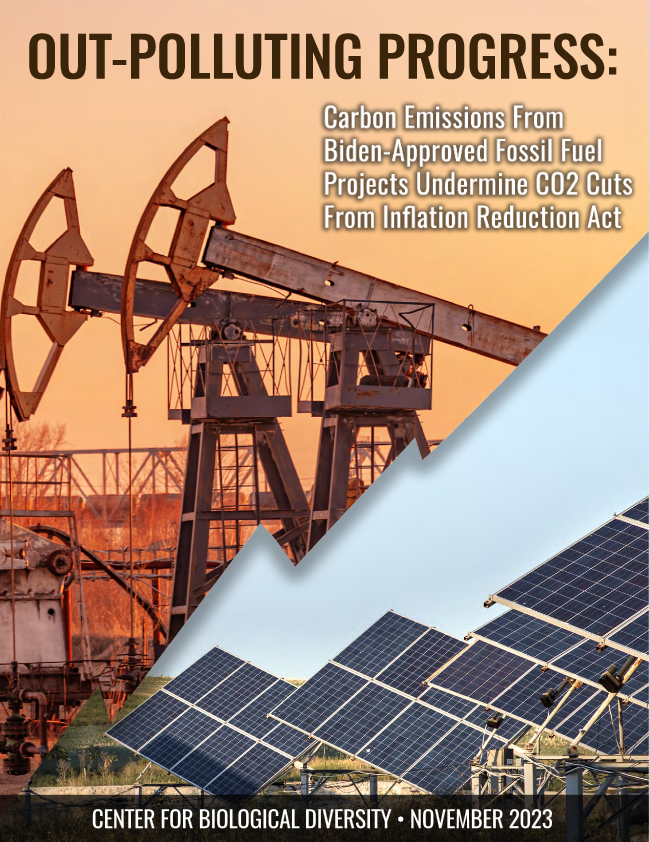
OUT-POLLUTING PROGRESS: Carbon Emissions From Biden-Approved Fossil Fuel Projects Undermine CO2 Cuts From Inflation Reduction Act

By Shaye Wolf, Ph.D., et. al. - Center for Biological Diversity, November 2023

A report from the Center for Biological Diversity demonstrates what many of us have feared—that carbon emissions from Biden-approved fossil fuel projects will cancel out the expected CO2 reductions from the Inflation Reduction Act.

“Approving more fossil fuels not only torches our climate future, but it also harms people’s health, degrades ecosystems, and threatens wildlife,” writes Shaye Wolf, the lead author. “The potential carbon emissions from 17 massive fossil fuel projects approved by the Biden administration are larger than the projected emissions reductions from the IRA and other climate policies.”

Those 17 projects have the potential to release emissions totaling 1,642 million metric tons of CO2 equivalent per year, or the same as the annual emissions of 440 coal-fired power plants.

Download a copy of this publication here (link).

UAW Strikers Have Scored a Historic, Transformative Victory

By Nelson Lichtenstein - Jacobin, November 1, 2023

The UAW’s victory in its forty-five-day strike against the Big Three Detroit automakers is historic and transformative, ending a forty-three-year era of concession bargaining and labor movement defeat that began with Chrysler’s near bankruptcy in 1979 and Ronald Reagan’s destruction of the Professional Air Traffic Controllers Organization two years later.

Not only did the union win substantial wage increases for all members in its tentative agreements (TAs) — at least 25 percent over the four-and-a-half-year contract — but the wage structure is radically progressive, eliminating the second- and third-class status endured by thousands of temps and second-tier workers. With the regularization of their employment status, these workers will enjoy extraordinary pay increases, in some cases upward of 150 percent.

And the union clawed back the annual cost-of-living adjustment (COLA) that had been eliminated during the 2008 financial crisis. COLA had been a standard feature of UAW contracts since 1948, when General Motors first proposed it to the union to blunt the effort, forcefully pushed by then UAW president Walter Reuther, to limit auto and steel industry price hikes either through collective bargaining or government regulation. The labor movement at the time was fighting to limit inflation but secure a healthy wage increase — benefitting working class and middle class alike, union and nonunion, by advancing a program that shifted income and wealth from capital to labor.

That ambition failed during the increasingly conservative postwar years, making COLA increasingly coveted, and not just among industrial workers. During the major 2022 strike of graduate students and other academic workers at the University of California, winning COLA became the key demand of the most radical and activist segment of the student workers. Among the unionized workers of the Big Three, the restoration of COLA will probably add a 7 or 8 percent wage boost to the nominal wages workers earn over the life of the contract. (UAW members still need to ratify the tentative agreements, which they’re expected to do so in the coming weeks given the strength of the deals.)

UAW president Shawn Fain and other progressives, in the unions and out, have correctly denounced the vast pay inequalities that have given corporate CEOs three or four hundred times more income than the bulk of those employed in the same firms. But that income gap has always had an abstract quality. Few workers ever meet a top executive. Far more important, and divisive, have been the petty inequalities within the working class itself. When the person doing the same work on the line or behind the counter is making two dollars more an hour, solidarity decays and resentment festers. That is why Shawn Fain’s campaign for the UAW presidency last year declared, “No corruption, no concessions, no tiers.”

Indeed, this strike victory, spearheaded by Fain and a new slate of union leaders, resembles the dynamic that launched onto the national stage other tribunes of the US working class, from Eugene V. Debs in 1894 and William Z. Foster in 1919 to Walter Reuther in 1946 and Cesar Chavez in the late 1960s, armed with a progressive message and a mobilized membership backing that up. The UAW strike flowed organically from the movement to democratize the union, a multigenerational effort that culminated in the successful push, led by an opposition caucus, United All Workers for Democracy (UAWD), to elect top union leaders by a referendum vote of the entire membership. This would curb the insularity, corruption, and self-perpetuating leadership of a UAW executive board long dominated by a machine known as the Administration Caucus.

UAW Settles With Big 3 U.S. Automakers, Hoping to Organize EV Battery Plants

By Dan Gearino and Aydali Campa - Inside Climate News, October 31, 2023

The shift to electric vehicles is looking better today for U.S. auto workers than it did before a strike against the three major Detroit automakers, thanks to agreements that expand the reach of the United Auto Workers to include battery manufacturing plants.

But the legacy of the strike—at least as it relates to EVs—will depend on the extent to which the United Auto Workers can use its gains from new contracts to build momentum in organizing nonunion plants, like those operated by Tesla, Honda and Toyota.

The union reached a tentative agreement with General Motors on Monday, which follows similar resolutions in recent days with Ford and Stellantis, the parent company of Chrysler. The UAW made several major gains, including provisions that will ease a path to unionization of workers at battery manufacturing plants, even if those plants are not wholly owned by the automakers.

The proposals, which end a strike that began on Sept. 15, still need to be ratified by members.

“We’ve said for months, ‘We refuse to allow the EV transition to become a race to the bottom,’” said UAW President Shawn Fain following the Ford agreement. “Corporate America is not going to force us to pick between good jobs and green jobs.”

EVs are only 8 percent of sales of new cars and light trucks in the United States, but their share is growing as manufacturers introduce waves of new models and as governments and consumers take steps to reduce carbon emissions. Transportation is the country’s leading source of emissions that contribute to climate change.

The Inflation Reduction Act has helped to supercharge investments in EV manufacturing. Much of the investment is at joint ventures between automakers and battery companies, and the UAW was seeking an opportunity to represent this fast-growing part of the automotive supply chain.

Building an Equitable, Diverse, & Unionized Clean Energy Economy: What We Can Learn from Apprenticeship Readiness

By Zach Cunningham, Melissa Shetler, et. al. - Cornell University, ILR School, Climate Jobs Institute, October 2023

With this report, the CJI addresses another core aspect of tackling the dual crises of climate change and inequality: ensuring that frontline, historically underserved communities have expansive, effective pathways into high-quality union clean energy careers. The Inflation Reduction Act and the Infrastructure Investment and Jobs Act have brought increased attention to two important clean energy workforce questions. First, does the U.S. have enough trained workers to meet the demands of the clean energy economy? And second, how do we ensure that the clean energy workforce is diverse and inclusive? This report responds to both of these questions by showing that there are model programs across the U.S. that create pathways for underserved communities into apprenticeship readiness, union apprenticeship programs, and ultimately, good union careers. This study, as well as our many years of experience in the field, have taught us that there is no simple or easy solution to creating or scaling successful pathways.
These pathways exist in an ecosystem of essential and interdependent actors that must be focused on the common goal of building a diverse, equitable and unionized clean energy workforce. Key actors and components include: union-led climate coalitions advocating for bold, equitable climate action; policymakers implementing ambitious, jobs-led climate policy; strong labor and equity standards that ensure clean energy jobs are good union jobs; high-quality union apprenticeship programs that pay apprentices well and make sure that the clean energy workforce is highly-skilled and well-trained; trusting partnerships between labor unions, environmental justice organizations, community groups, employers, MWBE contractors, government, and academic institutions; and the focus of this report, high-quality apprenticeship readiness programs that provide participants with the support they need to successfully enter union apprenticeship.

Download a copy of this publication here (PDF).

Blue Hydrogen Webinar

Employment Impacts of New U.S. Clean Energy, Manufacturing, and Infrastructure Laws

By Robert Pollin, Jeannette Wicks-Lim, Shouvik Chakraborty, Gregor Semieniuk, and Chirag Lala - Political Economic Research Institute, September 18, 2023

The report Employment Impacts of New U.S. Clean Energy, Manufacturing, and Infrastructure Laws by PERI researchers Robert Pollin, Jeannette Wicks-Lim, Shouvik Chakraborty, Gregor Semieniuk and Chirag Lala estimates job creation, job quality, and demographic distribution measures for the three major domestic policy initiatives enacted under the Biden Administion—the Inflation Reduction Act (IRA), Bipartisan Infrastructure Legislation (BIL), and the CHIPS Act. Pollin et al. find that, in combination, total spending for these measures will amount to about $300 billion per year. This will generate an average of 2.9 million new jobs within the U.S. economy as long as spending for these programs continues at this level. The newly created jobs will be spread across all sectors of the U.S. economy, with 45% in a range of services, 16% in construction, and 12% in manufacturing. Critically, the study finds that roughly 70% of the jobs created will be for workers without four-year college degrees, a significantly higher share than for the overall U.S. labor market. As such, these measures expand job opportunities especially for working class people who have been hard hit for decades under the long-dominant neoliberal economic policy framework.

Download a copy of this publication here (PDF).

Blue hydrogen: Not Clean, Not Low Carbon, Not a Solution

By David Schlissel and Anika Juhn - Institute for Energy Economics and Financial Analysis, September 12, 2023

Blue hydrogen hype has spread across the U.S., spurred by the billions of dollars of government funding and incentives included in the 2021 Bipartisan Infrastructure Law (BIL) and the 2022 Inflation Reduction Act (IRA). The fossil fuel industry promises that blue hydrogen, produced from methane or coal, can be manufactured cleanly and contribute to climate change mitigation measures. As we demonstrate in this report, the reality is that blue hydrogen is neither clean nor low-carbon. In addition, pursuing it will waste substantial time that is in short supply and money that could be more wisely spent on other, more effective investments for reducing greenhouse gas emissions in the immediate future.

In short, fossil fuel-based “blue” hydrogen is a bad idea.

Blue hydrogen’s environmental benefits rest largely on the assumptions baked into a Department of Energy (DOE) model named GREET (Greenhouse Gases, Regulated Emissions and Energy use in Transportation) that is the congressionally mandated evaluation tool for U.S. hydrogen projects. Due to a set of unrealistic and flawed assumptions, the model significantly understates the likely greenhouse gas intensity associated with blue hydrogen production.

Among the key shortcomings:

  • It assumes an upstream methane emission rate of just 1%. This is far less than recent peer-reviewed scientific analyses have found and what has been demonstrated by numerous airplane and satellite surveys.
  • It uses a 100-year Global Warming Potential (GWP). This significantly understates methane’s environmental impact in the short term, since its 20-year GWP is more than 80 times that of carbon dioxide (CO2).
  • It does not include any estimate (either over 20 or 100 years) for the global warming impact of hydrogen, which works to extend the lifetime of methane and increase its atmospheric abundance. Hydrogen also has a 20-year GWP more than 30 times that of CO2.
  • It does not include a full life cycle analysis (LCA) of all the emissions from the blue hydrogen production process. In particular, downstream emissions from the produced hydrogen and the generation of the electricity needed to compress, store and transport the hydrogen to the ultimate user(s) are excluded.
  • It includes overly optimistic assumptions about the effectiveness of carbon capture processes.

Using more realistic numbers shows blue hydrogen to be a dirty alternative. For example, if we change just two variables—using methane’s 20-year GWP and a more realistic 2.5% methane emission rate—the carbon intensity of blue hydrogen calculated by GREET jumps to between 10.5 and 11.4 kilograms of CO2e/kgH2 (kilograms of carbon dioxide equivalents emitted per kilogram of hydrogen). This is between two and three times the 4.0 kg CO2e/kg hydrogen Clean Hydrogen Production Standard (CHPS) established by Congress and the DOE. Note that these already very high carbon intensity figures still reflect DOE’s overly optimistic assumption that hydrogen production facilities will capture at least 94.5% of the CO2 they produce. They also exclude the impact of downstream hydrogen emissions.

If more conservative assumptions are used, reflecting: 1) more realistic carbon capture rates; 2) downstream leakage of the hydrogen produced; and 3) downstream CO2e emissions from the production of the electricity needed to fully compress, store and transport the hydrogen to the site where it will be used, then blue hydrogen gets even dirtier, with a carbon intensity more than three times as much as the DOE’s clean hydrogen standard.

Given these results, IEEFA is extremely concerned that the current blue hydrogen hype is going to result in the funding of projects that exacerbate climate change and lock in our reliance on fossil fuels for decades. For this reason, we have undertaken a series of analyses into the emissions from blue hydrogen production based on current scientific knowledge of methane emissions and hydrogen leakage rates and the existing status of carbon capture and sequestration (CCS) technologies. This report focuses on the production of blue hydrogen from methane; a subsequent report will examine hydrogen from coal gasification.

Download a copy of this publication here (Link).

The Industry Agenda: Hydrogen

By Hannah Story Brown and Emma Marsano - The Revolving Door Project, September 6, 2023

This Hydrogen Industry Agenda Report examines the influence agenda of the rapidly growing “clean” hydrogen industry, which is poised to receive tens of billions of dollars of funding and tax credits from the federal government over the next several years. The report outlines the executive branch departments, personnel, and policy fights that hydrogen industry stakeholders are most determined to influence, and points out the climate consequences of the lax standards that many industry players are lobbying for.

While hydrogen is widely touted by industry as a “clean energy source for the future,” it is neither an energy source (see “What is Hydrogen?”) nor necessarily clean. As this report explains, hydrogen’s reputation as a renewable energy “source” is misleading: hydrogen is only as emissions-free as the way in which it is produced, and the process in which it is put to use. Today, most hydrogen production and utilization results in significant quantities of greenhouse gas pollution.

The significant overlap between the hydrogen industry and the fossil fuel industry—involving not only many of the same corporations, but also shared lobbying groups and greenwashing tactics—is particularly troubling given how much money the Biden administration is pouring into hydrogen as a cornerstone of its climate strategy. As long as a role for fossil fuels is preserved in the hydrogen economy, hydrogen will not be “clean,” and its narrow potential role in true system-wide decarbonization will be overshadowed by the profit-seeking excesses of major industry players seeking federal funds without federal safeguards

Download a copy of this publication here (PDF).

Why the Climate Movement Is Supporting Auto Worker’s Fight for a Just Transition

By Sydney Ghazarian - Labor Network for Sustainability, August 17, 2023

Welcome everyone! My name is Sydney, I am an organizer with the Labor Network for Sustainability, and I am honored to facilitate tonight’s Solidarity Call for United Auto Workers Union, which is currently bargaining for a fair contract with the Big 3 Automakers- Ford, General Motors, and Stellantis. 

What makes tonight’s call so special is that it’s a solidarity call by and for the climate movement because we recognize that UAW’s fight is our fight too.

What I love about the climate movement is that we are fighters. And our fight has spanned decades and across generations, and for the last several years, hundreds and thousands of us have rallied, door knocked, made calls, and done sit ins and direct actions to fight for a Green New Deal– which is a society-wide mobilization and just transition to decarbonize the economy while repairing historic harm and creating millions of high-paying, union jobs.

And I want to be clear: Without us fighting for a Green New Deal, there would be no Inflation Reduction Act and its historic investments in clean energy. But we also know that the IRA is not a Green New Deal, and falls desperately short of the Green New Deal’s vision of the world we are trying to build. Rather than massive investments in the public sector, frontline communities, and good, green, union jobs that uplift working people, the IRA invests primarily in private corporations– often the same ones responsible for perpetuating the climate crisis in the first place. 

Unlike the IRA, the Green New Deal understands that the implementation of climate policy, and how resources are distributed to achieve it, are key to ensuring climate justice and ensuring that millions of people are equipped to take that leap of faith away from fossil fuels and into a green economy. 

Class Politics in a Warming World

Pages

The Fine Print I:

Disclaimer: The views expressed on this site are not the official position of the IWW (or even the IWW’s EUC) unless otherwise indicated and do not necessarily represent the views of anyone but the author’s, nor should it be assumed that any of these authors automatically support the IWW or endorse any of its positions.

Further: the inclusion of a link on our site (other than the link to the main IWW site) does not imply endorsement by or an alliance with the IWW. These sites have been chosen by our members due to their perceived relevance to the IWW EUC and are included here for informational purposes only. If you have any suggestions or comments on any of the links included (or not included) above, please contact us.

The Fine Print II:

Fair Use Notice: The material on this site is provided for educational and informational purposes. It may contain copyrighted material the use of which has not always been specifically authorized by the copyright owner. It is being made available in an effort to advance the understanding of scientific, environmental, economic, social justice and human rights issues etc.

It is believed that this constitutes a 'fair use' of any such copyrighted material as provided for in section 107 of the US Copyright Law. In accordance with Title 17 U.S.C. Section 107, the material on this site is distributed without profit to those who have an interest in using the included information for research and educational purposes. If you wish to use copyrighted material from this site for purposes of your own that go beyond 'fair use', you must obtain permission from the copyright owner. The information on this site does not constitute legal or technical advice.