You are here

Inflation Reduction Act (IRA)
The promise and perils of Biden’s climate policy

By unknown - European Trade Union Institute, September 15, 2022

The recent Inflation Reduction Act (IRA) is properly recognised as the largest climate policy in US history. In this short essay I will first summarise and comment on its provisions, then outline the reactions to it, with a focus on labour unions, and will close by providing my own thoughts.

The IRA allocates around $370 billion over a period of ten years. About 75% of that is in the form of incentives (rather than direct investments or regulatory mandates) to advance the transition to ‘clean energy’ that includes renewables but also nuclear power, biofuels, hydrogen, and carbon capture and sequestration. These incentives focus primarily on advancing the production of clean energy but also on stimulating its consumption. Smaller energy investments focus on tackling pollution in poorer communities and on conservation and rural development.

The IRA also authorises as much as $350 billion of loans to be disbursed by the Department of Energy. While such loans have been around since the Bush Administration, the amounts and the likelihood that they will be used during the Biden Administration are much higher. Finally, its main regulatory provision is the designation of carbon, methane and other heat-trapping emissions from power plants, automobiles, and oil and gas wells as air pollutants under the Clean Air Act, one of the bedrocks of US environmental legislation, which the Environmental Protection Agency implements. Overall, it is estimated that by 2030 the IRA will help reduce emissions by around 40% of 2005 levels, compared to the about 25% reduction projected without it. 

However, the policy mandates that renewable energy siting permits cannot be approved during any year unless accompanied by the opening up of 2 million acres of land or 60 million acres of ocean to oil and gas leasing bids, respectively, during the prior year (for more details see 50265 of Act). In either case, the amount of actual leasing and drilling is subject to market dynamics rather than regulatory limits, while the Act also streamlines the permitting process for pipelines. The growing transition to electric vehicles will lessen the market for oil but the strategic repositioning of natural gas in energy production (as well as plastics) suggests that it (along with nuclear power) will be a long-term source of energy, including in the production of hydrogen. Nevertheless, overall, it is the prevailing view that the IRA will decisively transition the US into renewable energy as part of a broader energy mix.

Supporting Coal Workers and Communities in the Energy Transition

By Sam Mardell and Jeremy Richardson - Rocky Mountain Institute, September 15, 2022

Across the United States, the transition from fossil fuels to a clean energy economy is accelerating and will be supercharged by the recent passage of the Inflation Reduction Act (IRA). The clean energy transition is creating widespread social benefits ranging from lower and more stable energy costs to improved air quality. However, without thoughtful planning, the shift to clean energy will harm workers who depend on fossil fuels for their livelihoods, as well as the communities where they live and work.

Policymakers have an opportunity to shape a clean energy transition that supports workers and communities instead of leaving them behind. The fossil fuel industry is central to the economic life of communities across the country, and the real risks these communities face in the clean energy transition — job loss, depressed property values, and reduced local tax revenue for social services and institutions — can be devastating. Well-designed, targeted, proactive, and long-term interventions can help diversify local economies and drive new economic activity that aligns the global need for rapid decarbonization with local visions and priorities.

And governments are beginning to take notice of this risk and opportunity. Over the past few years, seven states passed bills designed to support coal workers and communities facing economic transition. The IRA and the Bipartisan Infrastructure Law of 2021 represent the largest set of investments and resources available to support energy communities in history. These laws could even eclipse 50 years of investments in economic development by the Appalachian Regional Commission.

Building on previous work by key stakeholders, we introduce a policy framework that outlines the risks facing fossil fuel workers and communities in the shift to clean energy and provides guiding principles for supporting them in the transition. RMI’s fossil fuel community recovery and revitalization framework can be used to assess the strengths and gaps in existing legislation and help policymakers and advocates develop and implement comprehensive, strategic policies to support a fair transition from fossil fuels.

RMI’s recovery and revitalization framework consists of three steps:

  1. Relief for fossil fuel workers and communities to alleviate losses of local revenue and jobs that occur immediately following fossil fuel facility closure
  2. Reclamation of remaining fossil fuel sites to prevent prolonged pollution risks and promote short- and medium-term job creation and local economic activity
  3. Reinvestment in fossil fuel communities to promote long-term economic resilience and diversification

The Inflation Reduction Act and the Labor-Climate Movement

By staff - Labor Network for Sustainability, September 2022

Passage of the Inflation Reduction Act reveals the power that can arise when the movements for worker protection, climate protection, and justice protection join forces.

The fossil fuel industry, the Republican Party, conservative fossil-fuel Democrats, and right-wing ideologues combined to block the climate, labor, and social justice programs of the Green New Deal and Build Back Better. They almost succeeded. But at the last minute, the combined power of climate protectors, worker advocates, and justice fighters was enough to force passage of the Inflation Reduction Act, the most significant climate legislation in U.S. history.[1]

That power was enough to include important positive elements in the Inflation Reduction Act. It will provide the largest climate protection investment ever made. It will create an estimated 1 to 1.5 million jobs annually for a ten-year period.[2] It includes modest but significant funding to address pollution in frontline communities.[3]

But the power of the fossil fuel industry and its allies was still enough to gut important parts of a program for climate, jobs, and justice – and to add provisions that promote injustice and climate change. The legislation includes only one-quarter of the investment necessary to meet the Paris climate goals and prevent the worst consequences of global warming. It allows much of its funding to be squandered on unproven technologies that claim to reduce greenhouse gas emissions but whose primary effect may simply be to permit the continued burning of fossil fuels – and enrich their promoters. It allows increased extraction of fossil fuels, especially on federal lands. It allows massive drilling and pipeline construction that will turn areas like the Gulf Coast and Appalachia into de facto “sacrifice zones” where expanded fossil fuel infrastructure will devastate the environment – and the people. It does not guarantee that the jobs it creates will be good jobs. It makes few “just transition” provisions for workers and communities whose livelihoods may be threatened by the changes it will fund.

The Fight to Stop the Inflation Reduction Act’s Fossil Fuel Giveaway

By Yessenia Funes - Atmos, August 10, 2022

Depending on whom you ask, the United States is on the verge of passing one of its most beneficial climate bills—or one of its most harmful. The Inflation Reduction Act is historic, hands down, but it’s also imperfect in the way it continues to prop up the fossil fuel industry at a time when we need to urgently invest in new energy sources. 

The Senate voted to pass the bill Sunday (which all Republicans opposed), and it’s now in the hands of the House of Representatives, which is slated to vote on it later this week. For the first time in my lifetime at least, the U.S. government is on course to pass a climate policy that can actually reduce emissions on a national scale—but at what cost?

Welcome to The Frontline, where we’re still awaiting climate justice. I’m Yessenia Funes, climate director of Atmos. President Joe Biden promised us sweeping climate action, and he finally delivered. However, the Inflation Reduction Act is not built on the foundations of climate and environmental justice. It continues the traumatic legacy of sacrificing Black and Brown communities—of handing over their lives to the fossil fuel sector. Leaders on the frontlines are preparing to fight back.

The clean energy transition will create a lot of jobs — for men

By Jessica Kutz - 19th News, August 8, 2022

The investment in climate action from the Inflation Reduction Act will help create millions of jobs. But experts say changes are needed for women to reap those benefits.

Congress is poised to pass the Inflation Reduction Act, which includes $369 billion for climate action — what experts are calling the largest investment to combat climate change in U.S. history. It passed the Senate on Sunday and is expected to go to a vote in the House later this week. 

While it still falls short of the $500 billion Democrats were initially seeking for climate action, and includes some giveaways for fossil fuel companies, climate activists on the whole see it as a positive step. It’s expected to cut greenhouse gas emissions by 40 percent by 2030, through tax credits that incentivize solar and wind manufacturing and the production of electric cars, among other provisions. 

The influx of funding to combat climate change will add to the $1 trillion from the Bipartisan Infrastructure Law passed in November, which laid the groundwork for a clean energy transition through investments in the national grid, clean buses for schools, electric vehicle chargers, access to clean drinking water and public transit. Combined, the two pieces of legislation are predicted to create millions of jobs, many in the trades — for electricians and construction workers — and in the automotive and transportation industries. 

But without recruitment work and industry overhaul, most of those jobs will likely go to men.

According to the latest numbers released by the U.S. Department of Energy, women make up just 25 percent of the energy industry workforce, and when you drill down to where a lot of the job creation will come from in a clean energy transition and in infrastructure upgrades, the numbers look even more bleak. For example, women make up just 4 percent of the construction workforce. 

This is also where the opportunity lies to bring women — particularly women of color, who are disproportionately represented in low-paying jobs — into industries where wages can sustain a family, and where the educational barrier to entry can be low, said Marina Zhavoronkova, a senior fellow for workforce development at the left-leaning Center for American Progress. 

The Inflation Reduction Act Has Passed

By staff - Labor Network for Sustainability, August 8, 2022

The fossil fuel industry, the Republican Party, conservative fossil-fuel Democrats, and right-wing ideologues combined to block the climate, labor, and social justice programs of the Green New Deal and Build Back Better resulting in compromise legislation, the Inflation Reduction Act. 

Passage of the IRA, despite its drawbacks and limitations, is the most significant climate legislation ever passed into law. It could represent a huge opportunity for the labor-climate movement to shape the significant federal subsidies provided for non-fossil energy development, manufacturing, and for consumers. It will create an estimated 1 to 1.5 million jobs. It includes very modest funding to address pollution in frontline communities.

But the power of the fossil fuel industry and its allies was still enough to gut important parts of a program for climate, jobs and justice – and to add provisions that promote injustice and climate change. The legislation includes only one-quarter of the investment necessary to meet the Paris climate goals and prevent the worst consequences of global warming. It allows much of its funding to be squandered on unproven technologies that claim to reduce greenhouse gas emissions but whose primary effect may simply be to permit the continued burning of fossil fuels – and enrich their promoters. 

It allows increased drilling for fossil fuels, especially on federal lands. It allows drilling and pipeline construction that will continue to see areas like the Gulf Coast and Appalachia turned into de facto “sacrifice zones” where expanded fossil fuel infrastructure will devastate the environment – and the people. It does not guarantee that the jobs it creates will be good union jobs. It makes no “just transition” provisions for workers and communities whose livelihoods may be threatened by the transition to a climate-safe economy. 

The Inflation Reduction Act can provide the basis for an unprecedented people’s mobilization for climate, labor, and justice. That is what it will take to provide a sustainable future for our environment and a fairer economy.

GWA Statement on Senate Passage of Inflation Reduction Act

By staff - Green Workers Alliance, August 8, 2022

Green Workers Alliance Praises Clean Energy Provisions of Reconciliation Bill, Opposes Fossil Fuel Concessions

“This bill is just a first step - and we will continue by taking the fight directly to utility companies to force them to use more renewable energy and help create millions of good, green jobs.”

Washington D.C. - In response to the Senate passing the climate and tax package now known as the Inflation Reduction Act, the Green Workers Alliance, an organization made of renewable energy workers, released the following statement:

The reconciliation bill which includes $260 billion in funding for renewable energy projects is a significant victory for people and the planet as we transition to an economy based on renewable energy. The bill is also a welcome boost for more than 400,000 renewable energy workers, many of whom have been laid off due to supply chain issues. The tax credits and other financial incentives will help kick-start renewables projects across the nation and put people back to work, and the labor provisions incentivizing prevailing wages and apprenticeships will help ensure these projects create good, middle-class jobs.

But while much of the bill is a noteworthy achievement given the current political landscape, we strongly oppose the provisions greenlighting more fossil fuel projects in protected natural lands and offshore and speeding up approval of pipeline projects. Continued investment in fossil fuel projects not only contributes to climate change, but also causes serious harm to local communities, especially people of color. We will continue to stand with front-line communities and fight for a renewable energy future, one that is free from the corruption and pollution of the fossil fuel industry.

The concessions in this bill are just another example of the long-running campaign by the fossil fuel industry and investor-owned utilities to continue pumping out fossil fuels, raking in huge profits while emitting harmful and deadly pollution at the expense of the people, the planet, and workers. Utilities emit 25 percent of the nation’s greenhouse gas emissions. This bill is just a first step - and we will continue by taking the fight directly to utility companies to force them to use more renewable energy and help create millions of good, green jobs.

Together, renewable energy workers, front-line communities, and citizens everywhere can take on corporate power and win a just, green economy.

Green Workers Alliance is an organization made of renewable energy workers demanding more and better jobs in the field and a just transition off fossil fuels.

9 Million Jobs from Climate Action: The Inflation Reduction Act

By staff - Blue Green Alliance, August 2022

A new analysis commissioned by the BlueGreen Alliance from the Political Economy Research Institute (PERI) at the University of Massachusetts Amherst finds that the more than 100 climate, energy, and environmental investments in the Inflation Reduction Act will create more than 9 million good jobs over the next decade—an average of nearly 1 million jobs each year.1,2 That includes more than 6 million jobs created over the next 10 years by grants, loans, and tax credits and nearly 3 million jobs stimulated by new loan guarantee authority for the U.S. Department of Energy. The bill’s broad investments will also help sustain the millions of existing jobs in the clean economy. 

Few pieces of legislation this century have come close to such sweeping potential for good job creation. With robust application of the bill’s strong labor standards, many of these jobs in growing sectors like clean energy, clean manufacturing, and efficient buildings will offer workers good wages and benefits. To advance economic and racial justice, registered apprenticeship programs, targeted investments, and equitable hiring practices should be used to prioritize job access for low-income workers, workers of color, and workers in environmental justice, deindustrialized, and energy transition communities. 

In short, the bill’s unprecedented investments offer an unparalleled opportunity for workers and communities to capture the economic gains of the growing clean economy. Below is a synopsis of some of the jobs that the Inflation Reduction Act will create.

Rural Identity and Anti-Intellectualism

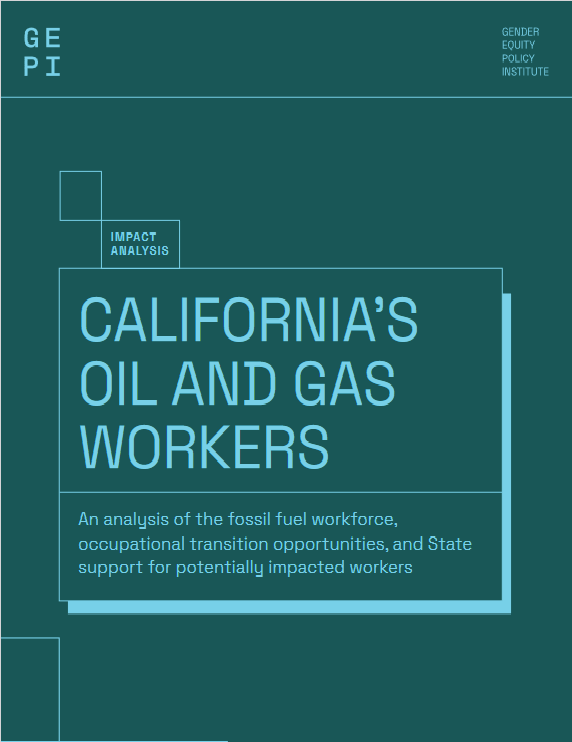
Impact Analysis: California’s Oil and Gas Workers

By Staff - Gender Equity Policy Institute, January 23, 2023

California’s ambitious climate goals, supported by state and federal investment, will create enormous economic opportunity over the coming decades. To meet the 2045 target of carbon neutrality, a 100% clean electric grid, and a 90% reduction in oil consumption and refinery production, the state will need to modernize its electrical grid and build storage capacity to meet increased demand for electricity. Carbon management techniques, plugging orphan wells, and the development of new energy sources such as geothermal will all come into play, providing economic opportunities to workers and businesses alike. Reducing use of polluting fossil fuels will likewise result in significant health benefits to Californians, especially to communities disproportionately burdened by polluting enterprises and proximity to freeways.

Supported by state investment and federal funding through the Infrastructure Investment and Jobs Act and the Inflation Reduction Act, the actions necessary to tackle the challenges of climate change are projected to create 4 million new jobs in the state. California is investing in developing the clean energy workforce, with an equity commitment to recruit and train historically disadvantaged and under- represented communities.

Decarbonizing the economy and accelerating the adoption of clean energy is necessary if we are to preserve a habitable planet. Progress to a carbon neutral future is already well underway in the state. Wind and solar power are less expensive than natural gas or coal powered electricity. A large majority of Californians are concerned about climate change and support action to address its impacts.

However, as with all sectoral economic change, some industries will grow and thrive, while others will shrink, leaving some of their workers behind. Labor unions and trades groups are rightly concerned that workers are not forced to abandon skills developed over their careers and thrown into an inhospitable labor market with no support.

Thus, a key challenge in meeting California’s climate action goals is to devise a fair, equitable, and empirically-based policy to provide support for workers at risk of unemployment and income loss as many factors combine to reduce demand in state for oil and gas products.

Pages

The Fine Print I:

Disclaimer: The views expressed on this site are not the official position of the IWW (or even the IWW’s EUC) unless otherwise indicated and do not necessarily represent the views of anyone but the author’s, nor should it be assumed that any of these authors automatically support the IWW or endorse any of its positions.

Further: the inclusion of a link on our site (other than the link to the main IWW site) does not imply endorsement by or an alliance with the IWW. These sites have been chosen by our members due to their perceived relevance to the IWW EUC and are included here for informational purposes only. If you have any suggestions or comments on any of the links included (or not included) above, please contact us.

The Fine Print II:

Fair Use Notice: The material on this site is provided for educational and informational purposes. It may contain copyrighted material the use of which has not always been specifically authorized by the copyright owner. It is being made available in an effort to advance the understanding of scientific, environmental, economic, social justice and human rights issues etc.

It is believed that this constitutes a 'fair use' of any such copyrighted material as provided for in section 107 of the US Copyright Law. In accordance with Title 17 U.S.C. Section 107, the material on this site is distributed without profit to those who have an interest in using the included information for research and educational purposes. If you wish to use copyrighted material from this site for purposes of your own that go beyond 'fair use', you must obtain permission from the copyright owner. The information on this site does not constitute legal or technical advice.