You are here

extractivism

EcoUnionist News #23

Compiled by x344543 - IWW Environmental Unionism Caucus, January 17, 2015

Disclaimer: The views expressed here are not the official position of the IWW (or even the IWW’s EUC) and do not necessarily represent the views of anyone but the author’s.

The following news items feature issues, discussions, campaigns, or information potentially relevant to green unionists:

Lead Stories:

Carbon Bubble:

Green Jobs and Just Transition:

Other News of Interest:

For more green news, please visit our news feeds section on ecology.iww.org; Twitter #IWWEUC

EcoUnionist News #21

Compiled by x344543 - IWW Environmental Unionism Caucus, January 13, 2015

Disclaimer: The views expressed here are not the official position of the IWW (or even the IWW’s EUC) and do not necessarily represent the views of anyone but the author’s.

The following news items feature issues, discussions, campaigns, or information potentially relevant to green unionists:

Lead Stories:

IWW Campaigns:

Other News of Interest:

For more green news, please visit our news feeds section on ecology.iww.org; Twitter #IWWEUC

EcoUnionist News #14

Compiled by x344543 - IWW Environmental Unionism Caucus, December 29, 2014

Disclaimer: The views expressed here are not the official position of the IWW (or even the IWW’s EUC) and do not necessarily represent the views of anyone but the author’s.

The following news items feature issues, discussions, campaigns, or information potentially relevant to green unionists:

Lead Story:

Other News of Interest:

For more green news, please visit our news feeds section on ecology.iww.org; Twitter #IWWEUC

Exporting US Coal and Carbon Emissions

By Al Engler - Dissident Voice, November 15, 2014

Disclaimer: The views expressed here are not the official position of the IWW (or even the IWW’s EUC) and do not necessarily represent the views of anyone but the author’s.

The governing Liberals in BC and Conservatives in Canada insist that jobs, public revenues and economic growth all depend on expanding fossil fuel exports. Christie Clark’s Liberals won the 2013 BC election promising a future of jobs and rising public revenues based on the export of liquified natural gas.  Now two years later faced with widespread protests and declining oil and gas prices, no LNG project has proceeded.
Additional oil pipelines to the Pacific are promoted but only Kinder Morgan is actually proceeding. Here preliminary efforts to double the existing line to Burnaby to carry diluted bitumen from the tar sands have been delayed by blockades and court action. One other project to export to Asia appears to be proceeding; it involves the dirtiest of all fossil fuels: thermal coal.  Port Metro Vancouver, a Federal Agency, has given a permit to ship thermal coal from Fraser-Surrey docks. The coal to be exported is mined in Wyoming and Montana. It is to be transported by rail to the docks, by barge to Texada Island and then by ships to Asia.

This proposal is also facing strong opposition. Fraser-Surrey docks are close to the center of heavily populated Metro Vancouver, directly across the Fraser from New Westminster. The permit is being appealed to the Federal Court by an environmental group, Ecojustice. The City of New Westminster is supporting the appeal as an intervener. City councils in Surrey, Burnaby, and Vancouver have voted to oppose the coal export permit. Communities along the rail route have also expressed their opposition. So has the Sechelt First Nation, whose traditional territory includes Texada Island.

The appeal is expected to argue that proper public hearings were not held;  communities near the port, along the rail lines and shipping lanes were not given fair opportunities to explain their health and pollution concerns. The appeal will make the case that the permit was tainted and should be overturned: Port Metro Vancouver had been instructed by the Harper government not to consider the impact these coal exports would have on global carbon emissions. Why is Canada not bound by international agreements to lower carbon emissions?

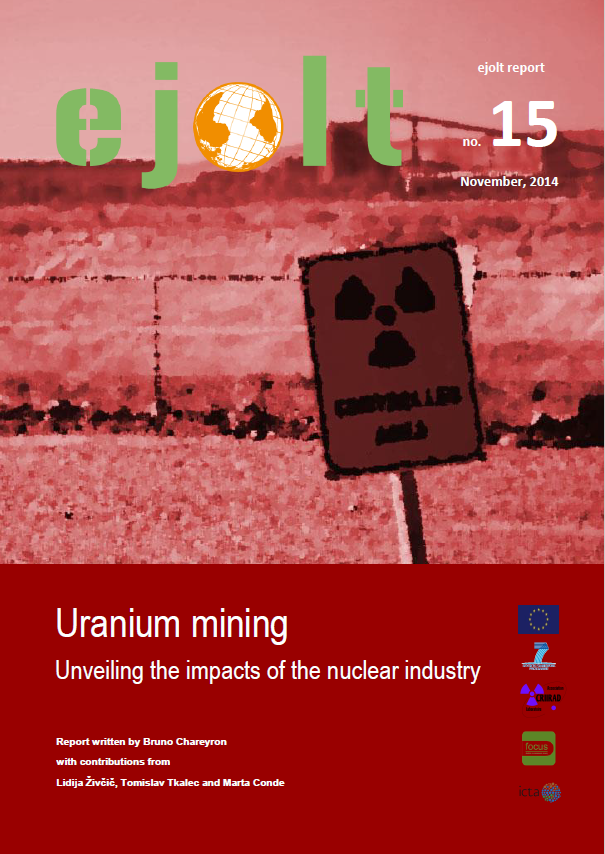
Uranium Mining: Unveiling the impacts of the nuclear industry

By Bruno Chareyron, et. al. - Ejolt, November 15, 2014

Uranium mining and milling comprise the first phase of the nuclear fuel cycle, and is one of the most polluting ones. The aim of this report is to give workers and communities basic information about radioprotection. The document deals with the radiological characteristics of materials and waste from the mines, principles of radiation protection, and methods of dose evaluation.
The report draws from on-site studies performed in Bulgaria, Brazil, Namibia and Malawi in the course of the EJOLT project and from previous studies performed by CRIIRAD in France and Africa over the last twenty years. It gives examples of the various impacts of uranium mining and milling activities on the environment (air, soil, water) and provides recommendations for limiting these impacts.

This report aims to contribute towards the development of the critical capacities of communities, so that they might have more information with which to face conflicts with states or companies in relation to uranium mining projects.

Read the report (PDF).

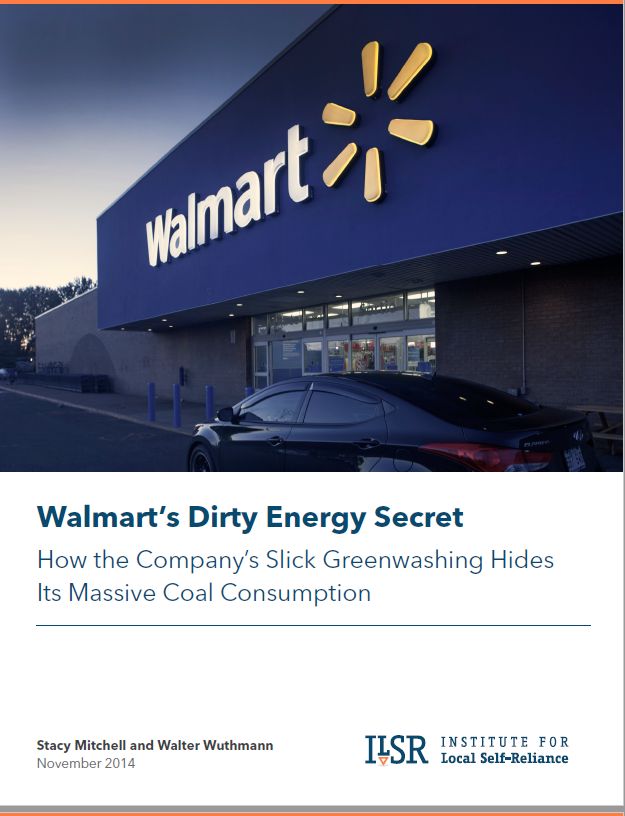
Walmart’s Dirty Energy Secret: How the Company’s Slick Greenwashing Hides its Massive Coal Consumption

By Stacy Mitchell and Walter Wuthmann - Institute for Local Self reliance, November 2014

In October 2014, at an event broadcast live from Walmart’s Arkansas headquarters, the company’s top executives took the stage to extol its environmental leadership. The announcements they made that day would be covered widely by the press, including the Boston Globe, Guardian, and New York Times.
The event opened with a video listing Walmart’s achievements over the preceding months: “We signed our largest multi-state solar power purchase agreement,” the narrator says, over a shot of workers installing new, glossy solar panels. “We were recognized by President Obama for announcing that we will double the number of on-site solar energy projects.” Then Walmart’s CEO, Doug McMillon, and its vice president of sustainability, Manuel Gomez, addressed the crowd. “You get one point for launching a goal,” said Gomez, “and nine points for execution... and what you saw in the video is exactly what we’re doing: executing against these goals.”

But off the stage and out in the real world, Walmart’s sustainability initiatives are heavy on admiration-inducing goals and astonishingly light on execution. Nearly a decade ago, the company pledged to shift to 100 percent renewable energy and acknowledged its responsibility to reduce its climate emissions as quickly as possible. Today, however, Walmart remains as deeply committed as ever to the dirtiest fuels, especially coal. It derives only 3 percent of its U.S. electricity from its renewable energy projects, down from 4 percent two years ago.

In this first-of-its-kind analysis, ILSR provides new information about Walmart’s energy mix and environmental footprint. We calculate the total electricity use, coal-fired power consumption, and resulting carbon emissions of every Walmart store and distribution center in the country in 2013. We also evaluate the company’s renewable energy projects, finding that they are too small and located in the wrong places to have much of an impact on Walmart’s coal use and climate emissions.

Our analysis finds that Walmart’s electricity consumption entails burning a staggering amount of coal: 4.2 million tons a year. That’s enough to give every kid in America a stocking filled with 126 pounds of the sooty stuff as a holiday present. Or, to measure it another way: If you dumped coal on a football field, you’d have to pile it 35 feet high, from end-zone to end-zone, just to power Walmart’s U.S. stores for one week. Walmart sources more of its electricity from coal (40 percent) than the U.S. as a whole (39 percent) — a remarkable fact for a company that has touted its environmental responsibility for years. Indeed, we find that Walmart alone consumes 0.5 percent of all the electricity produced from coal in U.S., a stunning figure given the size of the entire national economy and population.

Read the report (PDF).

Breaking the Rules for Profit: An Analysis of the Frac Sand Industry’s Violations of State Regulations & Manipulation of Local Governments in Wisconsin

By Stephanie Porter - Land Stewradship Project, November 2014

The frac sand industry has rapidly proliferated across Wisconsin, with the number of facilities multiplying by more than tenfold within four years,from 10 in 2010 to 135in 2014. The Land Stewardship Project reviewed readily available public data from the Wisconsin Department of Natural Resources (DNR)and media reports to determine what conclusions can be drawn about this industry and its rapid growth. We found that:

  • Of the forty-seven frac sand companies currently operating in Wisconsin, twenty-four or 51% have seriously violated DNR regulations, manipulated local governments, or engaged in influence peddling and conflicts of interest.
  • Twenty of forty-seven companies (43%) not only violated DNR regulations, but they required substantial regulatory action to come into compliance —or, even worse, never came into compliance even after court action and fines. (One county-level regulator was quoted as saying “citations are pretty much ineffective for this industry.”
  • In total, between 2011 and 2014 there were at least nineteen cases of frac sand companies abusing the annexation process to avoid regulations, engaging in influence peddling, and creating conflicts of interest in local governments.

The industry in both Wisconsin and Minnesota has claimed that violations of state regulations and abuses of the public trust are isolated incidents by “bad apples” or new, inexperienced companies. However, the data paints a picture of an industry in which violations are the norm, not the exception, and insider dealing, conflicts of interest, and influence peddling are common.

As recently as October 6, for instance, a mine in Trempealeau County was shut down for operating without proper permits, prompting a frustrated local regulator to say “they are just running wild, with no permit at all.” This recent case was not the first time a violation this basic has occurred. In 2011, Unimin Corporation –which has been mining for over 40 years –began constructing a site without a permit and continued with construction even after being notified by the DNR of their violation. As seen in these examples and the many others detailed below, this is an industry that consistently ignores state regulations enacted for the sake of the health of local citizens, rural communities, and the land.

Read the report (PDF).

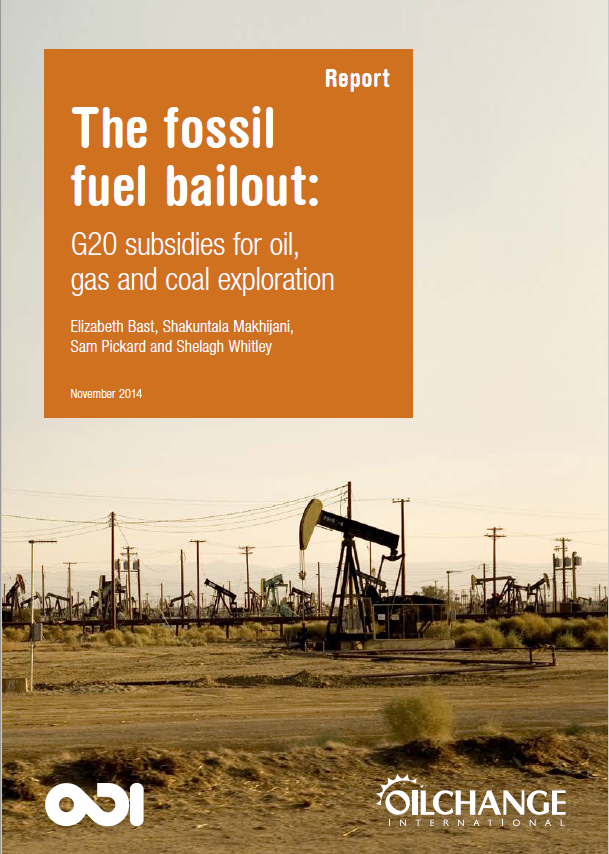
The Fossil Fuel Bailout: G20 Subsidies for Oil, Gas and Coal Exploration

By Elizabeth Bast, Shakuntala Makhijani, Sam Pickard, and Shelagh Whitley - Oil Change International, November 2014

Governments across the G20 countries are estimated to be spending $88 billion every year subsidising exploration for fossil fuels. Their exploration subsidies marry bad economics with potentially disastrous consequences for climate change. In effect, governments are propping up the development of oil, gas and coal reserves that cannot be exploited if the world is to avoid dangerous climate change.

This report documents, for the first time, the scale and structure of fossil fuel exploration subsidies in the G20 countries. The evidence points to a publicly financed bailout for carbon-intensive companies, and support for uneconomic investments that could drive the planet far beyond the internationally agreed target of limiting global temperature increases to no more than 2ºC.

It finds that, by providing subsidies for fossil fuel exploration, the G20 countries are creating a ‘triple-lose’ scenario. They are directing large volumes of finance into high-carbon assets that cannot be exploited without catastrophic climate effects. They are diverting investment from economic low-carbon alternatives such as solar, wind and hydro-power. And they are undermining the prospects for an ambitious climate deal in 2015.

Read the report (PDF).

Material Risks: How Public Accountability is Slowing Tar Sands Development

By Tom Sanzillo, Lorne Stockman, Deborah Rogers, Hannah McKinnon, Elizabeth Bast, and Steve Kretzmann - Oil Change International, October 29, 2014

The report, “Material Risks: How Public Accountability Is Slowing Tar Sands Development,” presents market analysis and industry data to support its estimates on lost sales revenue to the tar sands industry as public opposition creates delays and project cancellations. The report also describes other market forces that are putting tar sand developers at a growing disadvantage.

The report puts tar sands development lost revenue at $30.9 billion from 2010 through 2013, in part due to the changing North American oil market but largely because of a fierce grassroots movement against tar sands development. The report attributes 55% of the lost revenue, or $17 billion, to the diverse citizen protests against pipelines and the tar sands.

A significant segment of opposition, the report notes, is from First Nations in Canada who are raising sovereignty claims and other environmental challenges.

Among the reports findings:

  • Market forces and public opposition have played a significant role in the cancellation of three major tar sands projects in 2014 alone: Shell’s Pierre River, Total’s Joslyn North, and Statoil’s Corner Project. Combined, these projects would have produced 4.7 billion barrels of bitumen that would in turn have released 2.8 billion metric tonnes of carbon dioxide (CO2) into the atmosphere. This is equivalent to the emissions of building 18 new coal plants that would last 40 years each.
  • Tar sands producers lost $30.9 billion from 2010 through 2013 due to transportation bottlenecks and the flood of crude coming from shale-oil fields. Of that, $17.1 billion, or 55 percent, can be attributed to the impact of public- accountability campaigns.
  • The combination of risks facing the industry has the potential for canceling most or even all of the planned expansion of the industry in Canada.
  • Rather than seeing more than a doubling of output from 2 million barrels of oil per day to 4.8 million barrels per days — as the industry predicts — the report projects flat production levels.
  • Tar sands producers have lagged, with 9 of 10 leading tar sands producers in Canada underperforming the broader stock market in the last five years.

Analysts have recently downgraded their outlook for tar sands production.

The report also explores how smaller tar sands producers are having trouble accessing capital markets, how the industry is increasing capital spending even as it faces declining cash flows, weak revenue expectations, rising production costs and tight margins.

Read the report (PDF).

Feeding the 1%: An IT billionaire’s foray into agribusiness paints a disturbing picture of today’s farmland financiers

By staff - GRAIN, October 7, 2014

Since the global food crisis of 2008, there has been a massive wave of private sector investment in agriculture. More money flowing into agriculture means more innovation, more jobs and more food for a hungry planet, say the G8, the World Bank and corporate investors themselves.

But does it?

Looking at the investments made by Indian billionaire Chinnakannan Sivasankaran – one of the most active private sector players in the global rush to acquire farmland – a worrying picture emerges of what happens when speculative finance starts flowing into food production.

Since 2008, the Siva Group and its myriad subsidiaries have acquired stakes in around a million hectares of land in the Americas, Africa and Asia, primarily for oil palm plantations. On paper, this makes Sivasankaran one of the world’s largest farmland holders.

But Sivasankaran's also a land grabber and tax avoider. Like the majority of transnational investors in agriculture, his investments are channeled through a web of shell companies based in offshore tax havens. The companies he holds shares in are engaged in dubious land deals and kick back schemes, and seem more concerned with funnelling generous payments into the pockets of their directors than with producing food.

The alarming side effect of this type of investment is the commodification of land and the marginalisation of communities that rely on it. Wherever the Siva Group and its like go, they secure title to vast parcels of land by any means necessary – often without the meaningful consent of the affected communities. They then leverage these landholdings for cash and credit to turn still more deals.

Governments have so far done little, if anything to protect their people from this new wave of predatory investment. Their efforts have focussed more on providing investors with safeguards and incentives, while proposing only voluntary guidelines to keep corporate responsibility in check. The door is thus wide open for financial players like Sivasankaran to grab lands and make quick profits, undermining food systems and the livelihoods of farmers in the process.

Read the report (PDF).

Pages

The Fine Print I:

Disclaimer: The views expressed on this site are not the official position of the IWW (or even the IWW’s EUC) unless otherwise indicated and do not necessarily represent the views of anyone but the author’s, nor should it be assumed that any of these authors automatically support the IWW or endorse any of its positions.

Further: the inclusion of a link on our site (other than the link to the main IWW site) does not imply endorsement by or an alliance with the IWW. These sites have been chosen by our members due to their perceived relevance to the IWW EUC and are included here for informational purposes only. If you have any suggestions or comments on any of the links included (or not included) above, please contact us.

The Fine Print II:

Fair Use Notice: The material on this site is provided for educational and informational purposes. It may contain copyrighted material the use of which has not always been specifically authorized by the copyright owner. It is being made available in an effort to advance the understanding of scientific, environmental, economic, social justice and human rights issues etc.

It is believed that this constitutes a 'fair use' of any such copyrighted material as provided for in section 107 of the US Copyright Law. In accordance with Title 17 U.S.C. Section 107, the material on this site is distributed without profit to those who have an interest in using the included information for research and educational purposes. If you wish to use copyrighted material from this site for purposes of your own that go beyond 'fair use', you must obtain permission from the copyright owner. The information on this site does not constitute legal or technical advice.